
 Written by
Civil procedure – defendant response – practical guidance
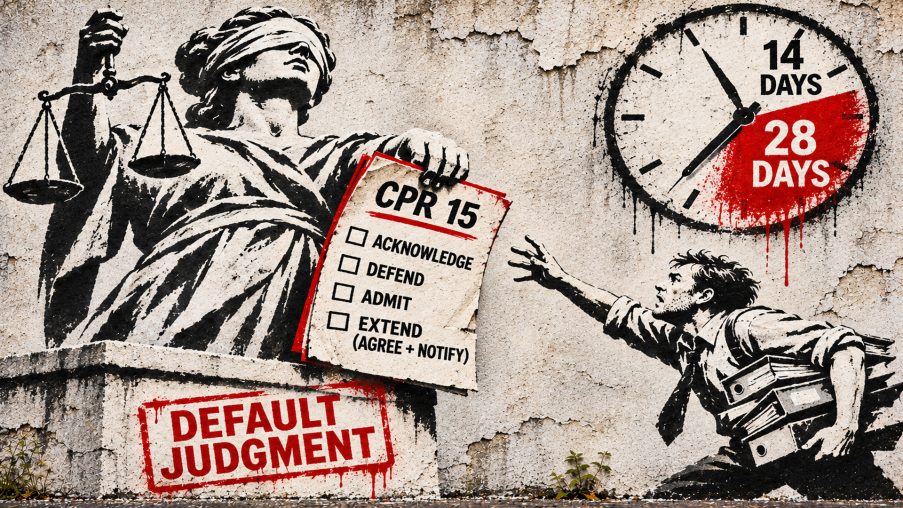
A civil claim response pack does not present one universal deadline. The useful first step is to identify the particulars of claim, establish the relevant service date and map the response steps. Only then can the 14-day period and the 28-day period be turned into a reliable timetable.
Snapshot
The response pack is the beginning of a scheduling exercise, not a reason to guess. Separate the documents, record the service evidence, decide which response route fits and write down the resulting date. An acknowledgment can change the defence period; an admission takes the response in a different direction. A private agreement for more time also has a court-notification step.
Start with the document and the service date
Open the pack with two questions: where are the particulars of claim, and what is the relevant date of service? The particulars may accompany the claim form or arrive separately. Keep the claim form, particulars, response forms, envelope and any email or online notification together. A short contemporaneous note of what arrived, and when, is more useful than reconstructing the sequence after correspondence has accumulated.
For a defendant who wishes to defend, the general starting point under CPR 15.4 is service of the particulars of claim: the period for filing a defence is 14 days after that service. The date written on a letter, the date of issue and the date on which you first read the documents are not interchangeable labels for that starting point. Check the applicable service provisions and any court order before fixing the calendar entry.
The acknowledgment calculation identifies the document more precisely. Under CPR 10.3, where the claim form says particulars are to follow, the general acknowledgment period is 14 days after service of the particulars; in any other case it is 14 days after service of the claim form. That is why a single “two weeks from the envelope” note can conceal the very distinction that matters.
How acknowledgment changes 14 days to 28
The acknowledgment of service is the procedural step for a defendant who needs the longer defence period or intends to challenge jurisdiction. If the defendant files an acknowledgment under Part 10, CPR 15.4(1)(b) makes the general period for filing the defence 28 days after service of the particulars of claim. It is a substitute period measured from the same service event, not 14 days followed by another 28.
CPR 10.1(3) says a defendant must file an acknowledgment if unable to file a defence within the rule 15.4 period or if wishing to dispute the court’s jurisdiction; Part 11 supplies the jurisdiction-challenge procedure. The acknowledgment therefore changes the defence period, but it does not replace the defence. Diarise the defence date at the same time as filing it.
General rules, not a universal answer. Both CPR 10.3 and CPR 15.4 expressly subject their general periods to other rules, including provisions concerning service outside the jurisdiction and court-ordered response periods. Part 15 does not apply where the claimant uses the Part 8 procedure. Read the whole pack and any order before adopting the ordinary timetable.
A further 28 days can be agreed, with one essential follow-up
Sometimes the parties need more time to obtain documents, take advice or clarify the response. CPR 15.5 permits the defendant and claimant to agree to extend the rule 15.4 defence period by up to 28 days; where they do so, the defendant must notify the court in writing. The agreement and the notification are separate practical tasks: keep both with the timetable.
Do not treat an informal suggestion that the claimant “will not object” as a completed scheduling exercise. Record the agreed period and the new calendar date in clear correspondence, then deal with the written court notification. The rule extends the existing defence period; it does not create a fresh 28-day period beginning whenever the parties happen to correspond.
Defending is not admitting
For Part 7, the pack offers defence, admission and acknowledgment forms. A defendant who wishes to defend all or part of a claim must file a defence under CPR 15.2, and CPR 15.6 requires a copy to be served on every other party. Filing with the court and serving the other parties should therefore both appear on the completion checklist, with evidence of each retained.
Part 14 separately allows a party, after proceedings have begun, to admit the whole or part of another party’s claim or case by written notice. For the money admissions described in rule 14.2(4), the claimant may request judgment and rule 14.2(5) provides that the court shall enter judgment. An admission is consequently not a softer way to dispute the amount or buy thinking time.
Partial admissions require particular care: identify exactly what is admitted and what remains disputed rather than using broad language that blurs the two. Under CPR 14.2(11), the court’s permission is required to amend or withdraw an admission. Read the admission route on its own terms before signing or submitting a form.
Why the defence date carries a default-judgment risk
A defence deadline is not an administrative courtesy. CPR 15.3 provides that, if a defendant fails to file a defence, the claimant may obtain default judgment if Part 12 allows it. A disagreement about the merits, or an intention to respond eventually, does not make the response timetable disappear.
Part 12 defines default judgment as judgment without trial where the defendant has failed to file an acknowledgment, a defence or a document intended to be a defence. Its conditions include expiry of the relevant response time and the absence of the required filing when judgment is entered. This is why the analysis should stay precise: Part 12 sets conditions and exclusions, so neither “nothing happens” nor “judgment is automatic in every case” is a safe working assumption.
Turn the rules into a dated response checklist
CPR 2.8 computes a period expressed in days as clear days, excluding the day on which the period begins. The following illustration assumes ordinary service of the particulars on Monday 5 October 2026, with no different order or special response period. It shows the arithmetic; it is not a substitute for checking the actual claim.
- 5 OctoberSecure the service record.
File the pack and supporting service evidence together. Identify whether the particulars came with the claim form or followed it.
- 19 OctoberComplete the 14-day step.
File the defence if relying on the ordinary period, or file an acknowledgment where that route applies. Check that the date was calculated from the correct document.
- 2 NovemberMeet the acknowledged defence date.
If an acknowledgment was filed, complete and file the defence by the 28-day date in this illustration, and serve the required copy.
- Before 2 NovemberDocument any extension.
If more time is needed, seek a clear agreement, record its length and give the court the required written notification. Enter the agreed date rather than leaving “28 more days” as an open note.
- 30 NovemberApply the full agreed extension, if applicable.
Adding 28 days to 2 November produces this date in the illustration. Finish with a filing and service check, retaining the confirmation and the final response documents.
Source anchors
These official rules supply the procedural framework. They do not determine the facts, service history or individual orders in a particular claim.
Rules 15.2–15.6 govern the defence, its ordinary periods, agreed extension and service.
Rules 10.1–10.3 identify when acknowledgment is required and its general 14-day period.
Rule 14.2 addresses admissions after commencement, judgment and withdrawal permission.
Rules 12.1–12.3 define default judgment and set conditions and exclusions.
Rule 2.8 explains clear days and time periods under the rules and court orders.
The closing point
A dependable response timetable has four entries: the document served, the service date, the chosen route and the resulting filing date. Add any agreed extension and court notification to that record. The claim may raise difficult merits, but the first protection against default is a deadline built from the right starting point.
Claim response decision point
Get a free written assessment of the response route
Legal Lens can structure a preliminary written review of the response pack: the documents supplied, the timetable to check and the response options that need attention.
Separate the claim form, particulars and service evidence before fixing the timetable.
Identify the proposed defence, acknowledgment, admission or extension steps and their supporting documents.
Assessment outputs
Documents, route choices and the next procedural steps.
Service evidence, response dates and extension correspondence.
Independent Legal Lens consultancy. Legal Lens is not a regulated solicitors’ firm. A preliminary assessment is not a substitute for regulated legal advice where that is needed.