
 Written by
Debt claims – statutory interest – practical guidance
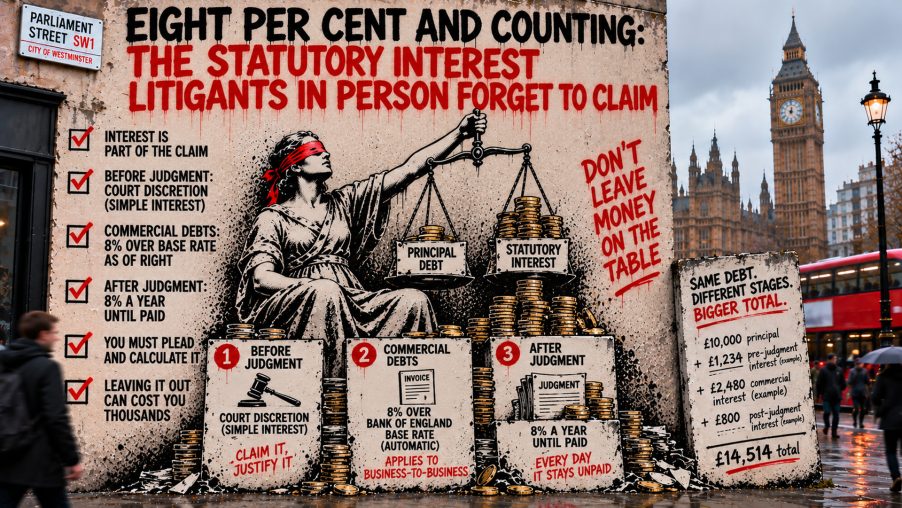
A claim for an unpaid debt is rarely worth only the figure on the invoice. Statute adds interest before judgment, on commercial invoices as of right, and on most judgments for every day they stay unpaid. Litigants in person routinely leave all three out of the arithmetic, and the other side is under no obligation to put them back in.
Snapshot
Interest is not a bonus the court adds if it feels generous. It is a head of claim with its own statutory machinery, and each regime has different triggers, rates and traps. Before judgment, the High Court and the County Court hold a discretion to award simple interest. On business-to-business debts, interest at eight per cent over the Bank of England base rate runs automatically. Once judgment is entered, most judgment debts carry eight per cent a year until they are paid. Each regime can be pleaded and calculated without a solicitor – but only if someone remembers to do it.
Interest is part of the claim, not an afterthought
A claimant who is owed £10,000 and has been kept out of it for two years has not lost £10,000. They have lost the use of £10,000 for two years, and the law recognises those as different things. Interest is the price the law puts on being kept out of money, and it attaches to a claim at three distinct moments: while the debt runs before judgment, on qualifying commercial debts whether or not proceedings ever start, and after judgment until the money is paid.
Each regime is created by a different statute, and none of them applies itself. Pre-judgment interest has to be asked for and justified; the commercial rate has to be identified as the correct basis; post-judgment interest has to be counted when settlement is discussed and enforcement planned. The claimant who treats interest as an afterthought usually finds, at the point of payment, a cheque smaller than the number the law would have produced.
The distinction that matters is between money the court may award and money the claimant must claim. Interest is almost always the second kind.
Before judgment: a discretion worth asking for
In proceedings before the High Court for the recovery of a debt or damages, section 35A of the Senior Courts Act 1981 allows the court to include simple interest in any sum for which judgment is given, at whatever rate the court thinks fit or rules of court provide, on all or any part of the debt or damages, for all or any part of the period between the date the cause of action arose and the date of judgment – or, where money is paid before judgment, the date of payment. Two features deserve attention. It is a discretion: the claimant must ask for interest, propose a rate and a period, and justify both. And it is simple interest, not compound – the calculation never adds interest to interest.
Section 69 of the County Courts Act 1984 confers the same power on the County Court in materially identical terms, and it provides that interest is ignored when deciding whether a debt or damages crosses a statutory financial threshold.
Two safeguards sit inside both provisions. A defendant who pays the whole debt after proceedings start but before judgment remains liable for interest up to the payment date – paying the principal at the door of the court does not escape it. Interest cannot be awarded under these sections for any period during which interest on the debt already runs, so there is no double recovery where a contractual or commercial statutory rate covers the same ground. The court may also apply different rates to different periods.
Key distinction. Discretionary interest is claimed, not conferred. A particulars of claim that is silent on interest invites a judgment that is silent on interest.
Commercial debts: eight per cent over base as of right
The Late Payment of Commercial Debts (Interest) Act 1998 applies to contracts for the supply of goods or services where both the supplier and the purchaser are acting in the course of a business – a definition that includes professions, government departments and public authorities, but excludes consumer credit agreements and contracts operating by way of security. The freelancer chasing an unpaid invoice from a company is inside the regime; the same invoice owed by a private individual is not.
Where the Act applies, it implies a term into the contract that any qualifying debt carries simple interest, and that statutory interest is treated as if it were interest under an express contract term. No discretion is involved and no permission is needed; the right exists whether or not proceedings are ever issued.
Statutory interest starts to run on the day after the relevant day for the debt: where a payment day was agreed, that day; where none was agreed, the last day of a 30-day period running from performance of the supplier’s obligation or the purchaser’s notice of the amount due, whichever is later. Longer agreed terms are capped at 60 days for private purchasers unless the agreed day is not grossly unfair to the supplier, and at 30 days where the purchaser is a public authority.
The rate is set by secondary legislation at eight per cent a year over the Bank of England’s official dealing rate – the base rate – taking the base rate in force on the 30 June or 31 December immediately before the day interest starts to run, and holding it for the whole of the relevant six-month period. On top of the interest, section 5A of the Act entitles the supplier to a fixed sum per debt – £40 for a debt under £1,000, £70 for a debt of £1,000 or more but under £10,000, and £100 for a debt of £10,000 or more – together with any reasonable recovery costs the fixed sum does not cover. For a claimant with a string of unpaid invoices, those fixed sums are per debt, not per claim, and they add up.
After judgment: eight per cent until paid
Under section 17 of the Judgments Act 1838, every judgment debt carries interest at eight per cent a year from the time prescribed by rules of court until the judgment is satisfied, and the interest can be levied under a writ of execution – although rules of court may allow the court to disallow all or part of it. The prescribed start point, under CPR rule 40.8, is the date the judgment is given, unless another rule or practice direction provides differently or the court orders otherwise – and the court can order interest to run from an earlier date. For a High Court judgment there is no minimum amount: the eight per cent runs on the whole judgment debt until it is paid.
County Court judgments carry interest only where the County Courts (Interest on Judgment Debts) Order 1991 applies: the judgment must be for at least £5,000, and the Order excludes, among other things, judgments on agreements regulated by the Consumer Credit Act 1974. Where payment is deferred or ordered by instalments, interest runs only from the date payment was required, or on each instalment as it falls due. Once County Court enforcement proceedings are taken, the debt stops carrying interest unless those proceedings produce no payment at all – charging order proceedings are the stated exception – and interest does not accrue while an attachment of earnings order or administration order is in force. The rate, where the Order applies, is the same eight per cent as the High Court rate.
The consequences run in both directions. A County Court judgment of £4,900 does not grow however long enforcement takes; one of £5,100 grows by more than a pound a day. And because the enforcement route can stop the clock, the route is worth weighing before process is issued.
Discretionary simple interest under section 35A of the 1981 Act or section 69 of the 1984 Act, at a rate the claimant must propose and justify.
Eight per cent over base as of right under the 1998 Act, plus fixed compensation per debt, on business-to-business supply contracts.
Eight per cent a year under the Judgments Act 1838 until payment – automatic on High Court judgments, and on County Court judgments of £5,000 or more.
Pleading it: what CPR rule 16.4 demands
Interest that is not pleaded is interest that is difficult to recover. CPR rule 16.4 requires the particulars of claim to state that the claimant is seeking interest and to give the basis – under a contract, under an enactment (saying which), or on some other stated basis. Where the claim is for a specified sum, the particulars must also state the percentage rate claimed, the date from which it is claimed, the date to which it is calculated (which must not be later than the date the claim form is issued), the total amount of interest to that date, and the daily rate at which interest accrues afterwards. Where the only claim is for a specified sum, the claim form itself must contain a statement of the interest accrued.
Read as a checklist, the rule is really asking five questions. On what basis – contract, statute or something else? At what rate? From when? To when, and how much does that produce? And how much is added each day the defendant continues not to pay? A particulars of claim that answers all five lets the court award interest as arithmetic rather than argument, and gives the defendant a running figure that concentrates the mind; one that answers none of them leaves the claimant asking the court to fill in gaps at the hearing.
The arithmetic: a running figure in three lines
Every regime discussed here uses simple interest, so the calculation is deliberately short. Take the principal, multiply it by the annual rate, divide by 365: the result is the daily rate, and the running total is the daily rate multiplied by the number of days.
Two illustrations, stated as arithmetic and nothing more. A £10,000 judgment at eight per cent produces £800 a year, which is £2.19 a day: every unpaid month adds roughly £66 to what the debtor owes. For a commercial debt under the 1998 Act, take the base rate in force on the relevant 30 June or 31 December and add eight; the rest of the calculation is identical. Keep the running total with the claim file’s chronology and update it before every letter and every hearing, and the interest is never out of date.
A working checklist
Five steps cover most cases.
Contractual rate, the 1998 Act for business debts, or the discretionary powers – they cannot run over the same period twice.
Basis, rate, start date, calculation date, total to that date and daily rate, exactly as rule 16.4 requires.
Under the 1998 Act the fixed compensation attaches per invoice, not per claim.
A County Court judgment under £5,000, or one on a regulated consumer credit agreement, carries no post-judgment interest at all.
County Court enforcement stops the eight per cent unless the proceedings produce no payment at all; know that before issuing process.
The closing point
Interest rewards the claimant who treats the arithmetic as part of the claim from the first letter before action to the last day of enforcement. The statutes have done the hard work – fixing the rights, the rates and the start dates. What remains is the discipline of asking, counting and keeping count. A claim that includes its interest is simply worth more than the same claim without it.
Source anchors
The primary materials behind this article. Source anchors support the legal framework described; they do not replace advice on the facts of any individual claim.
The High Court’s discretion to award simple interest on debts and damages up to judgment or payment.
The equivalent County Court power, with interest disregarded for financial threshold purposes.
The implied term giving business suppliers statutory interest and fixed compensation on qualifying debts.
Eight per cent a year on judgment debts until satisfied.
Which County Court judgments carry interest, and how enforcement choices affect the clock.
The interest-pleading requirements and the date from which judgment interest runs.
Claim value and interest decision point
Get a free written assessment of what the claim is really worth
Legal Lens can structure a preliminary written review of a money claim or judgment: which interest regimes apply, what the running figure is, and how the interest should be pleaded or counted.
Which interest regimes apply to the debt, and the date each one starts.
The basis, rate, dates and daily figure the particulars need to state.
Assessment outputs
Regimes, routes, documents and live dates.
The running figure, the rate basis and the start dates.
Independent Legal Lens consultancy. Legal Lens is not a regulated solicitors’ firm. A preliminary assessment is not a substitute for regulated legal advice where that is needed.