
 Written by
 Litigants in person – court support – legal representation
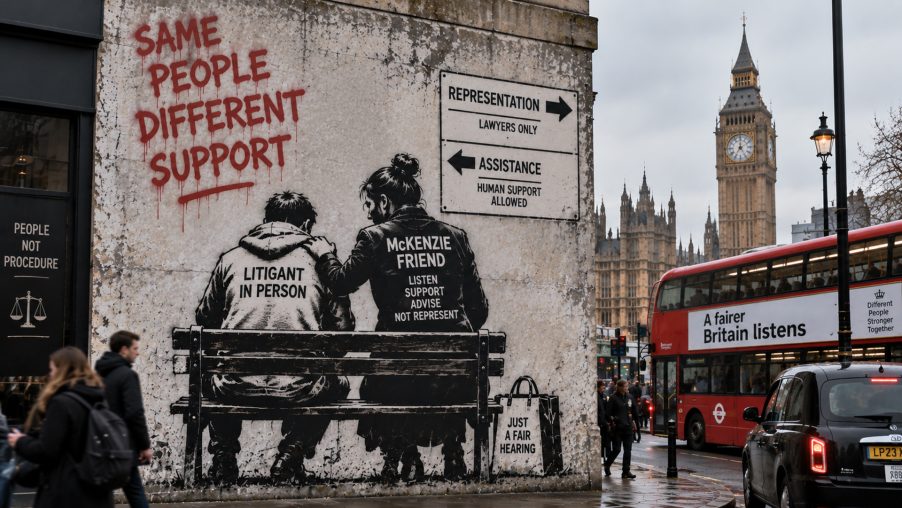
Having someone beside you in a civil hearing can change how the day goes. But the support role has firm edges: there is a right to reasonable assistance, not a right to be represented without a lawyer, and the line between the two is fixed by legislation and policed by judges. This guide maps that line.
Snapshot
A McKenzie friend can sit with you, take notes, organise your papers and quietly advise you. They cannot speak to the judge or run your case unless the court grants them that right separately, for that case alone. Paid help is lawful within the same boundaries. The arrangements fail when a helper crosses from supporting the litigant into conducting the litigation.
Choosing a helper
Almost anyone can act as a McKenzie friend: a relative, a trusted friend, a volunteer from a support charity, or a professional helper you pay. The important structural point is where the right sits. The right to reasonable assistance belongs to you as the litigant. The helper has no independent right to be involved, and assisting you does not make them your representative. You remain the litigant in person throughout, which means every document, every submission and every decision in the case stays yours.
Choose for temperament before expertise. The useful helper is calm, organised, discreet and willing to stay quiet while you speak. A helper who wants to fight their own corner, pursue their own grievance, or relitigate their own experience through your case is a liability, whatever they know about the law.
Practical formalities are light but real. You should tell the judge as early as possible who your helper will be, and the proposed helper should be ready to produce a short statement of relevant experience confirming that they have no interest in the case and that they understand the role and the duty of confidentiality. The guidance also points litigants towards free sources of support, naming the Personal Support Unit and Citizens Advice, so a paid arrangement is never the only option.
The default right to assistance
The framework courts work from is the Practice Guidance on McKenzie friends in the civil and family courts. It was issued on 12 July 2010 by the Master of the Rolls and the President of the Family Division, and it applies across the Court of Appeal (Civil Division), the High Court, the County Court and the family courts. Sixteen years on it remains the operative document: the current family procedure rules still direct courts and litigants to it as the relevant guidance.
The starting position is a presumption in your favour. The court retains the power to refuse assistance where the interests of justice and fairness do not require it, but the burden does not sit on you to justify having a helper. If the other side objects, or the court has concerns, it is for the objector or the court to provide sufficient reasons. The guidance is explicit about arguments that carry no weight: refusal cannot rest on the case being simple, on you appearing capable of managing alone, on you being unrepresented by choice, or on the other party having no lawyer either.
That distinction matters. A litigant who knows the default position can answer an objection calmly and on principle, rather than improvising a justification they were never required to give.
What a helper can and cannot do
The permitted role is deliberately practical. A McKenzie friend may provide moral support, take notes, help with the case papers and quietly give advice on any aspect of the conduct of the case. You are also entitled to share the filed evidence and other case information with them so they can advise you. In a long hearing, a second pair of eyes on the papers and a legible note of what was said are worth a great deal.
The prohibited list is equally clear. A McKenzie friend may not act as your agent in the proceedings, may not manage the case outside court, for example by signing court documents, and may not address the court, make oral submissions or examine witnesses. The boundary runs between advising you and acting for you. Everything the helper does should pass through you: they suggest, you decide, you speak.
Key distinction. Advising the litigant is assistance. Speaking to the judge, or running the litigation, is representation. The first is the default right; the second needs a separate grant from the court.
When a helper wants to speak
This is where lay support meets statute. The exercise of a right of audience and the conduct of litigation are reserved legal activities under the Legal Services Act 2007. Carrying on a reserved legal activity without being entitled to do so is a criminal offence, punishable by imprisonment or a fine, and purporting to exercise a right of audience or conduct litigation is also a contempt of court. Entitlement comes from being an authorised, regulated person or from falling within an exemption.
One exemption is made for exactly this situation. A lay person is exempt, for a particular case, where the court grants them a right of audience or a right to conduct litigation in those proceedings. Readers who find older textbooks citing sections 27 and 28 of the Courts and Legal Services Act 1990 should note that those provisions have been repealed; the current statutory route is the 2007 Act.
The courts apply that route cautiously. The Practice Guidance directs courts to be slow to grant such rights and to do so only for good reason, giving as examples of special circumstances a helper who is a close relative, health problems that prevent the litigant addressing the court, or a litigant whose inarticulacy would make prompting prolong the hearing. Grants to people who hold themselves out as professional advocates or professional McKenzie friends are confined to exceptional circumstances.
Procedurally, the two rights are kept apart. A right of audience and a right to conduct litigation are separate rights: each must be applied for and justified individually. An audience application is made at the start of the hearing; a litigation-conduct application must be made at the earliest possible time and always before the lay person does anything that amounts to conducting litigation. The court can later withdraw either grant, and a grant in one case is no precedent for the next.
Expect the judge to test the application before granting it. The questions are predictable, and a prepared litigant answers them in advance:
What is it about this litigant, this case or this hearing that means the litigant cannot speak for themselves?
Relationship to the litigant, relevant experience, any interest in the outcome, and whether they are being paid.
The judge will want confidence that the helper understands confidentiality and the limits of the role being granted.
Paying for lay support
Payment does not change the boundaries. A litigant may lawfully agree to pay a McKenzie friend for reasonable assistance in or out of court, including clerical and mechanical work such as preparing bundles or delivering documents, and including legal advice given in connection with the proceedings. Those fees are a private matter between litigant and helper and cannot be recovered from the opposing party. What money cannot buy is the reserved work: fees for conducting litigation where the court has granted no such right cannot be recovered from the litigant or from the other side.
There is a limited costs route worth knowing about. Under the Civil Procedure Rules, a litigant in person awarded costs can recover payments reasonably made for legal services relating to the conduct of the proceedings, within an overall cap of two-thirds of the costs that would have been allowed to a represented party. The rules do not define ‘legal services’ for this purpose, so a litigant paying for help should not assume it will cover a full fee. Treat any recovery as a possible contribution, never as the basis of the bargain.
The practical warning runs the other way, too. A paid helper who drifts into signing documents, corresponding as your agent or addressing the court is not giving you more for your money. They are exposing themselves to criminal liability and you to the loss of your support at the moment you need it most.
The red flags that exclude helpers
The Practice Guidance lists the circumstances in which assistance may be denied or withdrawn because it undermines the efficient administration of justice. They include assistance provided for an improper purpose; assistance unreasonable in nature or degree; a helper subject to a civil proceedings order or a civil restraint order; a helper using the litigant as a puppet; a helper directly or indirectly conducting the litigation; and a helper the court is not satisfied understands the duty of confidentiality. The court will generally consider a firm and unequivocal warning before exclusion, but it retains the power to act during the hearing, and the High Court can impose a civil restraint order on a McKenzie friend who repeatedly undermines the process.
The reported cases show this is not theoretical. In Attorney-General v Purvis in 2003, the High Court dealt with a habitual vexatious litigant who had been acting as a McKenzie friend for others: it continued an order preventing him from acting as a litigation friend or McKenzie friend, and directed that any future application by him to act as a McKenzie friend must have the court’s orders and judgment attached to it. The pattern to note is that the helper was not excluded for being unqualified. He was excluded because the assistance had become a vehicle for his own litigation conduct.
That is the thread running through every red flag: the courts protect the litigant’s right to support, and they police the helper’s drift into control. A litigant who keeps the roles straight, and chooses a helper who is content to stay behind the line, rarely has a problem.
Source anchors
The 2010 judicial guidance setting out the right to reasonable assistance, the permitted and prohibited roles, and the grant of rights of audience and litigation conduct.
Defines the reserved legal activities, restricts them to authorised or exempt persons, and makes unauthorised exercise a criminal offence.
The former statutory route to rights of audience for lay persons, shown as repealed; the current law is the Legal Services Act 2007.
Rule 46.5 governs what a litigant in person can recover in costs, including payments reasonably made for legal services.
Home of the reported judgment in Attorney-General v Purvis [2003] EWHC 3190 (Admin), where the court restricted a vexatious litigant from acting as a McKenzie friend.
Practice Direction 12B still points courts and litigants to the 2010 Practice Guidance as the current McKenzie friend framework.
Source anchors support the framework described in this article. They are starting points for your own reading, not a substitute for advice on your case.
The closing point
A good McKenzie friend makes you better at conducting your own case; they never replace you in it. The boundaries are not bureaucracy. They are the price of the access, and a litigant who respects them keeps the help.
Support-in-court decision point
Get a free written assessment of your support plan
Legal Lens can structure a preliminary written review of how you plan to use a helper at your hearing: the role they will play, the boundaries that apply, and the questions to be ready for.
What the helper will do at each stage, checked against what the court will permit.
The reserved activities your arrangement must keep clear of, and any application worth making early.
Assessment outputs
Permitted assistance, speaking requests and practical preparation.
Whether to ask for more than McKenzie assistance, and when to ask.
Independent Legal Lens consultancy. Legal Lens is not a regulated solicitors’ firm. A preliminary assessment is not a substitute for regulated legal advice where that is needed.