
 Written by
Judicial conduct – complaints – practical guidance
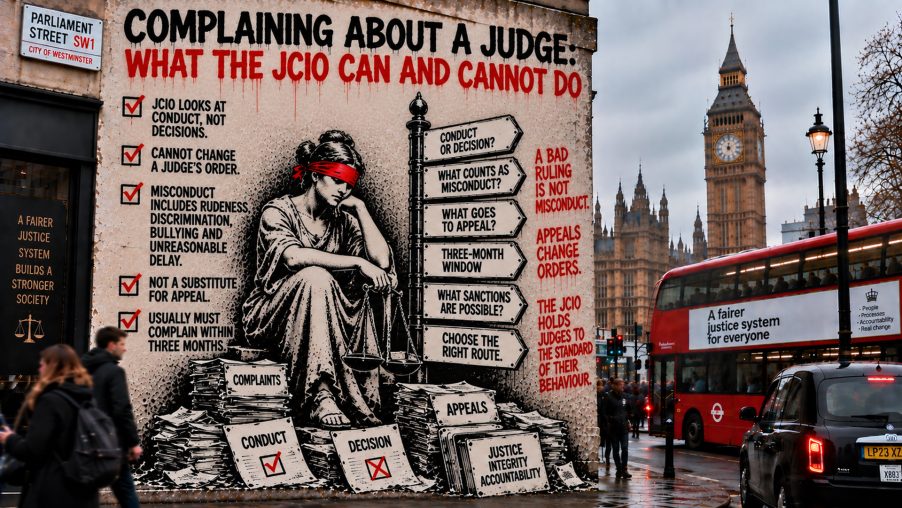
A difficult hearing can leave a litigant in person looking for somewhere to put a grievance, and the Judicial Conduct Investigations Office is often the first door tried. It is usually the wrong one. The JCIO exists to deal with how a judge behaved, not what a judge decided — and working out which side of that line a grievance falls on decides whether a complaint can deliver anything at all.
Snapshot
Judicial complaints and appeals do different work. A complaint to the JCIO can lead to a disciplinary sanction against a judge for personal misconduct — rudeness, discriminatory remarks, misuse of status, unreasonable delay — but it cannot change a single word of the order made against you. Only an appeal can do that. Most complaints are turned away at the door, many because they are really appeals in disguise. This guide maps the boundary, the three-month complaint window, the sanctions that can actually follow, and the route worth your effort.
Conduct or decision: the boundary that decides everything
Judicial discipline in England and Wales is the joint responsibility of the Lord Chancellor and the Lady Chief Justice, supported by the Judicial Conduct Investigations Office, an independent part of the Judicial Office. The process exists for complaints about personal misconduct — how a judicial office holder has behaved. It cannot be used to challenge a judge’s decision or case management, which can only be challenged by appeal to a higher court.
That boundary is not administrative tidiness; it is the price of judicial independence. If every disappointing ruling could be re-run as a disciplinary complaint, judges would decide cases with one eye on the complaints office. So the system separates the two questions sharply. The Judicial Conduct Rules 2023 require the JCIO to dismiss a complaint that is about a judicial decision or judicial case management and raises no question of misconduct, and they also require dismissal where the alleged facts are obviously untrue, where they would not warrant a disciplinary sanction even if true, or where the complaint is vexatious or misconceived.
The line has one genuine refinement worth knowing. In May 2026 the JCIO published a statement accepting that complaints about judicial case management can fall within its remit where there is a question of improper personal conduct — the manner in which a judge behaved while managing a hearing — while complaints about the substance of judicial or case management decisions remain outside its remit and can only be challenged through the courts. Manner is conduct; substance is decision. The distinction is narrow, but it is the difference between a complaint that is read and one that is returned.
What counts as misconduct
The JCIO’s own categories of misconduct include bullying or harassment, discriminatory language, aggressive or rude behaviour, misuse of judicial status, misuse of social media, failure to report personal involvement in legal proceedings, and unreasonable delay in issuing a judgment. Published disciplinary outcomes add texture: the most recent reporting year saw sanctions for shouting at court staff or legal representatives, swearing in court and rudeness to a witness, remarks indicative of bias made during a hearing, and using a mobile device for personal reasons during a hearing.
Two disciplines follow. First, the standard of proof. Questions of fact under the Rules — including at the disciplinary panel stage — are decided on the balance of probabilities. A complaint built on a precise account of what was said, and when, stands in a different position from a general sense of grievance. Second, the complaint itself must be properly made. A complaint must state the complainant’s name and contact address, contain an allegation of misconduct against an identified or identifiable office holder supported by relevant details, state the date or dates of the alleged misconduct, and be accompanied by the documents the complainant intends to rely on; complaints are made through the JCIO’s online portal. Complainants are not expected to supply a transcript: where misconduct in court is alleged, the JCIO will typically obtain the hearing recording itself.
The statistics show how demanding the gateway is. In 2024-25 the JCIO received 3,279 complaints; 82% were not accepted following assessment because they fell outside the JCIO’s remit or lacked the detail needed to take further. The characteristic failure is the subject of the next section: complaining about a decision as if it were conduct.
What has to go to appeal instead
If the grievance is that the judge got the law wrong, weighed the evidence wrongly, refused an adjournment that should have been granted, or made an order that should not have been made, the remedy lies in the litigation itself — an appeal, or where the rules allow, an application to the same court — not in a complaint. Government guidance is blunt about it: the complaints process cannot be used to challenge a decision or sentence, and a party in that position should get advice about how to appeal.
The practical point is sharper than it looks. Even a wholly successful conduct complaint leaves the order untouched. A judge can be reprimanded — or even removed — and the decision that prompted the complaint still stands until a court sets it aside. A litigant who spends the short appeal window perfecting a complaint, believing the complaint will fix the ruling, can lose the only route that actually could. Where both are genuinely in play, the appeal clock and the complaint clock run independently, and neither waits for the other.
The three-month window
A complaint must be made within three months of the matter complained of. The JCIO must not accept a complaint made outside that limit unless it considers there are exceptional circumstances, and the Rules say the fact that a complaint alleges misconduct is not, by itself, a reason to accept it late. A complainant told their complaint is out of time has ten working days from the notification to make representations for an extension.
The window is applied. In 2024-25, 57 complaints were rejected because they were out of time and no exceptional reasons justified an extension. Two habits follow. Diarise from the date of the conduct, not from the date of any later decision or correspondence. And do not assume that pursuing an appeal, or waiting for a judgment, pauses the complaint window — where delay in handing down a judgment is itself the complaint, the timing question is one to put squarely to the JCIO rather than to guess at.
What a complaint can actually deliver
Start with what a complaint cannot deliver. It cannot overturn the order, award compensation for the case that was lost, or order a rehearing. Its outcomes are disciplinary, and they belong to the public interest in judicial standards rather than to the private interest in the result.
The available sanctions run, in ascending order of severity, from formal advice, through formal warning and reprimand, to removal from office. The Lord Chief Justice may issue formal advice, a formal warning or a reprimand only with the agreement of the Lord Chancellor, and removal is for the Lord Chancellor with the Lady Chief Justice’s agreement. Judges of the High Court and above sit outside that ladder: they can only be removed by the Monarch following an address by both Houses of Parliament.
Nor does the JCIO decide these outcomes itself. The office investigates and advises; it has no power to make findings of misconduct or to impose sanctions. Findings are made by nominated judges, investigating judges or judicially chaired disciplinary panels, and every sanction is agreed by the Lord Chancellor and the Lady Chief Justice (or a senior judicial delegate). In 2024-25, 89 office holders received a sanction — under 0.5% of the roughly 20,000 judges, magistrates, non-legal tribunal members and coroners in England and Wales — comprising 36 cases of formal advice, 29 formal warnings, 5 reprimands and 19 removals. Where a sanction is imposed, a statement is normally published on the JCIO website, with publication periods that rise with severity: two years for formal advice, four for a formal warning, six for a reprimand, and indefinite publication for most removals. The outcomes are real, but they are modest in number and disciplinary in kind.
One route sits outside the JCIO entirely. Complaints about magistrates go first to the regional conduct advisory committee for the area, not to the JCIO, and reach the Lord Chancellor and the Lady Chief Justice via the JCIO only if a finding of misconduct is proposed.
If the complaint itself is mishandled
A separate office polices the process rather than the judge. The Judicial Appointments and Conduct Ombudsman can review how a complaint about a judge, magistrate, tribunal member or coroner was handled by the JCIO, a tribunal president or an advisory committee. The ombudsman cannot reopen the court or tribunal case, review the judge’s decision, reprimand or remove the office holder, or force anyone to pay compensation; it can recommend an apology or compensation, recommend changes to the complaints process, and set aside a flawed decision so it is looked at again. Complaints to the ombudsman should be made within 28 days of the final decision, although the ombudsman can be approached sooner where the original body has taken more than six months without deciding. The annual figures show how narrow this route is: in 2024-25 the ombudsman investigated 23 of the 447 complaints about the JCIO that came within his remit, and upheld or partially upheld 11.
Choosing the route: complaint, appeal, or both
The whole analysis compresses into one working test: what do I want to change? If the answer is the order, only the litigation route can change it. If the answer is the judge’s behaviour, only the conduct route can address it. The table below maps the common grievances onto the route that can actually respond to them.
| What happened | Route | Why |
|---|---|---|
| The judge was rude, shouted, or swore in court | JCIO complaint | Personal conduct in the hearing; the JCIO can obtain the recording. |
| Remarks in the hearing suggested bias or hostility towards you or your group | JCIO complaint — and advice on appeal if the remarks affected the decision | Behavioural bias is conduct; its effect on the outcome is for the appeal court. |
| The decision or case management was wrong in substance | Appeal or application in the case | Only a court can set aside or vary the order; a complaint never can. |
| The judgment has been outstanding for an unreasonable time | JCIO complaint | Unreasonable delay in issuing a judgment is a recognised misconduct category. |
| The judge misused their status outside the hearing | JCIO complaint | Misuse of judicial status and of social media are recognised categories. |
| Both the behaviour and the decision were wrong | Both, run in parallel | The clocks run independently; protect the appeal deadline first. |
| The JCIO, tribunal president or advisory committee mishandled the complaint | Judicial Appointments and Conduct Ombudsman | Process review only; normally within 28 days of the final decision. |
The merits matter. But routes decide where the merits can be heard. A well-made complaint to the wrong body is effort spent buying nothing, and the complaint statistics — most submissions turned away at the door — are largely the story of that mistake repeated thousands of times a year.
Source anchors
These anchors support the framework described in this article. They evidence the process and its published outcomes; they do not decide any individual complaint, which always turns on its own facts.
The official entry point: the three-month limit, the different routes for courts, tribunals and magistrates, and the onward ombudsman route.
The JCIO’s own site: who it covers, what counts as misconduct, and how to make a complaint through its portal.
The statutory framework: joint responsibility of the Lord Chancellor and Lady Chief Justice, the disciplinary powers, and the ombudsman.
The office’s short statement of the boundary: misconduct yes, a judge’s decision or case management no.
The closing point
Feeling wronged by a hearing is common, and sometimes the feeling is justified. But the system offers two keys that open two different doors, and neither key turns in the other’s lock. Choose the door by what you need changed — the decision or the behaviour — and the effort you spend stands a chance of buying something real.
Complaint and appeal decision point
Get a free written assessment of the route
Legal Lens can structure a preliminary written review of what happened at the hearing: which parts of the grievance are conduct, which are decision, and which route — complaint, appeal, or both — can respond to each.
Conduct or decision: each grievance mapped to the route that can answer it.
The three-month complaint window and any appeal time limits, sequenced together.
Assessment outputs
Conduct points, decision points and the route for each.
Hearing notes, recordings, correspondence and missing documents.
Independent Legal Lens consultancy. Legal Lens is not a regulated solicitors’ firm. A preliminary assessment is not a substitute for regulated legal advice where that is needed.