
 Written by
Civil procedure · witness evidence · practical guidance
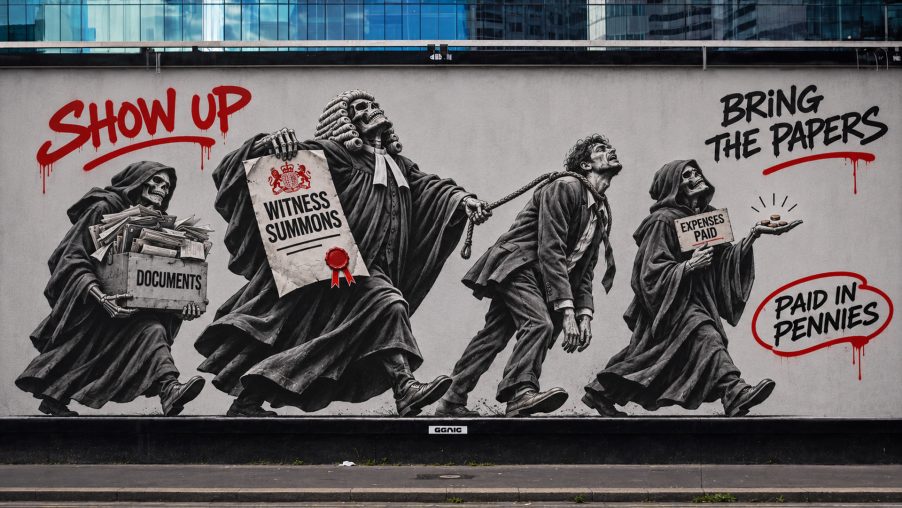
A reluctant witness can leave a litigant in person with a statement but no one to question, or with documents that never reach the courtroom. A witness summons is the court-issued mechanism for requiring attendance or production. It works best when it is focused, issued through the right court and served with time to deal with problems.
Snapshot
The practical question is not simply whether a witness is unwilling. It is what the court needs, which procedural route supplies it, and whether the summons can be issued and served properly. A summons is not a substitute for disclosure or for complying with directions about witness evidence.
What a witness summons can require
Under CPR 34.2, a witness summons is issued by the court and requires a witness either to attend court to give evidence or to produce documents to the court. Each witness needs a separate summons. That is different from asking somebody to cooperate voluntarily. The document comes from the court, so its wording, issue and service deserve corresponding care.
Practice Direction 34A paragraph 1.1 confirms that one summons may require attendance, document production, or both. The choice should follow the evidence needed. If the person saw an event, attendance may be the point. If they hold a record, production may be sufficient. If both are necessary, the request should explain each requirement distinctly rather than treating documents as an afterthought.
The relevant practice form is Form N20, published by HMCTS on GOV.UK for a summons to give evidence at a hearing and/or provide requested documents. Practice Direction 34A paragraphs 1.2–1.4 says that two copies should be filed for sealing, one being retained on the court file. A mistake in a name or address may be corrected before service, but the corrected summons must be re-sealed and marked “Amended and Re-Sealed”.
Why a summons is not ordinary disclosure
The difference lies in what is produced, to whom, and under which procedure. CPR Part 31 governs disclosure and inspection of documents; a Part 34 summons instead requires documents to be produced to the court. It should therefore not be treated as a replacement for the applicable disclosure directions or for a properly supported non-party disclosure application.
Rule 34.2(4) allows production on the date fixed for a hearing or on another date directed by the court. Where production is required before a hearing, rule 34.2(5) limits it to documents which the person could be required to produce at that hearing. A broad request for everything that might be useful is not made sound simply by putting it on a form.
Start with the disputed issue and identify the record that bears on it. Describe the document or a properly bounded class, its relevance and why the proposed recipient holds it. That discipline helps the court assess the request and helps the witness understand what must be found. It also reduces the risk of turning a narrow evidential need into an expensive search.
Issue: check the court and the permission gateway
A summons is issued on the date entered on it by the court. It must be issued by the court where the case is proceeding or the court where the relevant hearing will take place. Filing the form is consequently not the same as issue. The sealed document and its issue date matter to the timetable that follows.
Rule 34.3(2) requires the court’s permission in three situations: issue less than seven days before the trial; attendance or production on a date other than the trial date; and attendance or production at any hearing other than the trial. These are separate from any case-specific direction that may already govern evidence.
Do not merge the two clocks. Permission to issue late concerns the point at which the court issues the summons. The general service rule in CPR 34.5 concerns whether the summons is binding: service must be at least seven days before the required attendance, unless the court directs that shorter service will be binding. An application should address every gateway that applies, not assume that one order resolves both.
A proportionate explanation identifies the evidence, the reason the summons is needed, the proposed date and the steps already taken to obtain cooperation. Where time is short, explain why. Where another date or a non-trial hearing is proposed, connect the request to that event. The aim is to let the court decide on a concrete proposal rather than a general assertion that the witness is important.
Service, travel and loss of time
The court serves the summons unless the party requesting it indicates in writing, when asking for issue, that they wish to serve it themselves. If the court is to serve, that party must deposit at the court office the money to be paid or offered to the witness. Choosing to serve is therefore a decision to make at the outset, not an assumption to revisit after sealing.
A summons served in accordance with rule 34.5 and requiring attendance to give evidence remains binding until the conclusion of the hearing for which attendance is required. The party should keep the sealed summons, any order permitting issue or shorter service, and a clear record of when and how service and payment occurred.
At service, the witness must be offered or paid a sum reasonably sufficient for return travel and compensation for loss of time. Practice Direction 34A paragraph 3 links compensation to lost earnings or benefit, or the lesser proved loss, and bases the relevant sum on amounts payable to Crown Court witnesses. A party serving the summons must offer those sums; if the court serves, the party must deposit them. No single cash figure should be lifted from an old guide without checking the current basis.
Build the expense step into the plan rather than treating it as an administrative extra. A summons delivered without the required offer or payment creates a problem at the very point when the timetable may be least forgiving.
A summons does not displace evidence directions
Under CPR 32.1, the court may control the issues on which it requires evidence, the nature of that evidence and the way it is placed before the court. A summons cannot make evidence immune from those directions. Before seeking one, read the existing orders and identify exactly where the proposed evidence fits.
Where a party has served a witness statement and wishes to rely on that witness at trial, CPR 32.5 generally requires the party to call the witness to give oral evidence unless the court orders otherwise or the statement is put in as hearsay evidence. Attendance and the written evidence therefore need to be planned together.
If a party required to serve a witness statement cannot obtain one, CPR 32.9 allows an application without notice for permission to serve a witness summary instead. If the required statement or summary is not served within the time specified by the court, rule 32.10 says that the witness may not be called unless the court gives permission. A last-minute summons is not a cure for a missed evidence direction.
Asking the court to vary or set aside
Rule 34.3(4) gives the court power to set aside or vary a witness summons issued under that rule. That provides a route for the court to consider the summons; it is not a decision that the recipient can make unilaterally. The party seeking issue should also be ready to explain the request if its scope or timing is challenged.
A focused objection should identify the exact requirement concerned and the variation sought. Is the dispute about the date, the identity of the documents, the breadth of the request, or attendance itself? What narrower obligation, if any, would meet the evidential need? Prompt, precise communication allows the court to deal with a real issue rather than a general objection.
A proportionate timetable
Begin as soon as the evidential gap becomes apparent. The seven-day service rule is a minimum for a binding summons, not a sensible working target. Leave room for permission, sealing, correction, travel arrangements and an application about scope.
Identify the disputed issue, the witness and precisely why attendance or a document is needed.
Prepare a separate summons, check every permission gateway and arrange the required expense money.
Confirm who serves, make the offer or payment, and preserve a dated service record.
Deal promptly with corrections, objections and logistics; keep the other parties and court informed as appropriate.
Proportionality runs in both directions. Do not seek several summonses when one focused request will do, but do not leave a necessary witness until the final week because earlier correspondence remains unanswered. Convert uncertainty into a court-ready proposal while there is still time to adjust it.
Service checklist
- One correctly named summons for each witness.
- Attendance, documents, or both stated clearly, with the correct hearing or directed date.
- Every required permission obtained before issue.
- Two copies filed for sealing; any pre-service correction re-sealed.
- Court service selected, or written notice of party service given when issue was requested.
- Service at least seven days before attendance, unless the court has directed shorter binding service.
- Return travel and loss-of-time sums offered or paid, or deposited for court service.
- Sealed summons, permission orders, service record and expense record kept together.
Source anchors
These official sources set out the procedural framework. They do not determine the appropriate order in an individual case.
Rules 34.2–34.7 cover the summons, issue, service and witness expenses.
Paragraphs 1 and 3 address sealing, corrections, travel and loss of time.
The wider rules control evidence, statements, summaries and calling witnesses.
The HMCTS witness summons form for evidence and requested documents.
The separate framework for disclosure and inspection of documents.
The closing point
A witness summons is a procedural instrument, not a substitute for preparation. Define the evidence narrowly, separate issue from service, allow more than the bare minimum time, and budget for the witness’s expenses. That sequence gives the court a workable request and gives the witness a clear obligation.
Witness evidence decision point
Get a free written assessment of the evidence route
Legal Lens can structure a preliminary written review of the evidential gap, the proposed summons and the timetable around it.
What the witness or document is expected to prove, and which direction applies.
Permission, timing, service responsibility and expenses placed in one sequence.
Assessment outputs
Evidence, permission and procedural steps identified.
Issue, service and expenses arranged in date order.
Independent Legal Lens consultancy. Legal Lens is not a regulated solicitors’ firm. A preliminary assessment is not a substitute for regulated legal advice where that is needed.