
 Written by
Civil procedure – route selection – written evidence
Some civil claims turn on a question rather than a substantial contest about what happened. Part 8 offers an alternative procedure for those cases, but it changes more than the claim form: written evidence moves to the front, the ordinary defence falls away, and a defendant who considers the route unsuitable must explain why.
The route in one view
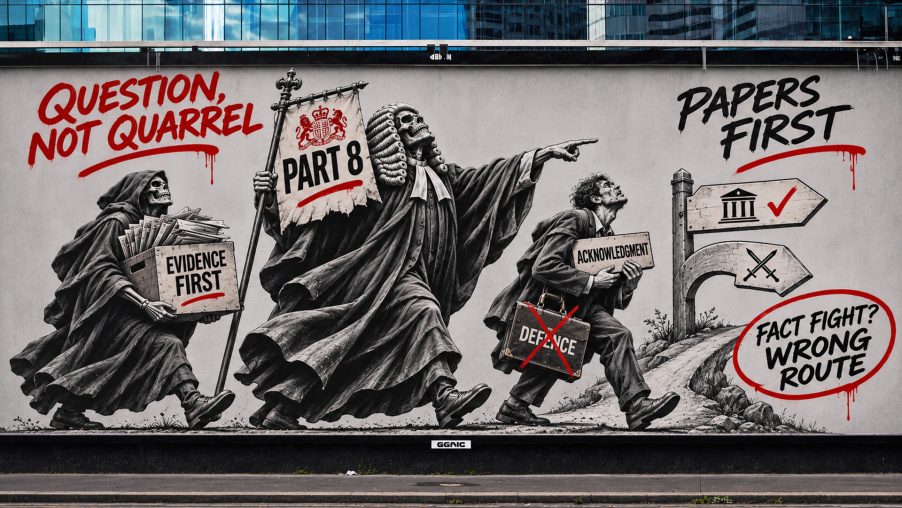
Part 8 is not simply a shorter version of an ordinary civil claim. The claimant identifies the question or remedy and puts in the supporting written evidence with the claim form. The defendant normally answers through an acknowledgment of service and written evidence, not a defence. The court retains control of the evidence and can move the claim into the ordinary process.
When the Part 8 route may fit
The starting point is the character of the decision the court is asked to make. A claimant may use Part 8, unless an enactment, rule or practice direction states otherwise, where the court’s decision on a question is unlikely to involve a substantial dispute of fact. A rule or practice direction may also disapply or modify Part 8 for a specified type of proceedings. The route therefore has both a general gateway and a subject-specific check.
That distinction matters. A dispute may be legally focused even though the parties disagree about the answer. The relevant question is not whether the defendant contests the claimant’s position, but whether resolving the claim is unlikely to require the court to decide a substantial factual contest. A claimant should be able to explain that distinction before choosing the form, rather than treating Part 8 as a faster label for an ordinary dispute.
A Part 8 claim is treated as allocated to the multi-track, and Part 26 does not apply. That is another reason not to confuse the alternative procedure with the familiar sequence of issue, defence and track allocation. Its management is built around the question and the evidence needed to determine it.
Check the special rules first. The general Part 8 gateway does not displace a provision governing the particular claim. Identify the enactment, rule or practice direction before assuming that the standard Part 8 arrangements will apply unchanged.
The claim form and the claimant’s evidence
A Part 8 claim form must state that Part 8 applies. It must then state either the question the claimant wants the court to decide, or the remedy sought and the legal basis for the claim to that remedy. It must also identify any enactment under which the claim is made and any representative capacity in which a claimant claims or a defendant is sued. This drafting exercise should expose the real decision, not bury it in a general narrative of the dispute.
The question or remedy and the evidence do different work. The first defines what the court is being asked to determine. The second supplies the material from which the claimant says the answer follows. A long chronology cannot repair a question that has not been formulated, while a precisely framed question is not a substitute for evidence where facts still need to be proved.
When filing the claim form, the claimant must also file any written evidence on which they intend to rely and serve that evidence on the defendant with the claim form. The claimant may rely on matters in the claim form as evidence if it is verified by a statement of truth. Written evidence may not be relied on at the hearing unless it has been served in accordance with rule 8.5 or the court gives permission. Evidence is therefore part of the opening step, not something routinely left until after the defendant’s case is known.
Part 22 requires a witness statement and an acknowledgment of service in a Part 8 claim to be verified by a statement of truth. A statement of truth says that its maker believes the facts stated in the document are true. The statement is not a decorative signature block: it identifies the document as one whose factual contents the maker believes to be true.
Write the exact question, or the remedy and its legal basis, in terms the court can determine.
File the written evidence with the claim form and organise it around the issues that matter.
Send the defendant the claim form and the supporting written evidence together.
The defendant’s response and timetable
Subject to the service-related exceptions in rule 10.3(2), a defendant must file an acknowledgment of service on the relevant practice form not more than 14 days after service of the claim form, and serve it on the claimant and any other party. It must state whether the defendant contests the claim and, if a different remedy is sought, what that remedy is. The ordinary Part 10 contents rules apply as modified by rule 8.3, including the requirements for the form, signature, full name and address for service.
A defendant who wishes to rely on written evidence must normally file it with the acknowledgment of service and serve a copy on the other parties at the same time. Where the acknowledgment indicates an intention to contest jurisdiction and no such application is made, the evidence must instead be filed within 14 days of filing the acknowledgment. A defendant should not assume that an acknowledgment reserves a free-standing opportunity to submit evidence later.
The claimant may file further written evidence in reply within 14 days of service of the defendant’s evidence, serving it on the other parties within the same period. A party may apply for more time or for permission to rely on additional evidence. The parties may agree in writing to an extension of not more than 14 days for the defendant’s evidence or 28 days for evidence in reply, subject to the filing requirements in rule 8.5(10). Any order or applicable special provision still needs to be checked against that general timetable.
The practical response is to separate three questions: whether the claim is contested, whether the Part 8 route itself is challenged, and what evidence supports each position. Keeping those questions distinct makes the acknowledgment and evidence more useful to the court than a single narrative responding to everything at once.
Why there is no ordinary defence or default judgment
Under Part 8 the defendant is not required to file a defence: Parts 15 and 16 do not apply, and the claimant cannot obtain judgment by request on an admission. The acknowledgment and written evidence occupy the procedural space that an ordinary defence and later evidence might otherwise fill. Responding to the merits therefore does not depend on producing a document called a defence.
A claimant using Part 8 cannot obtain default judgment under Part 12. If the defendant does not file an acknowledgment in time, the defendant may attend the hearing but cannot take part unless the court gives permission. Silence is not an administrative route to judgment for the claimant, and it is not a safe strategy for the defendant.
This is why both sides should read the claim as evidence-led from the outset. The claimant should not wait for default judgment that the route does not provide. The defendant should address the court’s permission and the substantive response rather than assume that doing nothing will have the same consequences as under the ordinary procedure.
Objecting to Part 8 and changing course
A defendant who contends that Part 8 should not be used because there is a substantial dispute of fact, and because its use is not required or permitted by a rule or practice direction, must state the reasons when filing the acknowledgment of service. When the court receives the acknowledgment and any written evidence, it will give directions for the future management of the case. A bare preference for another procedure is not the objection identified by the rule: the reasons should engage with the factual dispute and the absence of a provision requiring or permitting Part 8.
The court may at any stage order the claim to continue as if the claimant had not used Part 8, and may give any directions it considers appropriate. The initial choice of route is therefore not irreversible. The court can address a mismatch between the procedure and the issues by moving the claim into the ordinary process and setting the next steps.
Part 8 does not mean that oral evidence is impossible. The court may require or permit oral evidence and may direct attendance for cross-examination of a witness who gave written evidence. Under rule 32.1 it may control the issues on which evidence is required, its nature and the way it is placed before the court; it may exclude otherwise admissible evidence and limit cross-examination. The question is what the court needs to determine the claim fairly, not an assumption that every case remains paper-only.
A disciplined route-selection exercise
Before issue, write the proposed decision in one sentence. Then list every factual proposition that must be established to reach it. Mark which are agreed, which can be proved by documents, and which depend on resolving competing accounts. This exercise does not decide the legal gateway by itself, but it makes the presence and scale of a factual dispute visible before a procedure is chosen.
Next, identify the source of the proposed claim and read any enactment, rule or practice direction attached to that type of case. Finally, test whether the opening package works as a whole: a precise question or remedy, a stated legal basis where required, and written evidence ready to file and serve with the form. If those elements do not yet align, the difficulty may lie in the route, the framing, the evidence, or all three.
What exact question or remedy is the court being asked to determine?
Is there a substantial factual contest, and what evidence would be needed to resolve it?
Does a claim-specific enactment, rule or practice direction require or alter the route?
Source anchors
These official texts provide the procedural framework discussed above. They do not determine the appropriate management of any individual claim.
The official text of the alternative procedure for claims.
The acknowledgment-of-service rules read with the Part 8 modifications.
The official provisions on statements of truth.
The official provisions on the court’s control of evidence.
The closing point
Part 8 is a different way of putting a claim before the court, not a shortcut around factual disagreement. Its discipline is front-loaded: identify the decision, check for a special provision, and prepare the written evidence at the outset. Where a substantial dispute of fact emerges, the rules provide an objection process and a judicial power to change course.
Route-selection decision point
Get a free written assessment of the proposed route
Legal Lens can structure a preliminary written review of the question, remedy, factual issues and opening evidence, so the procedural choice can be examined before the next step.
The proposed question or remedy, its legal basis and any special provision identified.
The facts said to matter, the documents supporting them and any substantial disagreement.
Assessment outputs
The question, remedy, legal basis and factual contest.
The applicable steps, evidence sequence and live dates.
Independent Legal Lens consultancy. Legal Lens is not a regulated solicitors’ firm. A preliminary assessment is not a substitute for regulated legal advice where that is needed.