
 Written by
Civil procedure – court orders – practical guidance
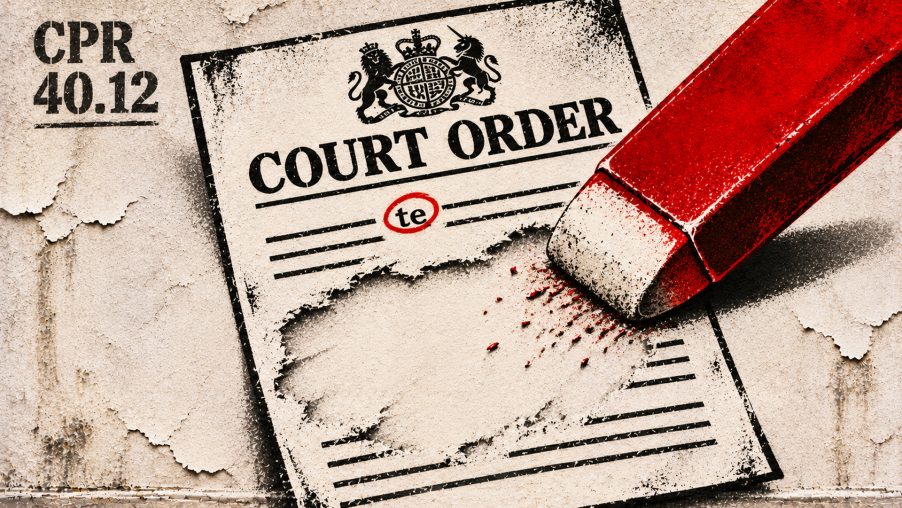
A sealed court order contains the wrong party name, a transposed figure or a word that reverses what the judge plainly meant. The CPR slip rule may provide a focused correction route, but it is not a way to ask the judge to decide the case differently.
The distinction in one minute
CPR rule 40.12 allows the court, at any time, to correct an accidental slip or omission in a judgment or order. The useful question is not whether the order looks wrong, but why it looks wrong. If the wording fails to record what the court intended at the time, correction may be appropriate. If the wording records the intended decision but a party now says that decision was wrong, the slip rule is not a substitute for an appeal or another available procedural challenge.
What the slip rule does
The slip rule addresses accidental failures of expression. A transposed sum, a misspelt name, an incorrect date or an omitted word may be candidates where the surrounding record shows what the court meant. The power is not confined to spelling mistakes. The question is whether the judgment or order accidentally failed to express the court’s intention at the time, rather than whether its reasoning or intended decision was mistaken.
Rule 40.12(2) says that a party may apply for a correction without notice. That does not make every correction administrative or uncontroversial. The requested wording still needs to demonstrate the accidental slip or omission, and the court controls how the request is determined.
Original intention is the reference point. The courts distinguish correcting an order so that it gives effect to what was intended when it was made from using the rule to accommodate second thoughts or a different substantive decision. The first is the slip rule’s work; the second is not.
That distinction also prevents an oversimplification. A correction can reverse the outcome expressed in the written decision where the original wording was a straightforward failure of expression: the Court of Appeal in Devani explained that even a 180-degree change in the stated outcome can be corrected if it gives effect to what was actually intended. The size of the correction is not the test. The difference between first thoughts and second thoughts is.
Compare the order with the judgment
Start with the sealed order and preserve an unchanged copy. Read the operative paragraphs beside the judgment, any approved transcript and any agreed note of the relevant hearing. Look for a precise mismatch: the judgment awards one figure but the order records another; the reasoning identifies one party but the order names another; a word such as “not” appears to have been omitted from a direction.
The comparison should cover the whole relevant reasoning, not an isolated sentence that supports the desired edit. A phrase may look accidental until another part of the judgment shows that the judge deliberately chose it. Equally, a party’s disappointment with the result does not establish that the court failed to express its intention.
Practice Direction 40B also records the court’s inherent power to vary its own orders to make its meaning and intention clear. That reinforces the need to identify meaning and intention from the contemporaneous record. It does not turn a general objection to the judge’s findings into a correction request.
Copy the exact paragraph and wording said to contain the slip.
Identify the passage said to show the court’s original intention.
Write the replacement wording narrowly, without improving other parts of the order.
Make a focused correction request
Practice Direction 40B says that the application notice may be an informal document such as a letter, and that it should describe the error and set out the correction required. Those two requirements reward precision. A useful request identifies the case, the order and the paragraph; quotes the existing words; states the proposed replacement; and points to the judgment or transcript passage that justifies it.
Keep the explanation proportionate. For example, explain that paragraph 3 records £15,400 whereas the judgment at paragraph 27 awarded £14,500, and ask for the figure in the order to be corrected accordingly. Do not use the request to rehearse the trial, challenge the evidence or add a new argument about costs. If the proposed edit depends on persuading the court that its original reasoning was wrong, the problem is no longer a simple mismatch of wording.
Set out the existing text exactly, including the paragraph number.
Give the precise judgment or transcript passage showing the intended wording.
Ask for the smallest wording change that resolves the identified mismatch.
The Practice Direction allows an application to be dealt with without a hearing in specified circumstances, including where the applicant requests it, the parties consent or the court considers a hearing inappropriate. If the application is opposed, it should, if practicable, be listed before the judge who gave the judgment or made the order. A hearing is therefore possible; “without notice” and “without a hearing” are not interchangeable.
Correction, appeal or set aside?
Route selection begins with the complaint itself. Correction addresses an accidental mismatch between the decision and its recorded wording. An appeal challenges the decision that the lower court actually made. In the Part 13 example below, setting aside or varying has its own gateway and promptness condition; it is not another name for slip-rule correction.
Correction
The order does not express what the court intended at the time. Identify the accidental slip and the original wording that demonstrates it.
Appeal
The order expresses the intended decision, but that decision is said to be wrong or unjust because of a serious procedural or other irregularity.
Set aside or vary
Part 13 supplies one route for default judgments entered under Part 12. Its discretionary gateway and promptness requirement are distinct from the slip rule.
CPR rule 3.10 separately addresses an error of procedure, such as a failure to comply with a rule or practice direction: the error does not invalidate a step unless the court orders, and the court may make an order to remedy it. That power concerns procedural error in the conduct of proceedings. It should not be treated as an alternative route to rewrite a substantive decision merely because CPR 40.12 does not fit.
For many civil appeals, permission is required. On a first appeal, the permission test is a real prospect of success or some other compelling reason for the appeal to be heard. The appeal court will allow an appeal where the lower court’s decision was wrong or unjust because of a serious procedural or other irregularity. Those tests direct attention to the validity of the decision, not simply to how it was typed.
Part 13 provides a particular set-aside and variation route for default judgments entered under Part 12. Where the court has a discretion under rule 13.3, it must have regard to whether the application was made promptly. This illustrates why the document and the complaint matter: a default judgment application has its own framework, distinct from correcting accidental wording in an order made after a hearing.
Act promptly and preserve the wording
“At any time” in rule 40.12 is not a reason to delay. Prompt action makes the comparison easier, reduces the risk of people acting on conflicting versions and allows any consequential issue to be addressed before it grows. Keep the original sealed order, the judgment, the relevant transcript and the correction request together so that the sequence remains clear.
More importantly, another procedural clock may be running. Where no different direction or specific time limit applies, rule 52.12 requires an appellant’s notice to be filed within 21 days after the date of the lower court’s decision; an application to vary that time limit must be made to the appeal court. Do not assume that asking for a slip-rule correction has extended the appeal timetable.
An appeal does not automatically stay the lower court’s order or decision unless the appeal court or lower court orders otherwise. A party concerned about compliance or enforcement while a correction or challenge is considered should identify that issue expressly rather than assuming that everything is paused.
The practical discipline is to preserve the precise wording first, classify the complaint second and choose the procedural route third. A short document showing “this is what the order says, this is what the judgment intended, and this is the exact correction sought” is more useful than a long complaint about why the outcome feels unfair.
Source anchors
These official rules and judgments explain the framework discussed above. They do not determine the facts or the appropriate route in an individual case.
The power to correct an accidental slip or omission at any time, and to apply without notice.
The contents of a correction request, hearing arrangements and clarification of the court’s intention.
Paragraphs 21-25 explain original intention and why even a reversed stated outcome may be a slip.
Paragraphs 31-48 review the authorities and distinguish first thoughts from second thoughts.
The separate power to remedy an error of procedure in the proceedings.
Permission, appeal grounds, filing time, variation of time and the absence of an automatic stay.
The distinct procedure for setting aside or varying a default judgment.
The closing point
The slip rule protects the integrity of the record; it does not provide a second hearing in disguise. Preserve the exact words, test them against the judgment and ask only for the correction that the contemporaneous record supports. If the judge intended the decision recorded in the order, turn to the rules governing appeal, variation or set aside rather than stretching a correction request beyond its purpose.
Order-correction decision point
Get a free written assessment of the order and the route
Legal Lens can structure a preliminary written review of the wording mismatch, the supporting judgment passages and the procedural options that need attention.
The order, the relevant reasoning and the narrow correction said to be needed.
Correction, appeal or another rule-specific challenge, with any current filing date identified.
Assessment outputs
The mismatch, the intended meaning and the documents that bear on it.
Available procedural options and the dates requiring attention.
Independent Legal Lens consultancy. Legal Lens is not a regulated solicitors’ firm. A preliminary assessment is not a substitute for regulated legal advice where that is needed.