
Many litigants in person assume that winning means being made whole – then meet CPR rule 27.14’s closed list. This guide explains exactly what is and is not recoverable on the small claims track: court fees in full, fixed commencement costs of £50 to £100, expert fees capped at £750, loss of earnings capped at £95 a day, and why legal representation costs stay with you even when you win. Includes a worked recoverable-costs schedule for a typical claim and the conduct and re-allocation exceptions where the limits lift.
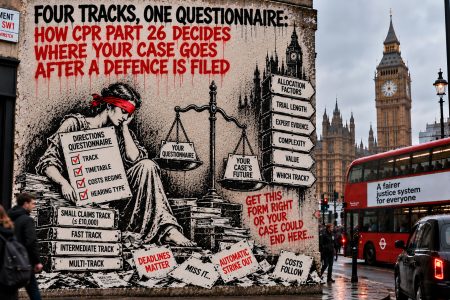
Once a defence is filed, CPR Part 26 begins the sorting exercise that decides where your case lives: small claims, fast, intermediate or multi-track. The directions questionnaire carries a fixed deadline the parties cannot extend, an automatic strike-out sanction for ignoring it, and answers that shape the timetable, the costs band and the hearing format. This guide explains the machinery – and how to complete the form so the answers work for you.
The ICO can investigate a data breach and fine the organisation – but it cannot award the victim a penny. Compensation only comes from a civil claim under Article 82 of the UK GDPR and section 168 of the Data Protection Act 2018, which expressly covers distress. This guide explains what a claimant must prove, what Lloyd v Google changed, realistic quantum for distress-only cases, and whether your breach is a court claim, an ICO complaint, or both.
Since October 2023 the County Court has had four case management tracks, and the newest — the intermediate track — now covers the defended claims worth between £25,000 and £100,000 that are too big or too complex for the fast track. Track allocation decides procedure and, through fixed recoverable costs, almost exactly what the winner recovers. Here is what to check before you return the directions questionnaire.