
 Written by
 Workplace harassment · NDAs · financial regulation
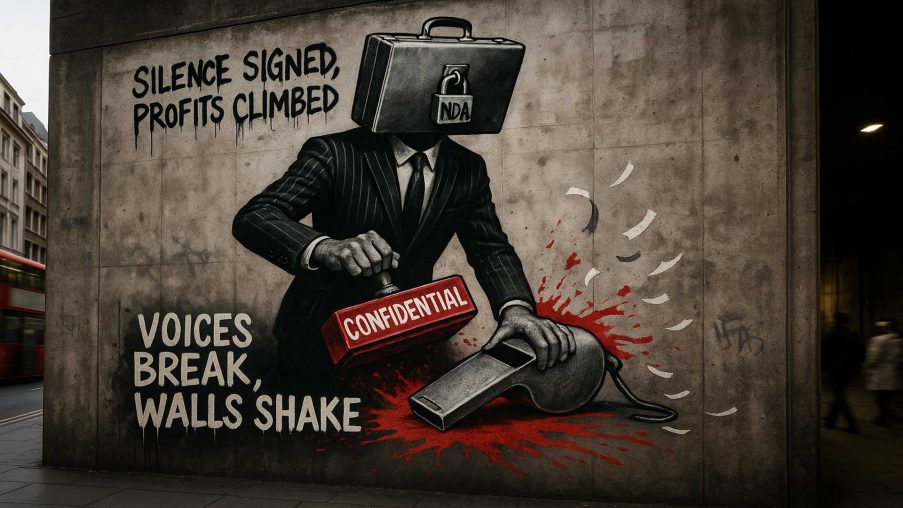
A former City employee writing under the pseudonym “Barbara Wagner” has accused Citibank of using NDAs, HR processes and data disclosures to suppress sexual harassment complaints. Her account raises serious public-interest questions about workplace accountability, tribunal transparency, regulatory oversight and the limits of confidentiality.
Publication snapshot
- The article is based on testimony and documentation provided by a whistleblower using the pseudonym “Barbara Wagner”.
- It concerns alleged workplace sexual harassment, settlement pressure, tribunal conduct and disclosure of confidential personal data.
- It refers to wider debate over NDAs, FCA-regulated professionals and institutional handling of harassment complaints.
- All allegations should be treated as allegations unless admitted, proven or determined by a competent authority.
Former City employee breaks silence
A whistleblower formerly employed at Citibank’s London office has accused the banking giant of systemic cover-ups, legal retaliation and data protection breaches after she raised complaints of workplace sexual harassment and misconduct by a senior colleague.
Writing under the pseudonym Barbara Wagner, the former sales employee alleges that Citibank’s internal HR and legal teams protected the alleged harasser, misled employment tribunal proceedings, and later disclosed her confidential data to assist a retaliatory claim by that individual — all despite a signed non-disclosure agreement.
Her case is now the subject of a police investigation, and she retains court-granted anonymity in all criminal and civil proceedings. Wagner, a pseudonym long used for her blogging and public writing, has shared her experience in a detailed exposé titled Me v. Citibank, published on Medium earlier this year.
From harassment to forced settlement
Wagner joined Citibank in 2017, working on the rates trading floor. She describes a culture rife with gender imbalance and sexual objectification.
In her post, she recounts how a male colleague once propositioned her for sex in the middle of the trading floor, and how a later relationship with a senior executive — formed during the 2020 lockdown — led to the non-consensual circulation of a bikini photo of her to other Citi and JP Morgan staff.
After she suffered a miscarriage, the executive allegedly ended the relationship in a torrent of verbal abuse. Her subsequent formal complaint to HR about the harassment and photo distribution was, according to Wagner, deliberately mishandled.
Citibank, she alleges, quickly pushed for a confidential settlement. In 2023, Wagner agreed to a payout of £80,000, but only after Citibank insisted she drop all claims, including a separate harassment case, and sign an NDA preventing any future legal action against Citibank or its executives.
Crucially, the accused colleague was explicitly named in that NDA as a “protected person”, which Wagner says created a perverse legal asymmetry: while she was restricted from speaking, he retained institutional and legal support.
Tribunal conduct and erased findings
What followed, Wagner says, raises serious questions about judicial handling. She filed an employment tribunal claim in case 3205586/2021, and says that on 6 March 2023, during a costs hearing, the judge verbally acknowledged that the distribution of the bikini photo constituted sexual harassment.
However, Wagner says this oral finding was removed from the written judgment following pressure from the accused colleague’s legal team. The same judge later denied ever making the remark, prompting Wagner to record a subsequent hearing where, she says, the judge reversed her own conclusion.
Wagner says her formal request for a transcript was refused, despite the judge acknowledging that the hearing had been recorded. She says she has obtained documents showing that the respondent’s barrister asked the tribunal to withhold publication of the judgment, citing reputational risk to the accused.
Citibank lawyer disclosed confidential data
Following the settlement, Wagner says she discovered that Citibank’s Managing Director of Legal, Emma Nelson, had provided her personal data — including HR reports and sensitive medical records — to the legal team representing her alleged harasser.
This disclosure, Wagner says, was made without her consent and in breach of the NDA. When she questioned it, Citibank allegedly claimed the tribunal had requested the documents. Wagner says she has written proof this was untrue, and she filed a complaint with the Information Commissioner’s Office.
In 2024, Bloomberg journalists reportedly questioned Citibank about this disclosure. Wagner says they asked what tribunal order mandated the release of her private HR documents to a third party. According to Wagner, Citibank “had no answer”.
Weaponised NDAs and regulatory inaction
Wagner’s account suggests that non-disclosure agreements can operate as tools for silencing complainants. “I know for sure every large bank and corporation does this,” she said. “BlackRock forced me into an NDA too.”
Her comments come amid growing pressure in the UK to ban NDAs in harassment and discrimination cases. Deputy Prime Minister Angela Rayner recently announced plans to outlaw such gagging clauses, stating: “No one should suffer in silence.”
Wagner supports the reforms, but says they must go further. She argues that private hearings in harassment cases should be outlawed, and that permanent restrictive reporting orders often imposed on FCA-regulated professionals must be banned.
Despite submitting detailed complaints to the FCA, Wagner says the regulator took no action.
Broader pattern: silence and complicity
Wagner’s case echoes other allegations emerging from Citibank globally. In 2024, Citigroup managing director Ardith Lindsey filed a US lawsuit alleging a “pervasive” culture of harassment and gender discrimination, particularly in Citi’s equities division.
Citi’s legal teams have consistently denied wrongdoing, while internal leadership maintains that all complaints are investigated thoroughly. Wagner’s experience, however, suggests a different picture.
She hopes others will follow. “I haven’t heard from others yet, but I will. I know I’m not the only one.”
Sources
- Wagner, B. (2025). Me v. Citibank. Medium. Available at: medium.com/@cinderellaofthecity/me-vs-citibank-063b39a71a46 [Accessed 10 Jul. 2025].
- Interview with Barbara Wagner, email correspondence with Legal Lens, 12–13 Jul. 2025.
- The Guardian (2025). UK bosses to be banned from using NDAs to cover up misconduct at work. 7 Jul. Available at: theguardian.com.
- Reuters (2024). Citi failed to protect managing director from sexual harassment, lawsuit claims. 23 Apr. Available at: reuters.com.
Legal disclaimer
The views and allegations presented in this article are based on the personal testimony and documentation provided by the whistleblower writing under the pseudonym “Barbara Wagner”. All individuals and organisations named in this piece are entitled to respond. This article is published in the public interest to inform debate around the use of non-disclosure agreements, regulatory accountability, and institutional responses to workplace harassment.
The publisher has taken reasonable steps to verify the factual basis of the material but does not accept liability for the accuracy or truth of any personal statements made by the source. Nothing in this article constitutes legal, financial, or psychological advice. Readers are encouraged to seek professional counsel where appropriate.
If any party believes a factual error or misrepresentation has been made, please contact the publisher with supporting information. Corrections will be considered in line with journalistic standards.