
 Written by
 Civil procedure – settlement – costs risk
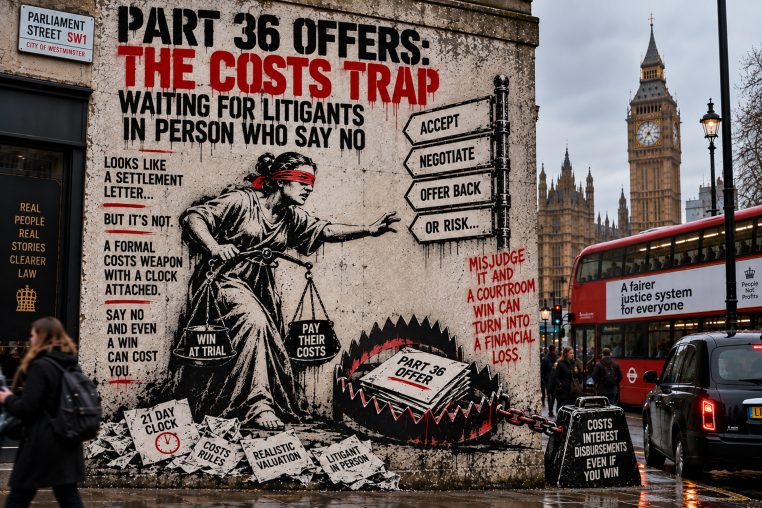
A Part 36 offer reads like an ordinary settlement letter, but it is not one. It is a formal costs instrument with a clock attached, and misjudging it can turn a courtroom win into a financial loss. This guide explains what makes an offer genuine, what rejecting one can cost, and how to answer.
Snapshot
A Part 36 offer does not oblige you to accept anything. What it does is change the arithmetic of continuing. Reject a defendant’s offer and fail to beat it at trial, and the court must, unless it would be unjust, order you to pay the defendant’s costs from the day the offer period expired – even though you won. The same machinery can work for you. The skill is in the evaluation, and the evaluation has a deadline.
The letter that is not just a letter
Most settlement letters are conversation: figures are exchanged, and nothing much happens if the exchange goes nowhere. A Part 36 offer is built differently. Its consequences do not depend on anyone’s view of what was reasonable. They follow from Part 36 of the Civil Procedure Rules, automatically, once the case reaches judgment.
Do you have to accept? No. But declining a Part 36 offer is not a free decision, and treating the letter as an ordinary negotiating move is one of the most expensive mistakes a self-represented party can make. The offer sets a price on continuing – your price, if you are wrong about the strength of your case. Everything that follows hangs on two questions: is the letter genuine, and when does its offer period expire?
Is it really a Part 36 offer?
Not every letter with a number in it qualifies, and the difference is worth checking before you worry about the consequences. To qualify, an offer must be in writing; it must make clear on its face that it is made pursuant to Part 36; it must specify a period of not less than 21 days within which the defendant will be liable for the claimant’s costs if it is accepted; and it must state whether it covers the whole claim, part of it or an issue in it, and whether it takes any counterclaim into account. A defendant’s offer to pay money must be an offer of a single sum. An offer that is not made in accordance with these requirements will not carry the Part 36 costs consequences – although the court may still weigh it when deciding costs in the ordinary way.
That cuts both ways. A sloppy letter from the other side may carry less threat than it appears to. And an offer you dash off yourself, marked “without prejudice” and silent on Part 36, buys you no protection. The form is not pedantry; it is what switches the machinery on.
Does the letter say, in terms, that it is made pursuant to Part 36?
Does it give at least 21 days, and does it deal with costs on acceptance?
Whole claim, part or issue? What happens to any counterclaim?
Key distinction. An ordinary “without prejudice” offer is an invitation the court may weigh later. A Part 36 offer is a mechanism with automatic consequences. Which one you are holding decides how carefully you need to answer it.
The 21-day clock
Every Part 36 offer specifies a “relevant period” of not less than 21 days. The offer is made when it is served on the other side, and it can be made at any time – including before proceedings are issued. A money offer is treated as inclusive of all interest up to the date the relevant period expires. The period matters because it fixes the date from which the costs consequences are measured.
Inside the period, acceptance is simple and safe. If a Part 36 offer is accepted within the relevant period, the claimant is entitled to their costs up to the date of acceptance. Accept a whole-claim offer late, and the position hardens: unless the parties agree otherwise or the court considers it unjust, the claimant keeps costs up to the expiry of the period but the late accepter pays the offeror’s costs from then until acceptance.
Offers made less than 21 days before trial are treated differently: the relevant period then runs to the end of the trial, and the automatic consequences do not apply unless the court has shortened the period.
What saying no can cost
This is the heart of it. If the case goes to judgment and you fail to obtain a judgment more advantageous than the defendant’s Part 36 offer, the court must – unless it considers it unjust – order that the defendant is entitled to their costs from the date the relevant period expired, plus interest on those costs. On a money claim, “more advantageous” means better in money terms by any amount, however small. In deciding what would be unjust, the court weighs everything, including the timing of the offer, the information available, the parties’ conduct, and whether the offer was a genuine attempt to settle.
Run the arithmetic on an imaginary case. You claim £40,000. The defendant offers £30,000. You refuse, fight to trial, and win £29,500. You have won – and you have lost. Judgment is yours, but you failed to beat the offer, so you can be ordered to pay the defendant’s costs for everything after day 21, which in a case fought to trial can approach or exceed the damages. That is the trap: a “win” that transfers money from you to the other side.
You fail to beat their offer
Judgment is no better than the defendant’s offer. Unless it would be unjust, you pay their costs – with interest – from the day the offer period expired, even though you won.
They fail to beat yours
Judgment is at least as good as your own offer. The consequences run the other way, sharpened to reward sensible offers.
Where judgment against the defendant is at least as advantageous as the claimant’s own Part 36 offer, the court must, unless it would be unjust, award the claimant costs on the indemnity basis from the end of the relevant period, interest at up to 10% above base rate on the sum awarded and on those costs, and an additional amount – 10% of the first £500,000 awarded, plus 5% of anything above that, capped at £75,000. Indemnity-basis costs are assessed more generously than the standard basis, and the additional amount is simply a sanction for the defendant’s misjudgement. It is what makes your own offer a weapon rather than a courtesy.
Working out what the offer is worth
Evaluating a Part 36 offer is not asking “is this figure fair?” It is asking “what is my realistic best outcome at trial, discounted for the chance I do not achieve it, and how does that compare with what is on the table now?” The comparison is against the offer, not against the claim, and the figure that matters is the one you can prove. Then add the hidden variables – interest, the costs you will not recover even if you win, and the courtroom risk that never reduces to zero.
Do all of this knowing that a Part 36 offer is treated as “without prejudice except as to costs”: the trial judge must not be told the offer exists, or its terms, until the case has been decided. The evaluation happens privately; the offer’s only voice comes afterwards, on costs. If the offer is unclear, you may ask the offeror to clarify it within seven days of it being made, and apply for an order compelling clarification if they do not.
Answering: accept, negotiate or offer back
There are three disciplined answers, and “ignore it” is not one of them.
Acceptance is formal too: written notice of acceptance must be served on the offeror and filed with the court, and there is a court form – N242A – for making and accepting offers. Once accepted, the claim is stayed on the terms of the offer, and a money sum must be paid within 14 days unless agreed or ordered otherwise; if it is not, the claimant can enter judgment for it. An accepted offer is not a promise to talk; it is the end of the claim on stated terms, with enforcement built in.
Negotiating is legitimate, but know the ground you stand on. Rejecting a Part 36 offer – even brusquely – does not kill it. The Court of Appeal confirmed in Gibbon v Manchester City Council that an offer stays on the table, open for acceptance, until it is formally withdrawn by written notice, and making a counter-offer does not withdraw it either. So do not assume the offer you dismissed last month has gone away. It may still be there, quietly pricing your case.
Offering back is often the strongest move. A counter-offer in proper Part 36 form buys you the enhanced consequences above if the other side fails to beat it, and frames you as the reasonable party without conceding anything. Two practical cautions. First, once your offer is made you cannot withdraw or worsen it within its relevant period without the court’s permission – an application on notice to a judge other than the trial judge, for which the current HMCTS fee is £321 under the EX50 fees schedule updated in July 2026; only after the period expires can an unaccepted offer be withdrawn freely. Second, an offer you improve counts as a new offer with a fresh 21-day period, not as a withdrawal of the old one.
Source anchors
These anchors support the procedural framework described in this article. They are not advice on any individual offer.
The full rule text: the formalities, the relevant period, acceptance and withdrawal, and the costs consequences in rules 36.13 to 36.17.
The practice direction supplementing Part 36: Form N242A, filing notices of acceptance, and how permission applications are made.
The Court of Appeal on Part 36 as a self-contained code, and why an offer that has not been formally withdrawn remains open for acceptance.
The HMCTS fees schedule, updated 13 July 2026, including the fee for a general application on notice.
The closing point
A Part 36 offer is the other side pricing your case for you, in writing, with a clock attached. Rejecting it is not defiance; it is a bet, and the rules tell you the odds in advance. Do the arithmetic while the clock is running – after it expires, the meter runs against whoever called it wrong.
Settlement offer decision point
Get a free written assessment of the offer on the table
Legal Lens can structure a preliminary written review of a Part 36 offer: whether it meets the formal requirements, when its period expires, and what accepting, rejecting or counter-offering could each mean for costs.
Does the letter meet the Part 36 formalities, and when exactly does the relevant period expire?
What accepting, rejecting or counter-offering could each add to – or save from – the final costs bill.
Assessment outputs
The offer, the claim, the counterclaim and the live deadlines.
The dates that decide who pays whose costs, and from when.
Independent Legal Lens consultancy. Legal Lens is not a regulated solicitors’ firm. A preliminary assessment is not a substitute for regulated legal advice where that is needed.