
 Written by
 Regulatory oversight – complaints routes – practical guidance
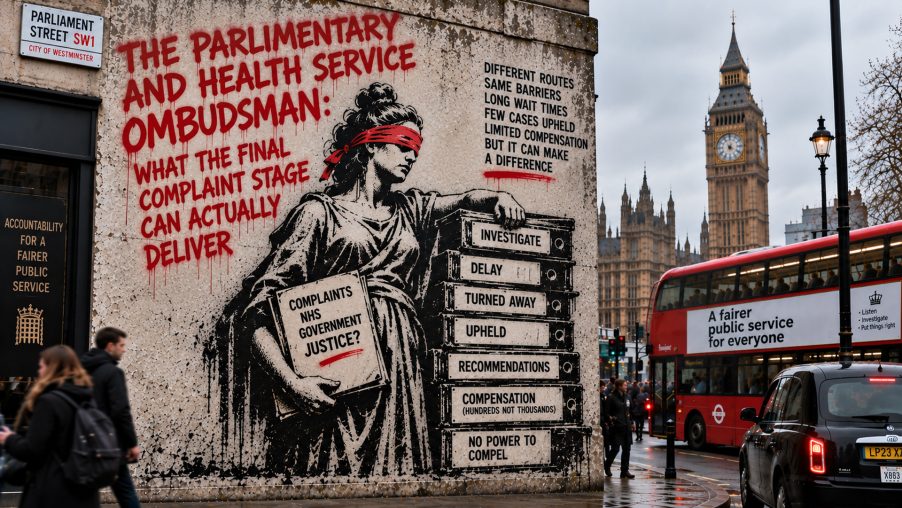
For complaints about the NHS in England or UK government departments, the Parliamentary and Health Service Ombudsman is the final stage. But the Ombudsman’s own figures show how few complaints complete the journey, how long the wait can be, and what an upheld complaint can realistically deliver. Before investing months in the route, it is worth reading the map.
Snapshot
The Parliamentary and Health Service Ombudsman (PHSO) investigates complaints about UK government departments and the NHS in England once the organisation’s own complaints process has been exhausted. It is free, independent and genuinely powerful when it finds maladministration — but it cannot compel anything, it turns away most of what it receives at the door, and its financial remedies are measured in hundreds of pounds, not thousands. This piece sets out the route, the filters, the time limits and the numbers, so readers can decide with open eyes whether the final stage is worth the months it takes.
The route, and the MP filter
The PHSO sits at the end of two different complaint journeys. The first covers the NHS in England — hospitals, GPs, trusts and other health bodies. The second covers UK government departments and a range of other national public organisations. In both cases the same threshold applies: you must complain to the organisation first and give it the chance to put things right. The Ombudsman is not a first resort, and a complaint that arrives too early will be sent back.
The two journeys then diverge in a way that surprises many complainants. For complaints about UK government departments, the Parliamentary Commissioner Act 1967 requires the complaint to be made in writing to a Member of Parliament and referred to the Ombudsman by an MP, with the complainant’s consent. This is the “MP filter”, and it remains the law for most parliamentary complaints: you cannot simply write to the Ombudsman directly about, say, the Department for Work and Pensions or HM Revenue & Customs. Your MP acts as the gatekeeper, and the referral is made through your MP’s office. Complaints about the NHS in England, by contrast, go straight to the Ombudsman without any MP involvement.
One institutional detail is worth knowing before you start. The Ombudsman has announced that it is preparing to change its name to the Public Service Ombudsman, on the basis that the current name obscures what the body actually does. The functions, powers and limits described in this article are unaffected; only the signage is expected to change.
Time limits and the legal-action bar
The clock on a PHSO complaint is shorter than many people assume, and it runs from knowledge, not from the end of the organisation’s own process. For parliamentary complaints, the 1967 Act bars a complaint made more than twelve months after the day the person aggrieved first had notice of the matters complained of, although the Ombudsman may still investigate where there are special circumstances. For NHS complaints, the Health Service Commissioners Act 1993 sets the same one-year limit from first notice, again with a discretion to accept late complaints where the Ombudsman considers it reasonable, and with a three-year outer limit for complaints against former family health service providers and independent providers.
The practical consequence is counter-intuitive. A slow internal complaints process does not stop the statutory clock. The Ombudsman’s own guidance acknowledges the problem: if the organisation has taken so long to answer that the complaint arrives out of time, that delay is precisely the kind of circumstance in which the Ombudsman may still be able to investigate. But that is a discretion, not an entitlement. The disciplined approach is to escalate promptly after the final response arrives, and to keep the letter that shows when you first knew of the problem.
There is also a jurisdictional boundary that catches people out. The Ombudsman generally cannot investigate where the complainant has or had a right of appeal to a tribunal, or a remedy through the courts, unless satisfied that it was not reasonable to expect them to use it. The PHSO says it will weigh factors such as the cost and length of legal action before deciding. If the heart of your grievance is a benefits entitlement decision or a clinical negligence claim, the Ombudsman is usually the wrong forum: the tribunal or the court is the route, and the Ombudsman will say so.
How the Ombudsman decides
The PHSO’s published process has three steps, and the first is the steepest filter. Initial checks confirm that the organisation and issue are within remit and that the organisation’s own process has been completed. Only around 25% of the complaints that reach the Ombudsman are taken forward past that first step. At the second step, caseworkers decide whether a full investigation is justified, weighing the seriousness of what went wrong, whether the impact has been put right, whether a legal route exists, and whether the issue fits wider priorities. The Ombudsman uses a “severity of injustice” scale to keep its recommendations consistent. Only at the third step does a full investigation gather evidence from both sides, sometimes with clinical advice in health cases.
For those who do get through, the odds shift markedly. Of the complaints the Ombudsman investigates each year, around 75% are upheld in full or in part. The honest reading of the two figures together is that the scheme is highly selective at the door and strongly complainant-favouring once inside it. A complainant whose case is accepted for investigation has a real prospect of vindication; a complainant turned away at the checks has, in most cases, reached the end of the road.
Demand, however, is running ahead of capacity. The Ombudsman reports that demand for its service has risen to record levels, with a significant increase in complaints about health and government services, and currently warns of waits of up to six months before it can look at an NHS complaint and up to seven months for complaints about UK government departments — and that is before any investigation itself begins. Anyone planning around this route should budget elapsed time in seasons, not weeks.
What an upheld complaint can deliver
Where the Ombudsman upholds a complaint, it can recommend that the organisation acknowledge its mistakes, apologise, repay money the complainant is out of pocket, make a payment recognising distress or damage to reputation, revisit a decision it mishandled, or produce an action plan to stop the same failure recurring. In health cases it may send its report to a doctor’s responsible officer for revalidation purposes. What it cannot do is equally clear from its own published table: it cannot make an organisation dismiss or “strike off” a member of staff, cannot award compensation in the way courts and tribunals can, and cannot substitute its own decision for one the organisation is entitled to take.
Calibrate the remedy. The Ombudsman restores people, as far as it can, to the position they would have been in. It is not a compensation scheme. If the realistic value of your grievance is a damages claim, the Ombudsman route will not deliver it, however strong the maladministration case.
The financial figures confirm the point. Across the whole of 2024-25 — every upheld complaint, every recommendation, government and health combined — the Ombudsman’s financial payment recommendations totalled £426,212. Spread across the year’s 1,274 recommendations, that is an average measured in the hundreds of pounds per recommendation. The remedy that matters most is usually non-financial: an authoritative finding that a public body failed, an apology extracted at official level, and an action plan with follow-up behind it.
The enforcement limit
Here is the structural fact that every complainant should understand before starting: the Ombudsman has no legal power to enforce its recommendations. It follows up, it reminds, it escalates to senior managers, and it reports that non-compliance is extremely rare — most organisations comply, because the reputational cost of refusing an ombudsman that reports to Parliament is high. But the power is persuasive, not coercive.
The statutory backstop is parliamentary rather than judicial. Where an investigation finds injustice caused by maladministration that has not been or will not be remedied, the 1967 Act allows the Ombudsman to lay a special report before each House of Parliament. That is the final weapon in the armoury, and it is used sparingly enough that its use makes news.
It made news recently. In 2025 the Ombudsman laid reports before Parliament after the Charity Commission declined to comply fully with recommendations on two investigations into its handling of sexual abuse concerns; the Commission went so far as to issue legal proceedings to prevent the reports being laid, and Parliament intervened to have them brought before it. The episode is instructive in both directions. It shows that even a defiant public body cannot ultimately stop the reports reaching Parliament. It also shows that a complainant in that position has no court-style order to execute — resolution depended, in the end, on political pressure. The public lesson is simple: the Ombudsman’s authority is real, but it ends where compulsion would begin.
The numbers behind the route
The figures below come from the Ombudsman’s annual report for 2024-25, laid before Parliament in July 2025 — the most recent annual report whose full dataset could be verified for this article. Its contact centre dealt with 123,987 enquiries; 38,045 complaints were accepted for consideration; 37,454 complaint decisions were made in total; 9,085 complaints were decided following a primary or detailed investigation; 1,274 recommendations were made; and 99% of initial-check decisions were reached within seven days.
Read as a funnel, the figures describe a service that filters hard and investigates few. The tens of thousands of enquiries and complaints narrow to roughly nine thousand investigated decisions, and to roughly thirteen hundred recommendations. None of this is an argument against using the route — for the right complaint, a 75% uphold rate among investigated cases is a strong prospect. It is an argument for using it deliberately, with evidence organised and expectations set by the statistics rather than by hope.
Before you commit
The route rewards preparation. The complainants who fare best are those who treat escalation as an evidence exercise: a completed internal process, a clear chronology, and a specific account of what the organisation did wrong and what it would take to put it right.
Obtain the organisation’s final response in writing. The Ombudsman will check for it at the door.
Work out when you first had notice of the problem. Inside a year, escalate promptly; outside it, prepare to explain why.
If a tribunal appeal or court claim covers the same ground, decide consciously between the routes before the Ombudsman decides for you.
Government department: write to your MP and ask for a referral. NHS in England: complain directly to the Ombudsman.
Apology, repayment, an action plan and an authoritative finding are realistic. Damages-level compensation is not.
Source anchors
These primary and official sources support the framework described in this article. They establish the route, the time limits and the published figures; they do not decide the outcome of any individual complaint.
Primary legislation for complaints about UK government departments, including the MP referral requirement, the twelve-month time limit and the special-report power.
Primary legislation for complaints about the NHS in England, including the one-year time limit and the discretion to accept late complaints.
The Ombudsman’s own guidance on scope, what to do before escalating, current wait times and what it can and cannot recommend.
Official complaint volumes and decision data for the NHS in England and UK government departments, published each year.
How the Ombudsman follows up recommendations, applies its Principles for Remedy and handles the rare case of non-compliance.
The closing point
The PHSO is the end of the line, and for the right complaint it is a meaningful one: independent, free, and willing to say in terms that a public body failed. But it filters out three complaints in four at the first step, it cannot compel anyone to do anything, and its cheques are small. The complainants who benefit most are those who walk in knowing that — with the internal process finished, the dates diarised and the remedy they actually want already matched to the forum that can grant it.
Complaint route decision point
Get a free written assessment of the complaint route
Legal Lens can structure a preliminary written review of a complaint before it is escalated: whether the PHSO is the right final stage, whether the time limit is engaged, and what evidence the file needs.
Ombudsman, tribunal or court: which forum can actually deliver the outcome sought.
Whether the internal process is complete, the clock is safe and the evidence file is investigation-ready.
Assessment outputs
Forum options, time limits and the realistic remedy each can deliver.
Key records, correspondence, chronology and missing documents.
Independent Legal Lens consultancy. Legal Lens is not a regulated solicitors’ firm. A preliminary assessment is not a substitute for regulated legal advice where that is needed.