
 Written by
 Civil procedure – counterclaims and additional claims – practical guidance
Filing or receiving a defence feels like the end of the opening exchange. Part 20 of the Civil Procedure Rules exists for what can happen next: a defendant who counterclaims, a defendant who claims a contribution or indemnity from someone else, and a third party pulled into a case they never started. This guide explains the routes, the permission points and the deadlines — in both directions.
Snapshot
Part 20 covers counterclaims against the claimant and a defendant’s claims against any person for a contribution, an indemnity or some other remedy; an “additional claim” is any claim other than the claimant’s original claim. Every additional claim is treated as if it were a claim, so defences, disclosure and case management follow it around.
When the defence stops being the end of the exchange
Most litigants in person treat the defence as a full stop. Then a document arrives headed “Defence and Counterclaim” — or an additional claim form lands on the mat of a stranger to the case. Neither event is an ambush; both are ordinary Part 20 procedure.
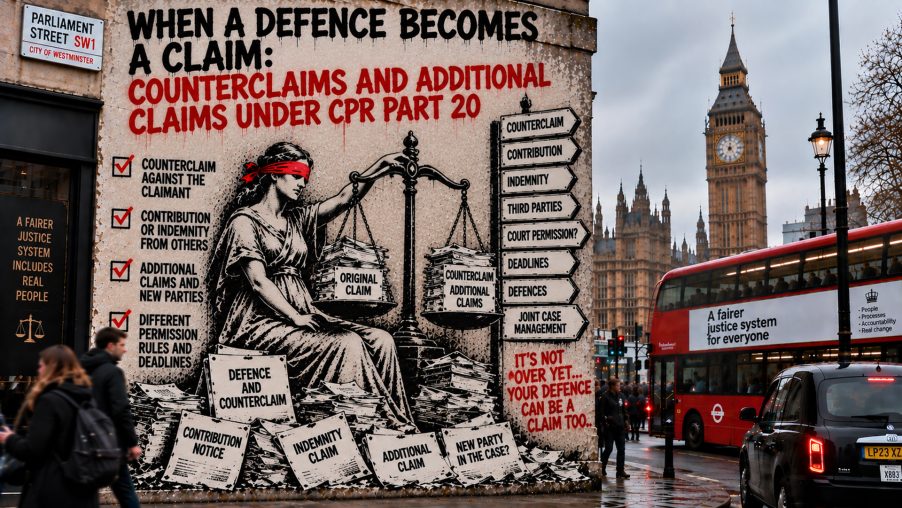
Disputes rarely stay two-handed: the defendant may say the claimant owes them money out of the same facts, two defendants may disagree about dividing liability, or the real responsibility may lie outside the case entirely. Rule 20.2 gathers this together. Part 20 applies to a defendant’s counterclaim against the claimant (with or without another person), to a defendant’s claim against any person for contribution, indemnity or some other remedy, and to further additional claims by a person added in that way — an “additional claim” being any claim other than the claimant’s claim against the defendant. And rule 20.3 supplies the engine: an additional claim is treated as if it were a claim, except as Part 20 provides — so it must be pleaded, it can be defended, and it is case-managed and tried. A counterclaim is not a grumble in a defence; it has to be answered like a claim.
Three routes, three permission points
Everything in Part 20 reduces to three routes, each with its own permission point.
Counterclaim
A claim back against the claimant. No permission is needed if the counterclaim is filed with the defence; at any other time the court’s permission is required.
Contribution or indemnity notice
A claim that another party should share, or take over, the liability. Made against an existing party by filing and serving a notice; no permission is needed if it is filed and served with the defence.
Any other additional claim
Any other claim by a defendant, including one against a person not yet in the case. No permission is needed only if the court issues it before or at the same time as the defence is filed.
Making a counterclaim
Rule 20.4 is the defendant’s route: a defendant counterclaims by filing particulars of the counterclaim, without permission if it is filed with the defence, and at any other time only with permission.
Key distinction. Timing controls permission. A defendant who discovers the counterclaim late should apply promptly and explain the delay.
The form matters as much as the timing. Rule 15.7 requires the defence and counterclaim to form one document, other than for good reason, with the counterclaim following the defence; Practice Direction 20 sets the same form as the normal practice. The heading — “Defence and Counterclaim” — is what signals a claim back, not merely a denial.
For the claimant on the receiving end, two traps follow. First, Part 10 does not apply to a claimant defending a counterclaim: there is no acknowledgment of service and no extra time to be bought that way. Second, a reply must be filed with a directions questionnaire and served on the other parties at the same time, and the reply and defence to counterclaim should normally form one document unless their due dates differ. Answering the defence while saying nothing about the counterclaim defends half a case.
Contribution and indemnity: the notice route
A contribution claim says a co-defendant should pay a fair share; an indemnity says they should repay the whole. Under rule 20.6, a defendant who has filed an acknowledgment of service or a defence makes the claim against an existing party by filing and serving a notice containing a statement of the nature and grounds of the claim — without permission if it goes in with the defence, or, where the claim is against a party added later, within 28 days after that party files their defence; at any other time permission is required.
Other additional claims and new parties
Beyond counterclaims and contribution notices sits everything else — most significantly, bringing a new person into the case. Under rule 20.7 an additional claim is made when the court issues the appropriate claim form; it may be made without permission if issued before or at the same time as the defence is filed, and at any other time only with permission. Particulars must be contained in or served with the additional claim. A counterclaim aimed at someone other than the claimant is stricter still: rule 20.5 requires an application for an order adding that person as an additional party, though it may be made without notice.
Service has its own rule. Where no permission was needed, a counterclaim against an additional party only must be served on every other party when the defence is served, and any other additional claim must be served on the person against whom it is made within 14 days after the court issues it. The 14-day rule does not apply to a rule 20.6 notice, and where the court gives permission it directs service at the same time.
A permission application has a prescribed shape. Practice Direction 20 expects the application notice to be filed with a copy of the proposed additional claim, and requires supporting evidence stating the stage reached, the nature of the claim or question to be decided, a summary of the facts, the name and address of any proposed additional party, and an explanation for any delay — with a timetable where possible. The application is made under Part 23 by an application notice stating what order is sought and, briefly, why; in practice the standard form is HMCTS form N244.
When a non-party is served
The sharpest Part 20 moment belongs to the person who was, until the envelope arrived, a stranger to the case. Service of an additional claim makes them a party if they were not one already, and the service pack is prescribed: forms for defending, admitting and acknowledging service, a copy of every statement of case already served, and any other documents the court directs — with a copy of the additional claim form also going to every existing party. Court documents will usually style the newcomer “Third Party”.
That pack is the map of a case the newcomer joins mid-stream; treating it as junk mail is, in substance, deciding to be bound by whatever happens next.
Default judgment and managing it all together
The consequences of ignoring an additional claim differ by route. Part 12 — default judgment — applies to a counterclaim but not to other additional claims; on a counterclaim made under rule 20.4, judgment in default of defence may be obtained where no defence has been filed and the relevant time has expired.
For other additional claims — not counterclaims, and not contribution or indemnity claims between defendants under rule 20.6 — rule 20.11 substitutes a different machinery: a party who fails to file an acknowledgment of service or a defence is deemed to admit the additional claim and is bound by any relevant judgment or decision. The additional claimant may then obtain judgment by filing a request, but needs permission where the default judgment against them is unsatisfied or they seek more than a contribution or indemnity; the court may at any time set aside or vary such a judgment.
Once an additional claim is defended, the case stops being parallel disputes. Rule 20.13 requires the court to consider the future conduct of the proceedings and to ensure, so far as practicable, that the original claim and all additional claims are managed together. Practice Direction 20 adds the working detail: a case management hearing, normally alongside the hearing for the original claim, at which the court may treat it as a summary judgment hearing, dismiss the additional claim, or direct what part the additional defendant plays at trial and how far they will be bound.
Responding when one lands against you
The receiving side of Part 20 rewards method over alarm. Four steps keep the procedural footing intact.
Counterclaim, contribution or indemnity notice, or issued additional claim form — each carries different permission and service rules.
Was the claim made with the defence? If later, was permission given? Was an issued additional claim served within 14 days of issue? A gateway defect is a point for the court, not a reason to ignore the claim.
Part 15 applies to a defence to a counterclaim by virtue of rule 20.3, and the general rule is 14 days after service of the particulars, or 28 days where an acknowledgment of service is available and filed. On a counterclaim against the claimant, no acknowledgment is available.
A defective additional claim can be challenged at the case management hearing, where the court may dismiss it. Silence produces a default judgment or a deemed admission.
The general defence period runs 14 days from service of the particulars — 28 where an acknowledgment of service is filed, which a counterclaim against the claimant does not permit.
An additional claim made without permission must be served on the person against whom it is made within 14 days after the court issues it.
A contribution or indemnity notice against a party added later must be filed and served within 28 days after that party files their defence, if permission is to be avoided.
The reader journey runs both ways: a defendant with a genuine claim back loses nothing by pleading it properly and on time; a claimant or third party served with one loses everything by treating it as an attachment to be read later.
Source anchors
These anchors support the procedural framework described in this article. They do not determine the outcome of any individual case.
The rules on scope, counterclaims, contribution and indemnity notices, permission, service, default and case management of additional claims.
The evidence required on a permission application, the case management hearing, and the single-document form for defences and counterclaims.
The 14 and 28-day defence periods, the single-document rule for counterclaims, and the reply and defence to counterclaim.
Default judgment in default of defence, including the specific provision for counterclaims made under rule 20.4.
The application notice mechanism used when permission to make an additional claim is required.
The standard HMCTS application notice, with guidance notes, used in practice for permission applications.
The closing point
A defence is rarely the end of the exchange; it is the point at which the exchange can multiply. The litigant in person who can name the route, the permission point and the clock has already recovered most of the ground that a surprise counterclaim — or a surprise arrival as Third Party — was meant to take away.
Counterclaim and additional-claim decision point
Get a free written assessment of the claim and the response
Legal Lens can structure a preliminary written review of a counterclaim or additional claim: which Part 20 route is in play, whether the permission and service gateways were met, and the response options that remain open.
Which Part 20 route the document actually invokes, and whether the timing gateway was satisfied.
The defence window, the service rules and any case management hearing, sequenced into one timetable.
Assessment outputs
Claims, counterclaims, routes, documents and live disputes.
Sequenced dates with the critical gateways identified.
Independent Legal Lens consultancy. Legal Lens is not a regulated solicitors’ firm. A preliminary assessment is not a substitute for regulated legal advice where that is needed.