
 Written by
 Access to justice – court fees – practical guidance
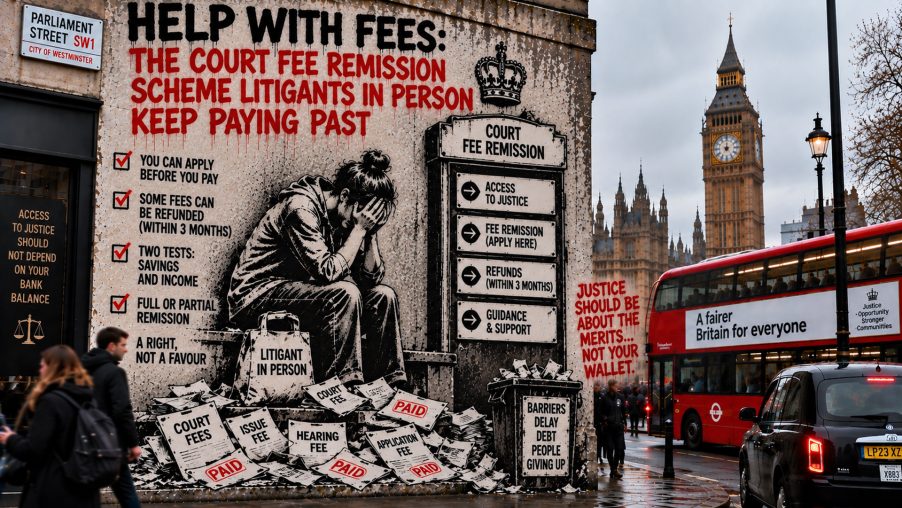
Issue and hearing fees are now one of the biggest practical barriers in civil litigation, yet the Help with Fees scheme — the statutory fee remission scheme for court and tribunal fees — remains easy to miss. You can apply before you pay, and in some cases after: a fee you paid while eligible can be refunded if you apply within three months of paying it. This guide walks through the two eligibility tests, the application mechanics, what happens when your circumstances change mid-case, and where remission fits into the fee stages of an ordinary county court money claim.
Snapshot
Help with Fees is not a favour and it is not discretionary charity: it is a structured scheme set out in secondary legislation, with a savings test, an income test and a benefits passport. A single applicant with a modest fee can hold up to £4,250 in savings and still qualify; a single applicant with no children qualifies for full remission on a gross monthly income of £1,420 or less, with more allowed for each child; and every fee in the case — the issue fee, the hearing fee, each application fee — needs its own application, made when that fee falls due. The readers who lose out are usually not the ineligible; they are the eligible who never apply.
A scheme hiding in plain sight
Start a county court money claim and the fee comes first, before any judge reads a word. Defend it to a hearing and a second, often larger, fee arrives later. For a litigant in person on a tight income, those payments can decide whether a good case is ever heard. Parliament’s answer is the Help with Fees scheme — still widely called “fee remission” — under which a party below set savings and income levels pays a reduced fee or no fee at all.
The scheme is statutory, not informal. For civil proceedings it lives in Schedule 2 to the Civil Proceedings Fees Order 2008, which requires an application for remission to be made at the time the fee would otherwise be payable. The public routes are the online Help with Fees service on GOV.UK and the paper form EX160; Court of Protection applications use a different form, COP44A, instead. And if you have already paid a fee while eligible, you can claim the money back — but only if you apply within three months of paying, a deadline the Lord Chancellor can extend only for good reason.
The stakes are constitutional as well as practical. In 2017 the Supreme Court quashed the employment tribunal fees order in the UNISON case, holding it unlawful from the outset because its effect was to prevent access to justice; the same judgment recorded that the remission scheme then in force was of very limited scope, save in relation to one category of hearing fee, and its exceptional-circumstances power confined in practice to exceptional hardship. The lesson cuts both ways: remission is the recognised safety valve that keeps court fees lawful, and a safety valve only works for the people who use it.
The two tests: savings and income
Eligibility turns on two tests, and the savings test comes first. The disposable capital test scales with the fee: where the fee is £1,420 or less you must have less than £4,250 in savings and investments; where it is £1,421 to £5,000, less than three times the fee; and where it is £5,001 or more, less than £16,000. If you or your partner are aged 66 or over, one rule applies instead: less than £16,000, whatever the fee.
What counts as savings is broader than many applicants expect. The guidance includes ISAs and savings accounts, stocks and shares (including cryptocurrency), lump sums such as redundancy payments, equity in second homes and money or property held outside the UK — and excludes personal pensions, student loans, the capital value of a self-employed business and your main home. A partner’s savings count too, because a partner’s capital and income are treated as yours unless your partner has a contrary interest in the case, for example because you are claiming against each other.
Pass the savings test and the income test decides how much of the fee is remitted. Certain benefits passport you to full remission: income-based Jobseeker’s Allowance, income-related Employment and Support Allowance, Income Support, Pension Credit (Guarantee Credit), and Universal Credit with additional gross annual earnings under £6,000. Otherwise the scheme looks at gross monthly income. Full remission is available at £1,420 a month or less for a single applicant and £2,130 or less for a couple, with the threshold rising by £425 for each child aged 13 or under and £710 for each child aged 14 or over.
Two mechanical details do real work. Income is measured as the lower of the last calendar month’s earnings or the average of the previous three months — on a fluctuating income, report it whichever way produces the lower figure. Above the threshold the scheme does not cut off: you contribute 50% of the first £1,000 of monthly excess income, 70% of the next £1,000 and 90% of the next, capped so you never pay more than the fee itself — until income exceeds the applicable threshold by more than £3,000, at which point no remission is available at all.
How the application actually works
The discipline that matters most is timing. Each fee needs a separate application, made at the same time as the court application or whenever the fee would otherwise be paid. Apply online and you receive a reference number in the format HWF-XXX-XXX, which must reach the court or tribunal within 28 days or it may be rejected; a signed paper EX160 should likewise be submitted within 28 days. If the court asks for evidence of income, the letter allows 28 days to provide it; miss that window and the application is treated as abandoned, and you start again.
The form carries a declaration and a statement of truth. The guidance is explicit that deliberate dishonesty can lead to criminal proceedings for fraud. That is not a reason to avoid applying; it is a reason to complete the form carefully, keep the payslips and statements you relied on, and answer the questions as they are asked rather than as you assume they are meant.
Two limits are worth knowing before you plan around the scheme. No remission or refund is available for fees for copy or duplicate documents or for searches. And only individuals — including sole traders — can apply; fees charged by third parties, such as transcript providers, sit outside the scheme.
When circumstances change mid-case
Because eligibility is assessed separately for each fee, a change of circumstances mid-case is not an anomaly the scheme struggles with — it is built into the design. If your income falls after issue, the hearing-fee application you make months later is assessed on your position then, not your position at issue. The corollary is less comfortable: an improvement in your circumstances means a later application may succeed less, or not at all, even though the first one succeeded.
Money already paid is recoverable only within a short window. A fee paid while you were eligible must be refunded if you apply within three months of paying and provide evidence of your position at the time you paid — the assessment looks back to the payment date, not to today. Past three months, a refund depends on the Lord Chancellor being satisfied there is good reason to extend the window. Anyone who realises they qualified weeks ago should treat the three-month date as a hard diary deadline.
A refusal is not a dead end. You can appeal by writing to the court or tribunal by the date stated in the refusal letter, with a response promised within ten working days, and escalate a refused appeal to the senior manager within 14 days. For the applicant who passes neither test but genuinely cannot pay, the Lord Chancellor retains a power to remit any fee where satisfied there are exceptional circumstances — a route the guidance frames as exceptional hardship, demanding evidence rather than assertion. It is a safety net of last resort, not a parallel scheme.
Worked example: a county court money claim
Take a typical money claim for £8,000, issued by a litigant in person in the county court. The issue fee for a claim above £5,000 and up to £10,000 is £455. That is the first remission point: the Help with Fees application goes in with the claim form, or the online reference is entered at issue.
Assume the claim is defended and allocated to the small claims track. When the court fixes the hearing, the hearing fee for a small claim above £3,000 is £346 — against £619 on the fast track and £1,334 on the intermediate or multi-track. That is the second remission point, and it needs its own fresh application assessed on your circumstances at that date. Where the court gives notice of the hearing 36 days or more ahead, the fee is payable at least 28 days before it; on shorter notice, within seven days of the notice. Doing nothing does not produce a reminder: if you neither pay the hearing fee nor file a Help with Fees application by the date given in the order, the claim is struck out automatically, without further order; reinstatement means a further fee-bearing application, and a hearing fee once paid is non-refundable.
| Stage | Fee | Remission point |
|---|---|---|
| Issue of claim | £455 | Apply with the claim form, or enter the HWF reference when issuing online. |
| Application notices en route (if any) | Varies by application type | Separate application for each fee as it arises. |
| Hearing fee (small claims track, over £3,000) | £346 | Fresh application when the hearing is fixed; assessed on current circumstances. |
| Total exposure | £801 plus any application fees | Refund route: three months from each payment if you were eligible when you paid. |
To see the partial scheme working, take a single applicant with no children whose gross monthly income is £1,920. The full-remission threshold is £1,420, so the excess is £500. The contribution is 50% of that excess: £250 towards the fee. On the £455 issue fee, £250 is payable and £205 is remitted; the same arithmetic runs again, on the income figures as they then stand, when the £346 hearing fee falls due. The scheme’s beneficiaries include those who pay a calculated part, not only those who pay nothing.
The practical discipline
None of this is complicated, but it is unforgiving of drift. The claimants the scheme fails are usually those who assumed they would not qualify, or who treated the fee paperwork as an afterthought to the “real” litigation.
Total everything the guidance counts — ISAs, shares, crypto, second-property equity, money abroad — and check it against the band for your fee.
Last calendar month or three-month average, whichever is lower. On a fluctuating income this choice alone can decide eligibility.
Issue fee with the claim; hearing fee when the hearing is fixed; each application fee as it arises. Get the HWF reference to the court within 28 days.
A request for income evidence carries a 28-day window. Miss it and the application is abandoned.
If you paid while eligible, three months from payment is the outer limit for an ordinary refund claim.
Source anchors
These primary and official sources support the framework described in this article. They establish the tests, the thresholds and the fee levels; they do not decide the outcome of any individual application.
The public Help with Fees service: eligibility in outline, the online application and the three-month refund rule.
The full applicant guidance: what counts as savings and income, evidence requests, the 28-day windows and the appeal route.
The current fee sheet for the civil courts, including money-claim issue fees, hearing fees and the strike-out consequence of non-payment.
The secondary legislation itself: Schedule 1 sets the fees and Schedule 2 sets the remission tests, refunds and exceptions.
The Supreme Court judgment on fees and access to justice: the constitutional context in which fee remission schemes operate.
The closing point
Court fees are deliberately set to be felt — that was the policy choice the Supreme Court scrutinised in UNISON — and the remission scheme is the mechanism that keeps that choice compatible with access to justice. But the mechanism is strictly self-service. It does not look back further than three months, it does not carry over from one fee to the next, and it does not chase you. The merits matter. But the fee paperwork decides whether the merits are heard at all.
Fees and remission decision point
Get a free written assessment of the fee position
Legal Lens can structure a preliminary written review of the fees ahead in your case: which fees will fall due and when, where remission can be sought at each stage, and what evidence the applications will need.
The issue, hearing and application fees your case will actually attract, sequenced against the procedural timetable.
The savings and income figures the tests turn on, and the documents to have ready before each application.
Assessment outputs
Fees due, remission points and the dates each window opens and closes.
The income, savings and benefits records each application will need.
Independent Legal Lens consultancy. Legal Lens is not a regulated solicitors’ firm. A preliminary assessment is not a substitute for regulated legal advice where that is needed.