
 Written by
 Access to justice – judicial review – practical guidance
Judicial review is often the only way to challenge a public body’s decision, but it is a route with a filter at the front door and a clock that starts before most people realise it is running. This guide explains what judicial review can and cannot reach, how the three-month time limit really works, and what the permission stage is actually for.
Snapshot
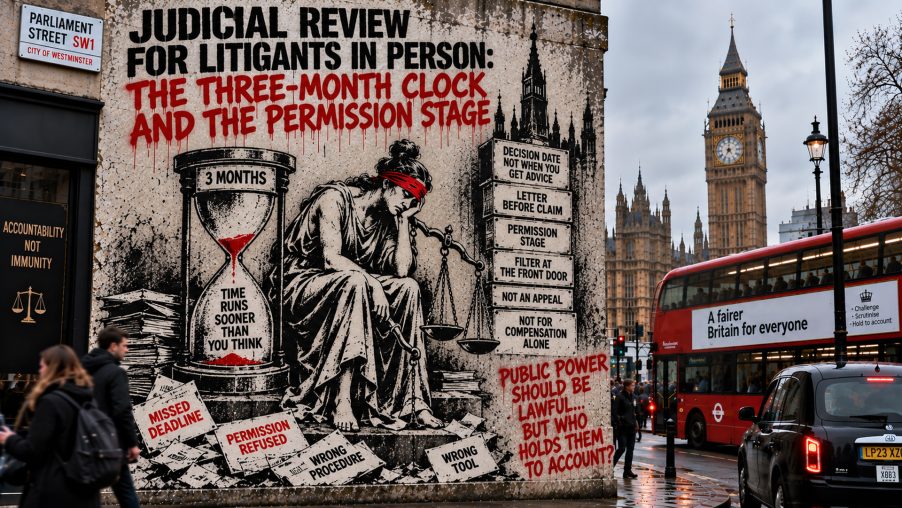
Judicial review asks the High Court to examine the lawfulness of a public body’s decision, action or failure to act — not to retake the decision. Every claim needs the court’s permission before it can proceed, and the claim form must be filed promptly and in any event within three months of the grounds arising. Both hurdles catch out litigants in person who assume the clock starts when they first get advice, or that a strong case will be heard on its merits. It will not be, unless it first survives the filter.
What judicial review is — and what it is not
Judicial review is the process by which the High Court supervises the exercise of public power. A claim for judicial review is a claim to review the lawfulness of an enactment, or of a decision, action or failure to act in relation to the exercise of a public function. The subject matter is therefore specific: decisions of government departments, local authorities, regulators, tribunals and other bodies exercising public functions. A dispute with a private company, a neighbour or an employer is not, on its own, judicial review territory.
The second boundary matters just as much. Judicial review is not an appeal: the court does not ask whether it would have reached a different decision; it asks whether the decision was lawful — whether the body acted within its powers, followed a fair process and took account of what it was required to consider. A decision can be wrong, unfair in outcome, or simply disliked, and still be lawful.
The remedies reflect that supervisory role. Where the claimant is seeking a mandatory order, a prohibiting order or a quashing order, the judicial review procedure must be used. Declarations and injunctions can also be sought. But a claim for judicial review may include a claim for damages only alongside one of those public law remedies — damages cannot be sought alone. If compensation is the real objective, judicial review is usually the wrong vehicle from the outset.
The three-month clock and the promptness requirement
The single most dangerous assumption in this area is that time runs from when you learn you might have a claim, or when you first speak to a lawyer. It does not. The claim form must be filed promptly and in any event not later than three months after the grounds to make the claim first arose — and the parties cannot extend that period by agreement between themselves. The starting point is objective. Where the claim asks the court to quash a judgment, order or conviction, the grounds are treated as having first arisen on the date of that judgment, order or conviction. For a challenge to an administrative decision, the practical starting point is the decision itself, not your discovery of its consequences.
Three months is the outside limit, not the working assumption. The promptness requirement stands independently of it, and where the High Court considers there has been undue delay it may refuse permission, or refuse relief, if it considers that granting relief would be likely to cause substantial hardship to, or substantially prejudice the rights of, any person, or would be detrimental to good administration. Some claims have far less time in any event: certain planning challenges must be filed within six weeks, and certain procurement challenges within 30 days.
Key distinction. The limitation clock runs from the grounds arising — typically the decision date — not from when you received advice. A letter before claim, a complaint to the body, or an ombudsman referral does not stop it.
The pre-action protocol: the letter before claim
Before any claim is issued, the Pre-Action Protocol for Judicial Review sets out the exchange the court expects. The claimant should send a letter before claim identifying the decision being challenged, the facts and the legal basis of the proposed claim, and the defendant should normally respond within 14 days. The protocol’s purpose is not ceremonial: it exists to identify the issues, to test whether the dispute can be resolved without proceedings, and to give the public body the opportunity to change or explain its decision before the court is troubled.
Two practical consequences follow. First, a well-drafted letter before claim frequently produces a concession, a fresh decision or a fuller explanation — any of which can end the dispute. Second, compliance with the protocol does not affect the judicial review time limit: sending the letter, or waiting for a response, does not extend the three-month period. In genuinely urgent cases the protocol itself accepts that a claim should be made immediately. The safe discipline is to draft the letter early, work on the claim form in parallel, and never let correspondence consume the clock.
What the permission stage actually screens for
Judicial review is unusual among civil claims because it cannot proceed on issue alone. The court’s permission to proceed is required in every claim for judicial review. The court cannot grant permission unless it considers that the claimant has a sufficient interest in the matter to which the claim relates. The court will generally consider the question of permission on the papers, without a hearing, in the first instance.
The filter is not a formality. The judge reading the papers is asking whether the grounds disclose an arguable case, whether the claimant has standing, whether the claim is in time and prompt, whether an adequate alternative remedy exists, and — since 2015 — a statutory merits screen: if it appears to the court to be highly likely that the outcome for the claimant would not have been substantially different if the conduct complained of had not occurred, the court must refuse permission, unless it considers it appropriate not to for reasons of exceptional public interest.
The published figures show how hard the filter bites. In the Ministry of Justice’s provisional statistics for April to June 2026, 220 claims reached the permission stage; 130 were refused permission, 53 were granted permission in full or in part, and 32 were recorded as totally without merit. Most claims reaching a permission decision in that quarter were therefore refused. A refusal on the papers is not quite the end: the claimant cannot appeal but may request that the decision be reconsidered at an oral hearing, and that request must be filed within seven days of service of the reasons — unless the court has recorded the application as totally without merit, in which case the right to reconsideration is lost.
When judicial review is the wrong tool
The honesty point is this: judicial review is a remedy of last resort, not first resort. The pre-action protocol states that judicial review should only be used where no adequate alternative remedy, such as a right of appeal, is available, and it directs parties to consider negotiation, the body’s own complaints or review procedures, the ombudsmen and mediation before litigating. A claimant who skips an obvious appeal route risks being refused permission precisely because that route existed.
The decision was made by a body exercising a public function; there is no adequate statutory appeal; the complaint is about lawfulness, process or rationality; and you can still act promptly within the time limit.
A right of appeal exists to a tribunal or court; the grievance is poor service or maladministration rather than unlawfulness; compensation is the real aim; or the decision is many months old and the grounds arose long ago.
The alternatives are not consolation prizes. A statutory appeal can revisit the merits, which judicial review cannot. A complaint to the relevant ombudsman can address maladministration without a court fee. Internal review procedures sometimes correct the decision outright. Choosing the wrong route does not merely waste the issue fee — it can consume the time limit for the right one.
If you proceed: what the claim demands
The claim form is not a placeholder. It must include or be accompanied by a statement of facts and a statement of grounds — together no more than 40 pages — identifying each ground of challenge in separate numbered paragraphs and the provision or principle of law said to have been breached. The statement of grounds is what the permission judge will actually read, so vague grievance needs to become identified public law error. Once issued, the claim form must be served on the defendant, and on any interested party, within seven days.
Two features of the process work in a litigant in person’s favour and deserve to be known. The first is the duty of candour: the defendant public body is expected, in its detailed grounds or evidence, to identify the relevant facts and the reasoning underlying the decision under challenge. The second is that the court’s own guidance is written for you: the Administrative Court Judicial Review Guide, now in its 2025 edition, is prepared for litigants in person as well as represented parties — while making clear that litigants in person are expected to comply with the Civil Procedure Rules and practice directions in the same way as lawyers.
None of this removes the hard truth at the front of this article. Permission is a real filter, the clock is short and objective, and the claim documents carry the whole weight of the case at the stage that decides most claims. Preparation before issue is not a luxury in judicial review; it is the case.
The closing point
The merits matter. But in judicial review, procedure decides whether the merits are ever heard. The three-month clock runs from the grounds, the permission stage screens for arguability, standing, delay and alternative remedies, and the papers you file do the persuading. The cheapest advantage a litigant in person can buy is early: identify the decision date, test the alternatives, and treat the claim form as the case itself.
Source anchors
These primary sources support the procedural framework described above. They establish the rules; they do not decide any individual case.
The judicial review procedure: permission, the promptness and three-month time limit, service and reconsideration of refusals.
The statutory basis of judicial review: sufficient interest, undue delay, and the “highly likely not substantially different” filter.
The letter before claim, the 14-day response norm, and the warning that the protocol does not extend the time limit.
The court’s own guide to every stage of a claim, written for litigants in person as well as lawyers.
Ministry of Justice official statistics on judicial review applications, permission decisions and totally without merit findings.
Judicial review route decision point
Get a free written assessment of the route
Legal Lens can structure a preliminary written review of a potential judicial review: whether the decision is amenable to challenge, whether another route fits better, and where you stand on the clock.
Judicial review, statutory appeal, complaint or ombudsman — and why the distinction controls the outcome.
When the grounds first arose, what the three-month and promptness requirements mean on your dates, and what runs first.
Assessment outputs
Amenability, grounds, alternative routes and live deadlines.
The decision, correspondence and documents that carry a permission application.
Independent Legal Lens consultancy. Legal Lens is not a regulated solicitors’ firm. A preliminary assessment is not a substitute for regulated legal advice where that is needed.