
 Written by
 Civil procedure – early disposal – practical guidance
Two applications can end a civil case before it ever reaches trial. Litigants in person usually meet them first as the respondent, on the receiving end of a well-drafted solicitor’s letter. This guide explains strike out under CPR rule 3.4 and summary judgment under Part 24, the deadlines each side must meet, and when it is legitimate for an unrepresented party to use the same procedures in return.
Snapshot
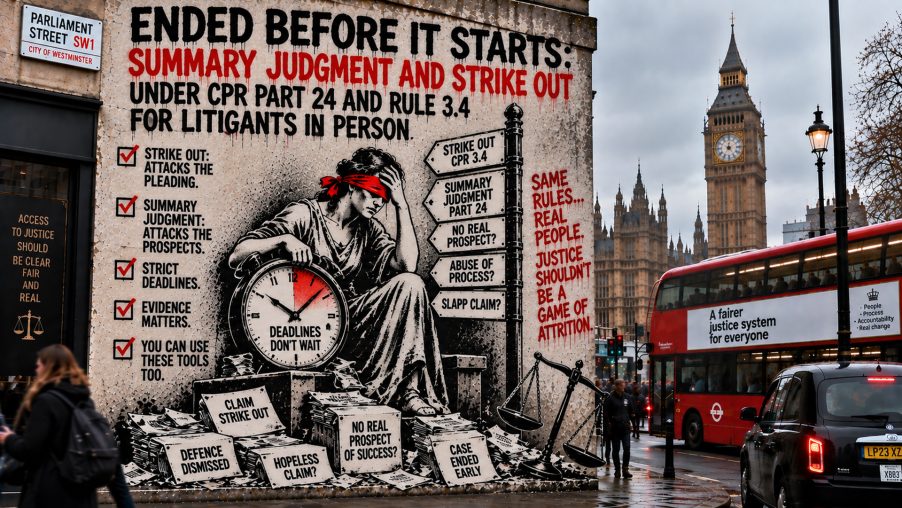
Strike out and summary judgment do different work. Strike out attacks the pleading itself: the statement of case discloses no reasonable grounds, is an abuse of the court’s process, or breaks a rule, practice direction or order. Summary judgment attacks the prospects: the claim, defence or issue has no real prospect of success and there is no other compelling reason for a trial. Both run to tight evidence deadlines, and both can be resisted with discipline — or used, legitimately, by a litigant in person facing a hopeless claim or defence.
Two routes to an early end
Litigants in person usually first meet these procedures in a solicitor’s letter announcing that the claim or defence is hopeless and will be struck out or summarily dismissed unless it is withdrawn. The tone is confident by design; what matters is the rule invoked, because the two procedures have different targets, tests and timetables.
Strike out under rule 3.4 of the Civil Procedure Rules is aimed at the statement of case — the claim form, particulars of claim or defence. The court may strike it out if it discloses no reasonable grounds for bringing or defending the claim, if it is an abuse of the court’s process or otherwise likely to obstruct the just disposal of the proceedings, or if there has been a failure to comply with a rule, practice direction or court order.
Summary judgment under Part 24 is aimed at the merits. The court may give summary judgment against a claimant or defendant, on the whole of a claim or on a single issue, where it considers that the party has no real prospect of succeeding on the claim, defence or issue and there is no other compelling reason why the case or issue should be disposed of at a trial. That distinction matters: a well-pleaded case can still have no real prospect of success, and a badly pleaded one can sometimes be cured by amendment.
Strike out — rule 3.4
Attacks the pleading or the conduct of the case: no reasonable grounds, abuse of process, or failure to comply.
Summary judgment — Part 24
Attacks the prospects: no real prospect of succeeding, and no other compelling reason for a trial. Evidence is central; strict filing deadlines apply.
The two are not mutually exclusive. Practice Direction 3A notes that a party who believes an opponent’s case has no real prospect of success on the facts, or is bound to succeed or fail on a point of law, may apply under rule 3.4 or for summary judgment under Part 24, or both.
Strike out under rule 3.4: the four grounds
The first ground — no reasonable grounds — is about legal coherence. Practice Direction 3A gives the working examples: particulars that set out no facts indicating what the claim is about, particulars that are incoherent and make no sense, and particulars whose facts, even if true, disclose no legally recognisable claim. A defence that is a bare denial, or whose facts would not amount to a defence in law even if true, is exposed in the same way. The question is not whether the case will win, but whether it is a recognisable case at all.
The second ground, abuse of process, covers proceedings that are vexatious, scurrilous or obviously ill-founded, or that obstruct the just disposal of the case. The third — failure to comply with a rule, practice direction or court order — is about conduct rather than substance, and is usually the most fixable: the problem is compliance, not the merits.
The fourth ground is new — it was added to the Civil Procedure Rules in 2025 — and narrow. Rule 3.4(2)(d) allows the court to strike out a claimant’s statement of case where the claim is strategic litigation against public participation — a SLAPP claim within the meaning of section 195 of the Economic Crime and Corporate Transparency Act 2023 — and the claimant has failed to show that it is more likely than not the claim would succeed at trial. Section 195 defines a SLAPP claim as one whose purpose or effect is to restrain the defendant’s freedom of speech about information connected to economic crime, where disclosure would serve the public interest in combating economic crime, and the claimant’s behaviour is intended to cause harassment, alarm, distress, expense or other harm beyond that ordinarily encountered in properly conducted litigation. The definition is confined to speech about economic crime; it is not a weapon against hostile litigation generally.
Own-initiative strike out. The court can strike out a statement of case of its own initiative, and court officers can refer apparently hopeless claim forms and defences to a judge. If the court strikes out a claim it considers totally without merit, its order must record that fact and it must at the same time consider whether to make a civil restraint order — a mark that makes future applications harder. A threat to seek a “totally without merit” recording is a serious escalation, not a formality.
Summary judgment under Part 24: “no real prospect”
Part 24 exists so that the court may decide a claim or issue without a trial. It is available against a claimant in any type of proceedings, and against a defendant in almost all types — the exception being certain proceedings for possession of residential premises against a mortgagor, tenant or contract-holder.
The test is the heart of it. “No real prospect” does not mean the court thinks the case will probably lose. The case law — Swain v Hillman in the Court of Appeal, gathered into a working summary by Mr Justice Lewison in Easyair v Opal Telecom — establishes that a real prospect means a realistic, not fanciful, prospect carrying some degree of conviction; that the court must not conduct a mini-trial; that it need not take every factual assertion at face value, particularly where contemporaneous documents contradict it; and that it must consider the evidence reasonably expected to be available at trial, not only what is before it on the day. Where an application raises a short point of law or construction, the court may grasp the nettle and decide it — and a respondent whose case is bad in law gains nothing from postponement.
The second limb — no other compelling reason for a trial — is the respondent’s friend. A case that needs disclosure, cross-examination or fuller investigation has a reason to be tried, even if the prospects look thin on paper.
The timetable: notice, evidence and disposal
Part 24 builds in procedural protection, and knowing the numbers is the respondent’s first defence. A claimant may not apply for summary judgment until the defendant has filed an acknowledgment of service or a defence, unless the court gives permission or a rule or practice direction says otherwise. Where a hearing is fixed, the respondent must be given at least 14 days’ notice of the date and of the issues to be decided. And if an application is made before a defence has been filed, the defendant by or against whom it is made need not file a defence before the hearing.
The respondent must be given at least 14 days’ notice of the date and the issues to be decided (rule 24.4(5)).
Written evidence relied on by the respondent must be filed and served at least 7 days before the hearing (rule 24.5(3)(a)).
The applicant’s evidence in reply must be filed and served at least 3 days before the hearing (rule 24.5(3)(b)).
The application notice itself must do specific work: state that the application is for summary judgment, identify concisely any point of law or document relied on, set out or attach the applicant’s evidence, state the belief that the respondent has no real prospect of succeeding, state that the applicant knows of no reason why disposal should await trial, and draw the respondent’s attention to their right to rely on evidence opposing the application. A notice that skips these steps is a target for objection.
On disposal, the court may give directions about the filing and service of a defence and further case management directions, and may make its order subject to conditions — including payment of money into court. On a strike-out, the court may make any consequential order it considers appropriate, and a judge who strikes out a statement of case at a hearing may enter judgment for the other party. The court’s toolbox is wider than the win-or-lose framing of the covering letter suggests.
Resisting an application
First, identify which procedure is being used and which limb is relied on; the answer shapes the response. Against a strike-out for incoherent pleading, the answer is the pleading: do the facts as pleaded, taken at their highest, amount to a recognisable claim or defence, and would amendment cure the drafting? Against a compliance strike-out, the answer is the breach: its seriousness, its reason, and what has been done to put it right. Against summary judgment, the answer is the evidence — material showing a realistic prospect of success or a compelling reason why the facts need a trial.
Identify the rule, the ground, the evidence relied on and the hearing date. Diarise the 7-day evidence deadline immediately.
Meet the actual test: the grounds in the pleading, the abuse alleged, the breach and its cure, or the prospects of success.
A witness statement with the facts and key documents exhibited, filed and served at least 7 days before the hearing.
Where the weakness is curable, a draft amendment or prompt compliance is often the strongest response.
Two temptations should be resisted: treating the letter as the decision — the court, not the sender, applies the test — and treating the hearing as a rehearsal of the whole case rather than the narrow question the rules pose.
Using the procedure yourself
The same procedures are open to a litigant in person facing a hopeless claim or defence, and there is nothing aggressive about using them properly. A defendant served with particulars that disclose no legally recognisable claim may apply to strike them out or for summary judgment; a claimant met with a bare-denial defence may do the same against the defence. Applications should be made as soon as possible and, if possible, before allocation. A defendant who applies to strike out need not file a defence before the hearing.
Legitimacy has conditions. The procedure is for cases that fail the tests, not for cases that are merely inconvenient. A weak application wastes the court’s time and costs the applicant money. The pre-application question is the one the court will ask: does the statement of case disclose a recognisable claim or defence, and is there any realistic prospect of success or compelling reason for a trial? If either answer is yes, the application is the wrong tool.
Source anchors
These anchors support the procedural framework described in this article. They do not determine the outcome of any individual application.
The current rules on availability, grounds, timing, evidence deadlines and disposal of summary judgment applications.
The four strike-out grounds, including the SLAPP limb, plus consequential orders and the “totally without merit” recording.
Worked examples of hopeless pleadings, own-initiative powers, and the choice between rule 3.4 and Part 24.
The statutory definition of a “SLAPP claim” — speech about economic crime, restrained through litigation behaviour.
Mr Justice Lewison’s summary at [15] of the “real prospect of success” principles, quoting Swain v Hillman.
The closing point
Early disposal procedures decide which cases are ever heard on their merits. Faced with one, the litigant in person who knows the rule, the ground and the timetable is no longer the soft target the covering letter imagined — and the same knowledge, used honestly, lets them ask the court to end a hopeless case brought against them.
Early disposal decision point
Get a free written assessment of the application and the response
Legal Lens can structure a preliminary written review of a strike-out or summary judgment application: the ground relied on, the evidence timetable, and the response options that remain open.
Which rule and limb the application actually invokes, and what the test requires of each side.
The notice period, the 7-day and 3-day evidence windows, and what needs filing first.
Assessment outputs
The ground relied on, the test it carries, and the response routes.
Notice and evidence deadlines sequenced against the hearing date.
Independent Legal Lens consultancy. Legal Lens is not a regulated solicitors’ firm. A preliminary assessment is not a substitute for regulated legal advice where that is needed.