
 Written by
 Civil procedure – interim remedies – practical guidance
A defendant can admit liability and still keep the claimant waiting months while quantum is assessed. For a litigant in person in financial difficulty, that delay has a price: it can force an undervalued settlement. Section V of CPR Part 25 exists to stop the clock being used as a weapon. This is how the interim payment machinery works, from both sides of the application.
Snapshot
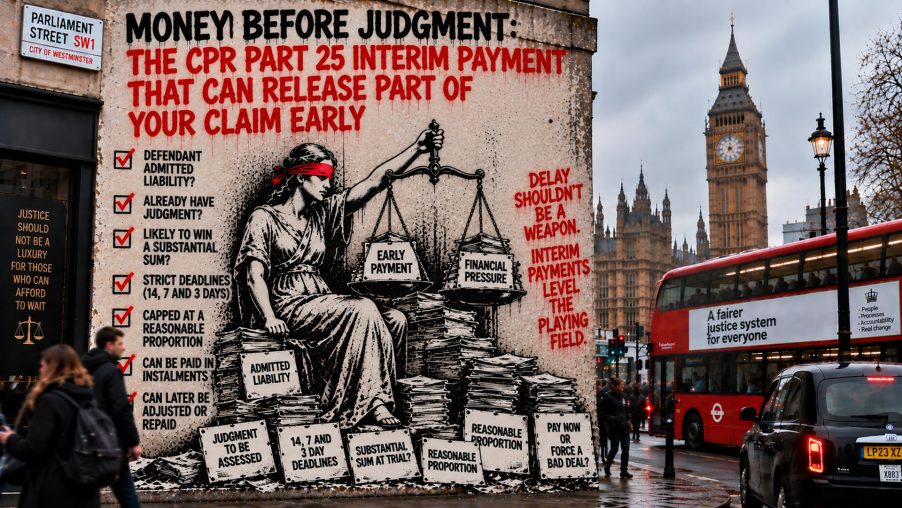
An interim payment order is money on account of a final judgment that has not yet been assessed. The court can order one where the defendant has admitted liability, where judgment for damages to be assessed has already been entered, or where the claimant would clearly win a substantial sum at trial. The amount is capped at a reasonable proportion of the likely award, the deadlines are short and fixed, and the order can later be adjusted or repaid. The machinery runs in both directions: it is a route to early money for a claimant, and a measured risk for a defendant.
Admitted liability, unpaid claimant
Civil claims have two questions, and they do not move at the same speed. Liability is who pays; quantum is how much. A defendant can concede the first within weeks and then legitimately spend many months arguing about the second: medical evidence, loss of earnings schedules, expert reports. The claimant’s liability argument has won, but the money has not moved. For a litigant in person carrying the cost of the dispute on a household budget, that gap is where the pressure builds, and where a settlement well below the real value of the claim starts to look attractive.
CPR Part 25 lists among the court’s interim remedies an order for payment by a defendant on account of any sum, other than costs, which the court may hold the defendant liable to pay. That is the interim payment: not an admission-driven shortcut to the whole claim, but a disciplined release of part of it while quantum catches up. It is discretionary and capped, but it changes the economics of waiting.
The gateways in rule 25.23
The court may only make an interim payment order where one of the conditions in rule 25.23 is satisfied. In practice, three do almost all the work: the defendant has admitted liability to pay damages or another sum of money; the claimant has already obtained judgment against that defendant for damages, or another sum, to be assessed; or the court is satisfied that, if the claim went to trial, the claimant would obtain judgment for a substantial amount of money against that defendant. A fourth gateway covers claims for possession of land where the defendant would be liable for occupation charges in any event.
The third gateway is the contested one. The question is not the trial-standard balance of probabilities in the round; it is whether the court is satisfied the claimant would recover a substantial amount — a high threshold, and one the evidence has to carry.
There is a special rule for claims against two or more defendants. Where the court is satisfied the claimant would obtain judgment for a substantial amount against at least one defendant but cannot determine which, it may order an interim payment against any of them, but only where all the defendants are insured in respect of the claim, are public bodies, or are covered by an insurer under section 151 of the Road Traffic Act 1988 or by the Motor Insurers Bureau. The logic is distributive: where every defendant is good for the money, the risk of paying the wrong one can be corrected between them later.
Timing and the 14, 7 and 3-day deadlines
Two timing rules frame the application. A claimant may not apply before the end of the period for filing an acknowledgment of service applicable to the defendant against whom the order is sought; and a claimant may make more than one application, so an early refusal on the evidence is not the end of the route. The first rule matters in fast-moving claims: the application cannot be used to ambush a defendant before they have even had the chance to acknowledge the claim form.
The service timetable is fixed and asymmetric. The application notice, supported by evidence, must be served at least 14 days before the hearing. A respondent who wishes to rely on written evidence must file and serve it at least 7 days before the hearing. An applicant who wishes to rely on evidence in reply must file and serve it at least 3 days before the hearing. These are minimum periods, not targets.
Served on the respondent, with the supporting evidence, at least 14 days before the hearing.
Filed and served on every other party at least 7 days before the hearing.
The applicant’s responsive evidence, filed and served at least 3 days before the hearing.
Under Part 23, which contains the general rules about applications, an application notice must state what order is sought and briefly why, and the default minimum service period is 3 days; the interim payment rule substitutes its own longer 14-day period. HMCTS publishes the standard application notice, form N244, with guidance notes for completing it. For most litigants in person, the N244 plus a witness statement is the working package.
Numbering trap. Practice Direction 25B still cross-refers to the old rule numbers 25.6 to 25.8 for the evidence and adjustment provisions. Those provisions now live at rules 25.20 to 25.23. Check the current numbering before citing the practice direction in an application.
What the evidence must show
Rule 25.22 prescribes the content of the supporting evidence. It must deal with the sum sought; the items or matters in respect of which the payment is sought; the sum for which final judgment is likely to be given; the reasons for believing the rule 25.23 conditions are satisfied; and any other relevant matters. In personal injury claims it must include details of special damages and past and future loss, and in a Fatal Accidents Act claim, details of the persons on whose behalf the claim is made. Supporting documents must be exhibited, including any medical report in a personal injury claim.
The list is the test in working clothes. An application that asks for £40,000 “on account” without showing how the likely final figure is built up gives the court nothing to proportion. The disciplined version works like a mini-quantum: a realistic final award, an honest explanation of why the gateway is met, and a requested figure that plainly sits well inside the conservative end of the range. Evidence turns confusion into an argument; here, evidence turns an admission into cash.
The cap, instalments and protected parties
The court must not order an interim payment of more than a reasonable proportion of the likely amount of the final judgment, and in setting the figure it must take into account contributory negligence and any relevant set-off or counterclaim. Both directions of that rule deserve attention. The cap protects the defendant from overpayment that may never be recovered. But the same calculation disciplines the claimant: the application should be pitched at the cautious proportion, not the headline claim value, because an ambitious figure hands the respondent an easy point.
The court may order payment by instalments, and if it does the order must set out the total amount, the amount of each instalment, the number and dates of instalments, and to whom payment is to be made. Instalments are a practical compromise where the defendant’s cash flow is the real objection: they release money steadily without a single large transfer ahead of assessment.
Where the claim is brought by a child or a protected party, the permission of the court must be obtained even for a voluntary interim payment. The safeguard exists because such payments may interact with the court’s wider protection of a vulnerable party’s damages.
Responding, adjusting and repaying
The machinery reads differently from the defendant’s side. An interim payment is not a concession that the claim is worth what the claimant says; it is a payment on account, and the final reckoning happens at assessment. The court may adjust any interim payment, whether or not it has yet been made. It may order all or part of it to be repaid, vary or discharge the order, or order one defendant to reimburse another who has paid. Where a defendant has paid more than their total liability under the final judgment, the court may award them interest on the overpaid amount from the date of payment. The court can also make an order under the interim payment rule of its own initiative when it disposes of the claim or part of it.
The respondent’s evidence, due seven days before the hearing, is where the overpayment risk is put on the record: the realistic range of the final award, the contributory negligence case, any set-off or counterclaim. A defendant who ignores the application and loses by default has surrendered the argument about proportion, which is usually the argument that matters most.
If you are applying
Build the likely final figure first, then ask for a conservative proportion of it. Explain the gateway, exhibit the documents, and serve the package at least 14 days before the hearing.
If you are responding
Contest proportion, not existence. Put the realistic award range, contributory negligence and any set-off into evidence at least 7 days before the hearing, and remember repayment and interest run the other way.
Personal injury: the benefits deduction
In a personal injury claim where the claim falls under the Schedule 2 heads and the defendant is liable to pay a recoverable amount to the Secretary of State, a contested interim payment application engages the compensation recovery scheme. The defendant must obtain a certificate from the Secretary of State and file a copy at the hearing; the order must set out the deductible amount; and the claimant is paid the net amount, although the gross amount is used when the interim payment is brought into account after the final judgment. The claimant should never read the net receipt as the full value of what was ordered.
The deduction works head-by-head under the Social Security (Recovery of Benefits) Act 1997. Schedule 2 lists three heads of compensation, for earnings lost, cost of care and loss of mobility, and the recoverable benefits that can be set against each. Section 8 reduces the compensation attributable to each head by the benefits shown against that head, to nil if necessary; a benefit cannot be deducted from a different head. A claimant who has received benefits during the relevant period may see a visibly smaller net payment than the order’s headline figure suggests.
What the trial judge is never told
The fact that a defendant has made an interim payment, whether voluntarily or under an order, must not be disclosed to the trial judge until all questions of liability and quantum have been decided, unless the defendant agrees. The rule exists to keep the trial clean: a judge who knows money has already moved might read it as a signal about liability or value. Litigants in person should treat this as a live trap. Do not exhibit the interim order to the trial bundle and do not mention it in trial skeleton arguments. The payment is brought into account afterwards, in the arithmetic of the final judgment, not before.
The closing point
Delay is not neutral in litigation; it redistributes the risk of the case towards whoever can least afford to wait. The interim payment rules are the counterweight the rules committee built for exactly that problem, and they reward the party who does the arithmetic early: a realistic final figure, a clearly satisfied gateway, a conservative proportion, and the deadlines met in the right order. The merits matter. But procedure decides when the money moves.
Source anchors
These anchors support the procedural framework described in this article. They are the primary texts; they do not resolve how the discretion will be exercised in any individual case.
Rules 25.20 to 25.25: the cap, applications, evidence, conditions, compensation recovery and the disclosure restriction.
Supplements Part 25 on evidence, instalments, compensation recovery and adjustment of the final judgment figure; note the pre-renumbering rule references.
What an application notice must contain and the default service rules that sit behind the interim payment timetable.
The head-by-head deduction of recoverable benefits from compensation, which drives the net figure in personal injury interim payments.
The standard application notice and official guidance notes for asking the court to make an order within existing proceedings.
Interim payment decision point
Get a free written assessment of the application
Legal Lens can structure a preliminary written review of a proposed interim payment application or response: the gateway, the likely-figure calculation, the evidence package and the service timetable.
Whether an admission, an existing judgment or the substantial-amount test opens the route.
A realistic final-award range, a defensible requested figure, and the 14, 7 and 3-day sequence mapped to the hearing date.
Assessment outputs
The gateway relied on, the evidence gaps and the service sequence.
Likely final award, conservative proportion and instalment options.
Independent Legal Lens consultancy. Legal Lens is not a regulated solicitors’ firm. A preliminary assessment is not a substitute for regulated legal advice where that is needed.