
 Written by
 Civil procedure – small claims track – costs
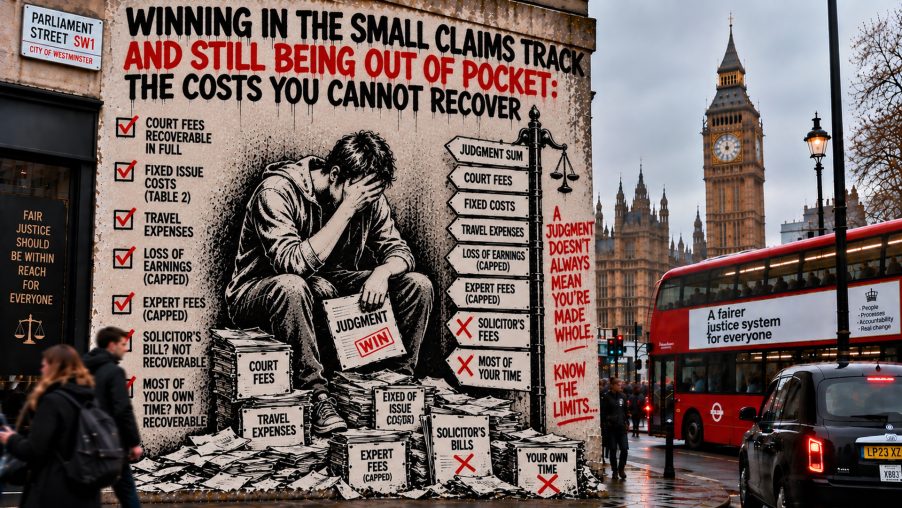
A judgment in your favour is not the same thing as being made whole. On the small claims track the winner can recover only a closed list of costs: court fees, a small fixed sum for issuing, capped expert fees and a capped daily rate for lost earnings. The lawyer’s bill, and most of the value of your own time, stays with you even when you win. This guide sets out exactly what rule 27.14 allows, with a worked schedule for a typical claim and the narrow exceptions where the limits lift.
Snapshot
The small claims track limits costs by design. Rule 27.14(2) of the Civil Procedure Rules is exhaustive: the court may not order one party to pay another’s costs except under the heads the rule lists. Court fees and reasonable travel expenses come back in full; fixed commencement costs, expert fees and loss of earnings are capped; the ordinary costs of instructing solicitors or counsel do not appear in the list at all. The limits lift only in defined situations: unreasonable conduct in the proceedings, and claims that move between tracks.
Winning, and still out of pocket
The surprise usually arrives after the hearing. A claimant proves the debt or the defective work, the district judge gives judgment, and the winner then asks for “their costs”: the solicitor who checked the particulars, the evenings spent on witness statements, the day off work to attend. On any other track, some version of that claim would be routine. On the small claims track it runs into a rule that most litigants in person meet only when it is too late to plan around.
The small claims track is the normal home for modest money disputes. The Civil Procedure Rules make it the normal track for most claims with a financial value of not more than £10,000, subject to special lower limits for personal injury and housing disrepair claims and an exclusion for harassment and unlawful eviction claims relating to residential premises. GOV.UK’s guidance on making a court claim for money explains that a claim can be started online or by post, and suggests mediation as a route that could be quicker and cheaper than going to court. The whole track is engineered for people without lawyers: hearings are informal, the strict rules of evidence do not apply, and the court may adopt any method of proceeding it considers fair. The costs rules are part of that engineering. If nobody is expected to need a lawyer, nobody is expected to pay the other side’s.
The closed list in rule 27.14
Rule 27.14(2) begins with a prohibition, not an entitlement: the court may not order a party to pay a sum to another party in respect of that other party’s costs, fees and expenses, including those relating to an appeal, except under the heads the rule goes on to list. The word “except” is doing all the work. A district judge has no general discretion to be generous to a deserving winner, because the discretion is bounded by the list.
The routine recoverable heads are: the fixed costs attributable to issuing the claim, calculated under Table 2 of Practice Direction 45; any court fees paid by the winning party; the reasonable expenses of a party or witness travelling to and from a hearing or staying away from home to attend one; a capped sum for loss of earnings or loss of leave; a capped sum for an expert’s fees; and, in proceedings that included a claim for an injunction or an order for specific performance, a capped sum for legal advice and assistance relating to that claim. Two further narrow heads, covering fixed protocol costs in certain road traffic and employers’ or public liability claims and approved transcript costs on appeal, rarely arise in an ordinary money claim.
What the list leaves out. Everything not on the list is unrecoverable from the other side, however reasonable the spending was. That includes the cost of instructing solicitors or counsel to draft, advise or appear, and it includes almost all of the time you spent preparing your own case.
If you win
You recover the judgment sum plus the listed heads: fees in full, the fixed issue costs, the capped daily rate and capped expert fees. The rest of your spend is the price of the victory.
If you lose
Your exposure is the other side’s identical, capped list. The rule that limits what you can recover also shields you from a large adverse costs bill, which is the track’s other kindness.
The numbers: a worked schedule
What the list means in money is best seen as a schedule. Take a typical claim: £4,800 for defective building work, allocated to the small claims track, won after a half-day final hearing at which a single jointly instructed expert’s report was relied on. The caps and fixed sums below are the current rule figures; the spend amounts are illustrative.
Court fees paid by the winning party come back in full, at the amount actually paid. GOV.UK’s fees guidance puts money-claim issue fees at between £35 and £10,000 depending on the amount claimed, and treats them as distinct from legal costs.
Table 2 of Practice Direction 45 fixes the commencement costs in a money claim at £50, £70, £80 or £100 depending on the claim band; a claim valued over £1,000 and not over £5,000, where the court serves the claim form, carries £80.
Practice Direction 27A caps recovery for loss of earnings or loss of leave at £95 per day for each person, whether party or witness, however high the actual day’s wage.
The recoverable sum for an expert’s fees is capped at £750 for each expert. The remaining £150 of the invoice is the claimant’s own.
Reasonable travel and overnight expenses of a party or witness are recoverable as actually incurred, without a fixed cap.
No head in the rule 27.14 list covers the ordinary costs of legal representation in a small claim.
The list contains no head for a party’s own time spent preparing the case.
On top of the £4,800 judgment: fees in full, plus £959 of capped items, from a spend of well over £3,300 once time is priced in.
Read the schedule from the losing defendant’s side too: their exposure is the same capped list, which is why the track is safe enough to use without representation. The austerity cuts in both directions, and seeing that early changes how both sides should approach settlement.
Why the lawyer’s bill stays with you
The rule’s silence on representation costs is deliberate: the track assumes both parties present their own cases at an informal hearing. Paying for representation is permitted, but it is treated as a private choice, and the fee does not transfer to the loser. The same limits also catch informal advocacy help: the caps apply to any fee or reward charged by a lay representative exercising a right of audience under section 11 of the Courts and Legal Services Act 1990.
There is one narrow door. Where the proceedings included a claim for an injunction or an order for specific performance, the court may allow a sum not exceeding £260 for legal advice and assistance relating to that claim. That figure has not kept pace with anything, and in a straightforward money dispute it will usually be irrelevant. The practical consequence deserves to be said plainly: paying a solicitor to run a small claim to trial is a consumption decision, not an investment, because the bill will not come back. Unbundled help at the pressure points, a single conference to check the particulars or the schedule of loss, can still be money well spent. But it should be priced as money you will not see again.
Your own time: the £24-an-hour rule
Elsewhere in the civil courts, an unrepresented party’s own time is not worthless. The Litigants in Person (Costs and Expenses) Act 1975 provides that, where a litigant in person’s costs are ordered to be paid by another party in civil proceedings in the county court or the Senior Courts, sums may be allowed in respect of any work done and any expenses and losses incurred by the litigant in or in connection with the proceedings. CPR rule 46.5 gives that principle its working form: a litigant in person can be allowed costs for the same categories of work and disbursements a legal representative could have claimed, but except for disbursements the total may not exceed two-thirds of what would have been allowed to a representative; time spent is compensated at the financial loss the litigant can prove, or, where no financial loss can be proved, at the rate set out in Practice Direction 46. Practice Direction 46 currently fixes that rate at £24 per hour.
Two qualifications matter on the small claims track. Rule 46.5 presupposes that a costs order can be made at all, and rule 27.14(2) controls what can be ordered once a claim is on this track. Its list contains no head for a party’s own preparation time, so the £24-an-hour mechanism has little room to operate here. In practice the £95-per-day head is the track’s answer to your own time, and it is aimed at attending the hearing, not the weeks of preparation before it. Budget on that basis.
When the limits lift
The first exception is conduct. The court may order such further costs, assessed by the summary procedure, as it sees fit against a party who has behaved unreasonably; and although a party’s rejection of a settlement offer does not of itself amount to unreasonable behaviour, the court may take the rejection into account when applying that test. The exception is aimed at behaviour in the proceedings, not the merits of the dispute, and it operates in a track where Part 36, the formal settlement-offers regime with its automatic costs consequences, is one of the Parts disapplied to small claims — so a refusal to settle is only ever one factor, never a trapdoor.
The second exception is movement between tracks. Where a claim is re-allocated from the small claims track to another track, the costs allowed are those of the new track as if the claim had been allocated to it from the outset; where a claim comes down to the small claims track from the multi-track, rule 27.14 applies to the period before re-allocation as well as after it, unless a court order or rule provides otherwise. A defendant whose conduct persuades the court the claim belongs on a higher track can therefore find the ordinary costs rules waiting. There is also a quieter rule for partial admissions: where a claim issued for more than the small claims limit reaches that track only because the defendant’s admission of part reduces the amount in dispute, the court may, on entering judgment for the admitted part, allow costs in respect of the proceedings down to that date.
The closing point
Winning on the small claims track is worth doing when the judgment itself is worth having. The prize is the money claimed; the costs regime will only ever hand back a fraction of what the fight cost. So price the dispute before you issue: assume every pound of spend is unrecoverable except the fees, the fixed sum and the caps, and treat any offer that beats that arithmetic seriously. If the numbers only work when a lawyer’s bill comes back, the numbers do not work.
Source anchors
These anchors support the procedural framework described in this article. They are the primary texts; the caps, fixed sums and hourly rate quoted are the current figures in those texts at the review date.
Rule 27.1 (track scope), rule 27.8 (informal hearings), rule 27.14 (the closed costs list) and rule 27.15 (re-allocation between tracks).
Paragraph 7: the £260 legal-advice cap, the £95 daily loss-of-earnings cap and the £750 per-expert cap.
Table 2: the fixed commencement costs (£50 to £100 by claim band) recoverable for issuing a money claim.
The two-thirds cap and the categories of work and disbursements an unrepresented party can claim where a costs order is available.
Paragraph 3.4 (the £24 hourly rate) and paragraph 7.1(3) (pre-allocation costs where an admission reduces a claim into the small claims track).
Section 1: the statutory basis for allowing sums for work done, expenses and losses incurred by an unrepresented party.
The current guidance on money-claim issue fees (£35 to £10,000 by claim value), distinct from legal costs, and the EX50 fee lists.
Claim value and costs decision point
Get a free written assessment of the claim and its costs
Legal Lens can structure a preliminary written review of a proposed or defended small claim: what the costs rules would return, the spend that will not come back, and the evidence the hearing will actually turn on.
What the rule 27.14 list would hand back in your case, and what stays with you on either outcome.
Track fit, settlement posture and whether the claim’s value justifies the spend it will take to win it.
Assessment outputs
Claim value, route, documents and live disputes.
The recoverable heads, the caps, and the spend that stays with you.
Independent Legal Lens consultancy. Legal Lens is not a regulated solicitors’ firm. A preliminary assessment is not a substitute for regulated legal advice where that is needed.