
 Written by
Financial services – ombudsman complaints – award limits
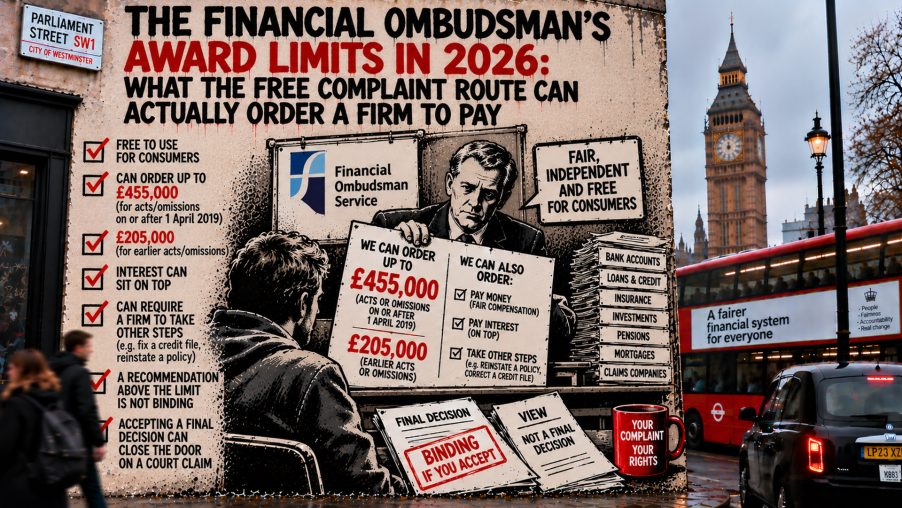
The Financial Ombudsman Service is free, and it can order a financial business to pay up to £455,000 for complaints referred on or after 1 April 2026 about acts or omissions on or after 1 April 2019. But the limit is a limit on compulsion, not on fairness; the clock starts running long before most people realise; and accepting a final decision can close the door on a court claim. Here is what the 2026 rules actually say.
Snapshot
Most complaints about banks, insurers, lenders, advisers and claims management companies can go to the Financial Ombudsman Service at no cost, and the service handled around 305,000 new complaints in 2025. What it can order is bounded by two numbers that change every April: £455,000 where the act or omission happened on or after 1 April 2019, and £205,000 where it happened earlier. Only the limit is binding; anything above it is a recommendation the firm can refuse. Interest for being kept out of your money can sit on top. And the decision you accept at the end of the process is final in law, so the route you choose matters as much as the complaint you bring.
What the ombudsman can actually order
The ombudsman scheme exists because Parliament decided that these disputes should be “resolved quickly and with minimum formality by an independent person” – the words of section 225 of the Financial Services and Markets Act 2000, which established the scheme in Part 16 of the Act. Its operator, the Financial Ombudsman Service, covers the regulated financial activities a consumer is likely to encounter, since authorised firms carrying on regulated activities are obliged to be subject to its compulsory jurisdiction.
When a complaint is upheld, the toolkit is in some respects wider than a court’s. A determination can include a money award for fair compensation, but also a direction that the business take steps the ombudsman considers just and appropriate – reinstating a policy, correcting a credit file, reworking an account – whether or not a court could order those steps. A money award can carry interest at a rate and from a date specified in the award, and it is enforceable by the complainant through the courts under Part III of Schedule 17 to the 2000 Act; a direction is enforceable by injunction.
The part that attracts the headlines is the money. For complaints referred to the service on or after 1 April 2026 about acts or omissions that occurred on or after 1 April 2019, the award limit is £455,000. For complaints about acts or omissions before 1 April 2019, the limit is £205,000 – and complaints referred before 1 April 2019 remain subject to the older £150,000 limit. The limits are uprated each April, which is why older guides quoting £445,000 or £415,000 are now out of date: the figure that matters is the one in force when the complaint is referred, not when the loss happened.
The scale of the scheme is worth pausing on. The service’s own figures for 2025 record around 305,000 new complaints, a number cited by the High Court this year in Barclays Bank UK plc and others v Financial Ombudsman Service Ltd [2026] EWHC 1555 (Admin). This is not a niche remedy. For most consumers with a financial complaint, it is the remedy.
The limit is a cap on compulsion, not on fairness
The most common misunderstanding is that £455,000 is the most the ombudsman can say a complaint is worth. It is not. Section 229(5) of the 2000 Act draws the line precisely: a money award may not exceed the monetary limit, but where the ombudsman considers that fair compensation requires a larger amount, he may recommend that the respondent pay the balance. The award binds; the recommendation does not. A business that refuses the recommended excess breaks no rule.
The second misunderstanding runs the other way: that the cap swallows everything. It does not. Interest awarded because you were deprived of your money can sit on top of the limit. For complaints referred since 1 January 2026 the service typically uses simple interest at the time-weighted Bank of England average base rate plus one percentage point; for earlier referrals the typical rate was 8% simple. Where an accepted award is paid late – the usual deadline is 28 days after the business is told of acceptance – a default rate of 8% simple a year normally applies. On a large, long-running loss the interest element can be substantial.
Key distinction. £455,000 is the most a firm can be made to pay as a money award. It is not the most the ombudsman can say is fair, and it is not necessarily the total that changes hands once deprivation interest and late-payment interest are added.
Awards are also not confined to pounds lost. The FCA’s DISP rules permit a money award for financial loss – including consequential or prospective loss – and for pain and suffering, damage to reputation, or distress and inconvenience, whether or not a court would award on the same basis. Costs awards exist but are uncommon, and the Act forbids the costs rules from making a complainant pay the business’s costs; only improper or unreasonable conduct, or responsibility for unreasonable delay, can expose a complainant to a contribution towards the scheme’s own resources. The structure is deliberately one-sided in the consumer’s favour, reflecting a scheme designed from the outset as a free, accessible and user-friendly alternative to the courts.
Eligibility and the clock
Eligibility is broader than many people assume. Individual and joint consumers can complain, and so can personal guarantors, micro-enterprises, small businesses with an annual turnover under £6.5 million (measured alongside balance sheet and staff thresholds), charities with an annual income under £6.5 million, and trusts with a net asset value under £5 million. Size is judged at the point the complaint was made to the business, with a two-year averaging rule for organisations that cross a threshold temporarily.
The procedure before the ombudsman is gated by deadlines that punish delay. The business gets the first chance: complain to it first, and if it has not responded within eight weeks you can refer the complaint without waiting for a final response. If it does issue a final response, you have six months from the date on that letter to bring the complaint to the service. The service calculates the period in calendar months – a final response dated 7 May means a deadline of 7 November – and the six months run from the date the business sent the response.
Miss the six months and the service will usually be unable to help. The exceptions are narrow: exceptional circumstances such as serious ill health or bereavement that actually prevented referral, a final response that was not valid, or the business consenting to a late investigation. The test is strict: the exceptional circumstances must actually have prevented you from referring your complaint in time.
Behind the six-month rule sits a longer stop. Under DISP 2.8.2R in the FCA’s Dispute Resolution sourcebook, the ombudsman cannot consider a complaint referred more than six years after the event complained of, or (if later) three years from the date the complainant became aware, or ought reasonably to have become aware, that they had cause for complaint – a rule the High Court set out and scrutinised in the 2026 Barclays litigation. That case is a live reminder that the time rules are hard-edged law, not guidance the service can bend.
A view is not a final decision
The service is free, and you do not need to pay a lawyer or a claims management company to use it – you can ask a family member, friend or trusted person to help, or bring the complaint entirely in your own words. The funding has shifted at the margins: since 1 April 2025 a complaint referred by a professional representative, such as a paid claims management company, is a chargeable complaint attracting a case fee payable by that representative, but the service remains free for consumers, small businesses, charities and trusts, and informal helpers such as friends and family are not charged. Most cases are settled at the first stage: an investigator considers both sides, gives an answer, and if both parties accept it, that is the end of the complaint. The service aims to give answers within 90 days, and to resolve 90% of cases within six months of the point it accepts them.
The legal significance attaches to the second stage. If either side rejects the investigator’s answer, the complaint can go to an ombudsman for review, and the ombudsman issues a final decision; if you accept the findings, the business must follow them. Accepting an award made in a final decision means it is unlikely you will be able to take the business to court for more compensation later; if suing is something you are considering, take independent legal advice before you accept.
The statute explains why. Under section 228 of the 2000 Act, a complaint is determined by reference to what is, in the ombudsman’s opinion, fair and reasonable in all the circumstances – a broader standard than a court’s analysis of legal liability. The ombudsman must give a written, reasoned statement requiring the complainant to say, by a specified date, whether he accepts or rejects. Acceptance makes the determination binding on both parties and final. Silence is treated as rejection, although a late acceptance can still take effect if the ombudsman is satisfied that conditions set in the scheme operator’s rules are met.
Two consequences follow. Never treat the acceptance deadline in a final decision as administrative trivia: do nothing, and you have rejected the award. And the “fair and reasonable” standard cuts both ways – the ombudsman can look past strict legal defences, but is not bound to replicate what a court would award.
Ombudsman redress versus suing: the realistic comparison
The two routes are not interchangeable. The ombudsman route costs nothing, needs no representative, applies a fairness standard, and caps compulsion at £455,000. A court applies legal liability and can in principle award the full proven loss without that cap, but charges issue and hearing fees, runs on procedure and evidence rules, and exposes an unsuccessful claimant to a costs risk the scheme deliberately does not create. For a loss well inside the limit, the comparison is rarely close.
The genuinely difficult case is the loss at or above the cap. The ombudsman can still investigate, can award £455,000 plus interest, and can recommend the balance – but a recommendation is only as good as the firm’s willingness to pay it. Suing preserves the chance of full recovery at the price of cost, delay and risk. What you cannot sensibly do is treat the ombudsman as a free rehearsal: accept a final decision and the matter is binding and final, and the service warns that court time limits continue to run while your complaint is being handled.
Free to use; no representative needed; decides what is fair and reasonable; binding award capped at £455,000 (or £205,000 for pre-April 2019 acts) with recommendations above the cap; deprivation interest on top; no costs risk; enforceable through the courts.
Legal liability, not fairness; full proven loss recoverable in principle; issue and hearing fees; procedure and evidence rules apply; costs exposure if you lose; limitation keeps running while any complaint is investigated.
The disciplined sequence is: diarise the six-month deadline the day the final response lands, keep one eye on the long-stop, and make the ombudsman-versus-court decision consciously – before the final decision, not after it.
Source anchors
The award limits in force from 1 April 2026, the full history of the limits, and how interest is applied. Page last updated 1 April 2026.
The FCA rules governing money, interest, costs and direction awards; the money-award limit rule was last amended on 26 March 2026.
Sections 225 to 234B: the statutory scheme, the fair and reasonable test, awards, the monetary limit and enforcement.
The wider chapter governing how the ombudsman investigates, determines and reports on complaints, including the fair and reasonable test in DISP 3.6.
These anchors support the framework described in this article; they are starting points for your own reading, not a substitute for advice on a specific complaint.
The closing point
The ombudsman route is the strongest free remedy in British consumer law, and the 2026 limits make it stronger than it has ever been. But its protection is conditional: on being eligible, on being in time, and on understanding that the decision you accept is the decision you keep. The merits matter. But procedure decides when the merits are heard – and here, procedure starts with the date on the final response letter.
Complaint route decision point
Get a free written assessment of the complaint route
Legal Lens can structure a preliminary written review of a financial complaint: which route fits the loss, whether the time rules are still open, and what the award limit means for your position before you accept anything.
Ombudsman, court or both in sequence – mapped against the size of the loss and the strength of the evidence.
The final response date, the six-month window and the long-stop rules, set out as a working timetable.
Assessment outputs
Complaint routes, forums, documents and live options.
Sequenced dates with the critical windows identified.
Independent Legal Lens consultancy. Legal Lens is not a regulated solicitors’ firm. A preliminary assessment is not a substitute for regulated legal advice where that is needed.