
 Written by
 Civil justice reform – digital courts – practical guidance
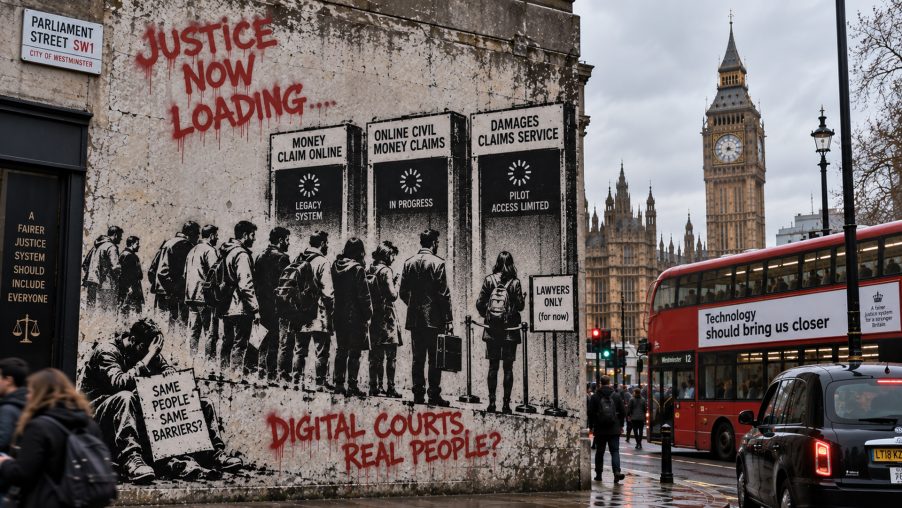
A claimant with a money dispute in England and Wales now faces three different digital systems, each with its own rulebook: Online Civil Money Claims, the Damages Claims Portal, and the older Money Claim Online. Announcements about court reform rarely explain which system covers which claim. This is a status inventory, built from the practice directions and official sources, of what each service can and cannot do today.
Snapshot
Online Civil Money Claims is live, mainstream and, for represented claimants within its scope, mandatory. The damages claims service remains a pilot, currently running to 6 April 2027, and its door is closed to claimants without a legal representative. Money Claim Online still exists for specified money claims under £100,000, with exclusions of its own. The reform programme that built these services ran from 2016 to March 2025 and has formally concluded; what remains is a mixed estate of live services, long-running pilots and legacy systems.
Reader note. The practice directions behind these services are amended frequently, and both civil pilots currently run to 6 April 2027. Check the current text of the relevant practice direction and the GOV.UK service pages before issuing any claim.
Three systems, three rulebooks
More than 1.9 million civil claims were issued in the County Court in 2025, and ministers describe four routes by which they can be made: HMCTS’s modern digital services (Online Civil Money Claims and the Damages Claims service), its older digital services (Money Claim Online and Possession Claims Online), or paper. That single sentence from an April 2026 written parliamentary answer is the most honest map of the current estate: not one online court, but a layered set of systems built at different times to different designs.
Each layer has its own procedural rulebook. Online Civil Money Claims is governed by Practice Direction 51R. The damages claims service is governed by Practice Direction 51ZB. Money Claim Online is governed by Practice Direction 7C, a scheme in force since 2001. Which system a claim belongs in is not a matter of preference or convenience. It is decided by the conditions in those practice directions: the remedy sought, the parties, the representation position and, in some cases, the value of the claim.
The practical consequence is simple. A litigant in person who reads only the announcements about digital court reform will plan around a system that may not be open to their claim at all. The distinction that matters is between what is live, what is still a pilot, and what has been quietly re-scoped along the way.
Online Civil Money Claims: live and mainstream
Online Civil Money Claims is technically a pilot under Practice Direction 51R, running since 7 August 2017 and currently extended to 6 April 2027, applying in the County Court. Claimants acting in person may use it; claimants with a legal representative must use it where their claim falls within the pilot’s conditions. The word “pilot” should not mislead anyone: after nine years this is the mainstream route for specified money claims, and the GOV.UK service pages direct individual claimants straight to it.
The pilot’s scope is defined by exclusions. The claim must be for a specified amount of money only. It cannot be a personal injury claim, it cannot be brought under most provisions of the Consumer Credit Act 1974, the claimant cannot be a protected party, and for claimants in person the claim is one claimant against one defendant, with the defendant’s address for service in England and Wales. Claims that fail these conditions do not enter the system at all.
Within its walls the service is genuinely digital: ministers describe Online Civil Money Claims and the Damages Claims service as enabling parties to manage a civil claim digitally from start to finish, including uploading evidence, making applications and viewing judicial orders online. Defendants can respond online, and directions questionnaires are completed within the service.
Two features deserve particular attention from anyone planning a claim. First, there is a ceiling in practice: where a claim is defended and the amount claimed excluding interest exceeds £25,000, the court must send the claim out of Online Civil Money Claims to the preferred court unless all parties are legally represented, so for most claimants the digital journey ends at that point even though the claim began online. Secondly, the small claims track automatic referral to mediation pilot applies to claims submitted through the service at or after 11am on 5 November 2024, so a defended small claim is now likely to be referred to mediation as part of its ordinary path.
Key distinction. “Pilot” describes the procedural instrument, not the maturity of the service. HMCTS reports a 92% user satisfaction rate for online civil money claims, and had processed more than 400,000 such claims by February 2023. Plan around what the practice direction says, not around the label.
The damages claims service: a pilot with a closed door
The damages claims service is a pilot under Practice Direction 51ZB, testing an online claims process run through the Damages Claims Portal, an online portal managed by HMCTS. The pilot has run since 28 May 2021 and currently continues until 6 April 2027, applying in the County Court. It is the newer and more ambitious of the two reform-era civil services: a full digital case-management environment rather than a claim-issue front end.
Its scope, however, surprises many readers. The conditions for using the pilot require the claimant to be represented by a legal representative. The claim must be for damages only, or for damages together with an injunction, a declaration or rescission. It must not be a claim that could have been started through Money Claim Online or the Production Centre, and the issue fee must be paid in full without an application for fee remission.
Read those conditions together and the position is stark: a litigant in person cannot start a claim in the Damages Claims Portal at all. The service that carries the reform programme’s flagship name for civil damages is, as the rules currently stand, a professional-users-only environment. Claims also move in and out of the portal: the practice direction provides for claims to be transferred out of the Damages Claims Portal in defined circumstances, continuing as if started under Part 7, and the pilot’s procedure stops applying from that point.
For an unrepresented claimant with a damages claim – for negligence, say, or for damage to property where the figure is not a fixed debt – the practical routes remain the older ones: a paper claim form, or professional representation that brings the portal within reach. Knowing that before drafting the claim saves a wasted journey.
What remains on Money Claim Online
Money Claim Online predates the reform programme by well over a decade, and it has not been switched off. Under Practice Direction 7C it remains available for claims where the only remedy sought is a specified amount of money, less than £100,000 excluding interest and costs, in sterling, using the Part 7 procedure, against one defendant or two defendants where a single amount is claimed against each. The claimant must not be a child or protected party, must not be in receipt of legal aid, and must have an address for service within the United Kingdom.
One exclusion catches people out: a claimant who wishes to apply for help with fees cannot use Money Claim Online and must file the claim form at court instead. The service also operates differently in feel from its younger sibling. It is an issue-and-request system – claim, default judgment, admission, warrant of control – rather than a managed digital case file, and defended claims leave it for a hearing centre in the ordinary way.
It is also, quietly, one of the places where the friction between paper and digital is managed by hand. Ministers have explained that Money Claim Online applies a buffer to check for paper responses before default judgment is entered, precisely because defendants can still reply on paper to claims issued online. The legacy service survives because the system around it is still hybrid.
Which portal does your claim belong in?
The routing question is answered by four checks, in order. Work through them before drafting anything, because each check can move the claim to a different system or out of the digital estate altogether.
A fixed, specified sum points to Online Civil Money Claims or Money Claim Online. Unliquidated damages points away from both.
Check the number of claimants and defendants, whether anyone is a protected party or the Crown, and whether every address for service is in England and Wales.
Personal injury, most Consumer Credit Act claims and – for Money Claim Online – any application for help with fees all change the route.
A defended claim above £25,000 excluding interest will leave Online Civil Money Claims for the preferred court unless all parties are legally represented.
GOV.UK’s own guidance applies the same logic from the claimant’s side: you can claim online unless you do not know how much money you want to claim, you are claiming on behalf of more than one person or organisation, your claim is against three or more people or organisations, an address for service is outside England or Wales, or the claim is against a government department. Everyone else is pointed to the paper N1 form, sent to the Civil National Business Centre in Northampton.
Specified money claims. Open to litigants in person; mandatory for represented claimants in scope. Digital to the point a defended claim over £25,000 is sent out unless all parties are legally represented. Practice Direction 51R.
Damages claims, with or without certain other remedies. Represented claimants only; fee paid in full. Pilot running to 6 April 2027. Practice Direction 51ZB.
Specified money claims under £100,000. No help-with-fees applications. The legacy route, still in force. Practice Direction 7C.
Reading the reform programme honestly
Between 2016 and March 2025 HMCTS ran a reform programme that launched 14 new digital services across all jurisdictions and processed more than 4.1 million digitally submitted cases from April 2019. HMCTS is explicit that the programme has concluded; modernisation continues as ordinary business, not as a single programme with an end date.
The scrutiny record matters for how the remaining estate should be read. The National Audit Office, reporting in February 2023, concluded that following repeated delays HMCTS had prioritised delivering reforms at pace over embedding sustainable change, that some delivered services were not working as efficiently as expected, and that its understanding of the impact of reforms on users remained limited. Those findings were aimed most sharply at the criminal courts’ Common Platform, but the discipline they teach applies across the estate: treat each service as it is documented today, not as it was announced.
On that test, the civil estate in September 2026 is a mixed picture. Online Civil Money Claims is live and load-bearing. The damages claims service is live for represented users but remains, on paper, a pilot with under seven months left to run. Money Claim Online endures as the legacy layer. And ministers have announced further modernisation of the civil courts backed by more than £50 million of investment, which means the map in this article will be redrawn again. That is the reason for working from the practice directions rather than the press releases.
Source anchors
The status map in this article rests on the following official sources. Source anchors support the framework described; they are a starting point for checking the position in any individual case, not a substitute for the current text of the rules.
justice.gov.uk. The scope conditions, the 7 August 2017 to 6 April 2027 pilot period, the mandatory use rule for represented claimants, and the £25,000 defended-claim ceiling where not all parties are legally represented.
justice.gov.uk. The Damages Claims Portal’s scope conditions, including the requirement that the claimant be legally represented, and the 28 May 2021 to 6 April 2027 pilot period.
justice.gov.uk. The legacy scheme: specified money claims under £100,000, the party and status exclusions, and the bar on help-with-fees applicants using the service.
GOV.UK. The claimant-facing routing guidance: who can claim online, the exclusions that push a claim to paper, and the Civil National Business Centre postal route.
GOV.UK, 24 March 2025. HMCTS’s account of the 2016 to March 2025 reform programme, its conclusion, and the reported satisfaction rates for reformed services.
National Audit Office, 23 February 2023. The independent scrutiny baseline: delivery at pace, limited understanding of user impact, and the value-for-money risks.
The closing point
Court digitisation in England and Wales is real, but it is not one door. It is three doors with different keys, and the practice directions – not the announcements – hold them. A claimant who fixes the remedy, the parties, the exclusions and the ceiling before drafting will arrive at the right portal the first time. The merits matter. But the route decides whether the merits are ever uploaded.
Portal and route decision point
Get a free written assessment of the claim route
Legal Lens can structure a preliminary written review of a proposed money claim: which system the rules place it in, what that system can and cannot do, and the exclusions worth checking before issue.
The remedy sought, the amount, the parties, their addresses and the representation position.
Which practice direction governs the claim, and the exclusions and ceilings to check before issuing.
Assessment outputs
Remedy, parties, exclusions and the systems in scope.
The portal the rules point to, and the checks to make first.
Independent Legal Lens consultancy. Legal Lens is not a regulated solicitors’ firm. A preliminary assessment is not a substitute for regulated legal advice where that is needed.