
 Written by
 Surveillance law · IPT · Litigants in person
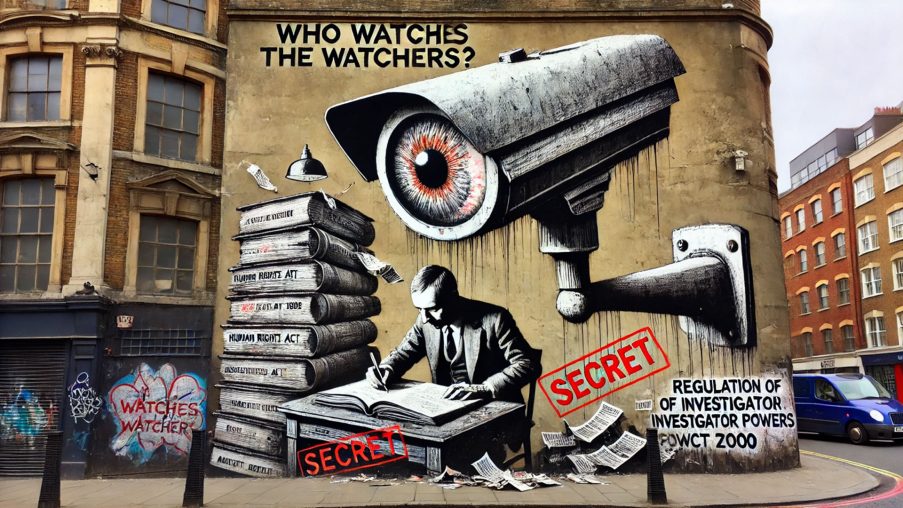
The Investigatory Powers Tribunal is the specialist forum for complaints about unlawful surveillance, covert state activity and intelligence-service conduct. It sits at the edge of open justice: powerful enough to investigate secret agencies, but often criticised for secrecy, complexity and the difficulty faced by ordinary complainants trying to challenge the surveillance state.
Publication snapshot
- The article explains the IPT’s role under RIPA 2000 and its relationship with human-rights claims.
- It examines the Tribunal’s authority over intelligence agencies, police forces, local authorities and covert investigatory powers.
- It considers access for litigants in person, including the absence of fees and the practical limits of a secretive process.
- It highlights major case studies involving undercover policing, journalists, mass surveillance and intelligence-sharing.
- It identifies barriers and reform proposals aimed at transparency, appeal rights, claimant support and procedural fairness.
Role and jurisdiction: the court of the surveillance state
The Investigatory Powers Tribunal is an independent judicial body established under section 65 of the Regulation of Investigatory Powers Act 2000. It is the specialist forum for complaints and claims concerning unlawful surveillance, interception, covert activity and investigatory conduct by public authorities.
Its remit includes complaints involving the UK intelligence agencies, police forces and, in appropriate cases, local authorities. It can consider claims under RIPA and the Human Rights Act 1998, giving individuals a route to argue that covert state intrusion has breached their rights.
Intelligence agencies
The IPT can hear complaints involving MI5, MI6 and GCHQ, including alleged misconduct by or on behalf of the intelligence services.
Police and public authorities
Its remit can extend to covert policing, directed surveillance, tracking, property interference and investigatory conduct by public bodies.
Human rights claims
The Tribunal can consider whether surveillance or covert activity has breached Convention rights, including privacy, expression and association rights.
Specialist forum
For many surveillance complaints, the IPT is the only domestic forum where members of the public can challenge secret investigatory conduct.
The Tribunal operates independently of government and is chaired by senior judicial figures. It has authority to require information and documents from bodies within its remit, call evidence and investigate complaints that would otherwise remain hidden from ordinary public view.
Using the IPT: access for litigants in person
One important feature of the IPT is that ordinary individuals can use it without instructing a lawyer. The draft records that a complainant can submit the relevant claim or complaint form and that no fee is required. It also notes that legal aid is not available for IPT proceedings, meaning many complainants proceed as litigants in person or rely on pro bono assistance.
In principle, that makes the IPT accessible. A private citizen can ask a judicial body to investigate conduct by agencies and authorities that would otherwise be almost impossible to confront directly.
No immediate fee barrier
The draft describes the IPT complaint process as free of charge, with no requirement to appoint a lawyer.
Paper-based entry point
The initial complaint can be set out in writing, making it easier for an individual to explain the suspected surveillance or covert conduct.
Investigative powers
The Tribunal can call for information and investigate matters that the complainant could not realistically prove alone.
Practical opacity
Once the Tribunal begins examining secret material, the claimant may be excluded from key evidence and may receive limited explanation if the complaint is not upheld.
The draft gives the example of Vaughan v South Oxfordshire District Council, in which a litigant in person challenged a local council’s use of covert surveillance in connection with council tax discount enquiries. It also notes that some claimants start as litigants in person before later obtaining representation.
Notable IPT rulings and case studies
The IPT’s public importance becomes clearer through the cases in which it has exposed, tested or constrained secret state conduct. The following case studies are drawn from the supplied draft and should be checked against the published judgments before publication.
Undercover policing: Kate Wilson
The draft describes the IPT litigation brought by Kate Wilson after she discovered she had been deceived into an intimate relationship with undercover police officer Mark Kennedy. It records that the Tribunal found a serious range of human-rights breaches, including violations linked to degrading treatment, privacy, expression and association.
The case is presented as a major example of an individual using the IPT to expose serious institutional failure in undercover policing. Its wider importance lies in the finding that the abuse was not simply the act of one officer, but reflected management and oversight failures.
Journalists and source protection: Birney and McCaffrey
The draft discusses the IPT complaint brought by investigative journalists Trevor Birney and Barry McCaffrey after their work on the Loughinisland massacre. It records that the Tribunal found unlawful police surveillance and breaches of Article 10 and Article 8 rights.
The case is used to illustrate the IPT’s role in protecting journalistic source confidentiality and constraining police surveillance where press freedom is engaged.
Mass surveillance and NGO challenges
The draft refers to post-Snowden complaints brought by civil society organisations, including Liberty, Privacy International and Amnesty International. Those challenges forced scrutiny of intelligence-sharing, bulk interception and surveillance safeguards.
The article presents these cases as evidence that the IPT can expose unlawful or insufficiently safeguarded surveillance arrangements, even where the underlying operations are highly secret.
Errors, corrections and institutional trust
The draft also notes an incident in which the Tribunal initially gave Amnesty International the wrong impression about whether it had been unlawfully surveilled, later correcting the position. That episode is used to underline why transparency and procedural confidence matter.
Procedural barriers and transparency concerns
The IPT’s strength is also its difficulty. It can examine secret evidence, but that means claimants may not see the core material on which their case turns. It can protect national security, but that can leave the individual feeling excluded from their own complaint.
Secrecy and closed proceedings
Much of the evidence from public authorities may be considered in closed session. That can make it difficult for a claimant to challenge the case against them or understand the basis for dismissal.
Neither confirm nor deny
If a complaint is not upheld, the Tribunal will often avoid confirming whether surveillance took place at all. This protects secrecy, but it also limits the complainant’s understanding.
Legal complexity
Surveillance law involves RIPA, IPA 2016, HRA 1998, warrants, authorisations, interception, covert human intelligence sources and technical distinctions that can be difficult for litigants in person.
Evidence difficulty
Citizens rarely have direct proof that they were surveilled. They may rely on suspicion, patterns or later disclosure, while the agencies hold the decisive records.
Time limits
The draft refers to a one-year time limit for IPT complaints, subject to potential extension. Late discovery of surveillance can therefore create a major access problem.
Delay
Some cases take years. That may be unavoidable in sensitive matters, but delay can reduce the practical value of the remedy for individuals.
These concerns do not make the Tribunal unimportant. They make its procedural design critical. The IPT must preserve legitimate secrecy while maintaining enough openness for the public to trust that secret power is genuinely being tested.
Reforms and proposals to improve accessibility
The draft identifies several reforms, some already implemented and others still proposed, which could improve access, transparency and public confidence.
1. Preserve and strengthen appeal rights
The introduction of an appeal route on points of law was a major reform. It reduces the risk that the IPT becomes a wholly self-contained jurisdiction insulated from ordinary appellate scrutiny.
2. Hold open hearings where possible
Legal arguments that do not require secret evidence should be heard in public where feasible. Redacted judgments and open summaries can improve confidence without exposing sensitive operational material.
3. Consider special advocates or equivalent safeguards
The draft notes debate about whether security-cleared advocates could better represent claimant interests in closed sessions, rather than relying only on Counsel to the Tribunal.
4. Publish clearer statistics and guidance
More detailed annual reporting, accessible guidance and public-facing explanations would help demystify the IPT for ordinary complainants.
5. Improve support for litigants in person
A pro bono panel, specialist legal clinic or navigator-style support service could help individuals frame complaints, identify relevant evidence and understand the process.
6. Revisit late discovery and notification
Where surveillance only becomes known years later, the Tribunal should remain alive to fairness arguments on time limits. Broader post-surveillance notification remains politically contentious but would materially improve access to remedies.
Conclusion: secret power remains subject to law
The Investigatory Powers Tribunal occupies a special place in the UK constitution. It is the courtroom for the surveillance state: unconventional, specialist and often opaque, but essential where the alleged wrong is itself hidden from public view.
The draft presents a balanced picture. The IPT can investigate agencies and police forces, expose unlawful conduct, award remedies and influence wider reform. At the same time, its closed procedures, technical law, limited legal aid position and “neither confirm nor deny” culture create real barriers for litigants in person.
For citizens who believe they have been unlawfully surveilled, the IPT may be the only meaningful domestic route. For that reason, its accessibility matters. A tribunal that polices secret power must be robust enough to command trust from those outside the closed room.
Disclaimer
This article provides general public-law commentary on the Investigatory Powers Tribunal, surveillance powers and access to remedies in the United Kingdom. It is not legal advice and should not be relied upon as a substitute for specialist advice on any specific surveillance, public-law, human-rights or national-security matter.
References to case outcomes, statutory provisions, procedural rules, appeal rights, surveillance powers and tribunal practice are based on the supplied draft and should be checked against current legislation, IPT rules, published judgments and official guidance before publication or use in any live case.
Where the article discusses unlawful surveillance, police conduct, intelligence agencies or covert state activity, those references should be read in the context of the cited or described proceedings and not as allegations against any person or body outside those established facts.
IPT is a Fraud and Front to screen Complaints against the UK GCHQ.
My entire family are under generational ritúal abúse non religious as stated by ñational referral mechanism fírst réspoñder iñtruçtións to report law lord mp & chief inspector of royal protection for historical & ongoing fraud. Murdering HH justice kenneth Deale president of the high court Ireland when he tried to sort this ongoing fraud. When I went to home office to lodge the papers I was physically threatened by nameless huge Pakistani man who refused ID. My clítorís vàgina womb FGM cut out with organ tissue and bone harvestiñg to terroríse me to silénce on their crímiñal actioñs. So we were not even allowed lodge investigatory powers tribunal papers. Daily death threàts tó my son’s life if I don’t keep quiet but when I kept quiet they murdered my mother anyway. So either way they do whatever they want. Met pólice stole my laptop’s email address mes and have total control of my family phone body and homes. I have neural links fitted with illegal drug delivery system to drug ràpe próstitute me broàdcasting to silence me & profit. My entire vagina hips body altered 4 human traffiçkiñg próstitution. My sons life stolen .