
 Written by
Civil procedure · directions · practical guidance
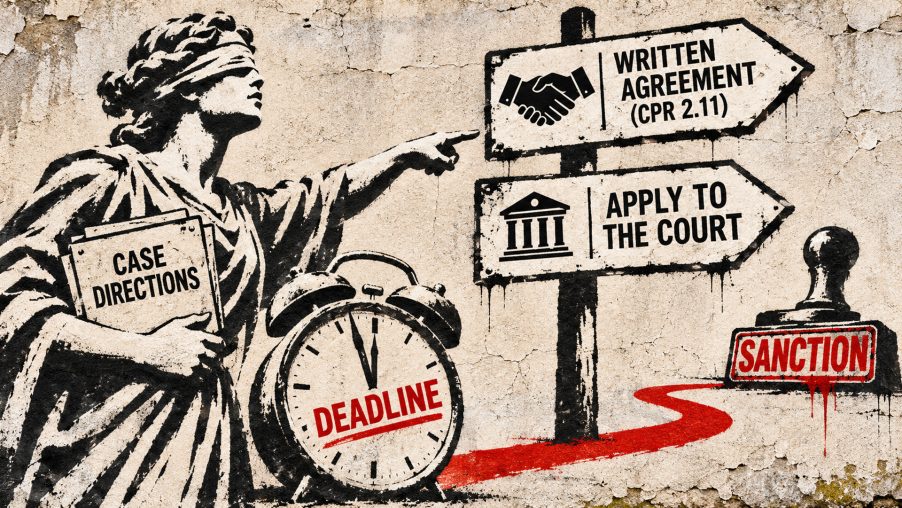
A directions deadline can become unworkable long before it becomes a sanction. The useful question is not simply how to explain the difficulty, but which procedural route can change the date: a written agreement under rule 2.11 or an application to the court. The answer depends on the order, the track and the consequences attached to default.
The decision in one paragraph
Act while the existing date is still ahead. Identify exactly what must be done, check whether the order specifies a consequence and map the proposed change against hearings and later directions. If the rules permit variation by agreement, record a precise agreement in writing. If they do not, or agreement cannot be reached, ask the court for a focused variation rather than treating correspondence as though it has changed the timetable.
Start with the order, not the difficulty
A problem with a directions deadline usually arrives as a practical story: a report has not arrived, a witness is unavailable, or the volume of work was underestimated. The court, however, will need a procedural answer. Which paragraph has to change, from what date and time to what new date and time, and what else in the timetable will move if that change is made?
Begin by copying the operative direction rather than paraphrasing it from memory. Check who must act, what must be filed or served, and whether the order uses an expression such as “unless” or “in default” before stating what will follow. Then list the next three events in the case. A modest extension for one step may be workable in isolation but unrealistic if it compresses the time available for the steps that follow.
Record the paragraph, required act, existing calendar date and time.
Look for any express consequence and any restriction on agreement.
Map later directions, hearings and the trial date or trial period.
Only then approach the other party. A useful proposal identifies the obstacle briefly, offers a realistic replacement date and explains the effect on the remaining timetable. It does not bury the request in a general complaint about the litigation. Keep the existing order as the working plan while the proposal is being considered; an email sent, but not answered, is not a variation.
The written-agreement route under rule 2.11
Rule 2.11 starts with a general permission: unless the Civil Procedure Rules or a practice direction provide otherwise, or the court orders otherwise, a time specified by a rule or by the court for an act may be varied by the written agreement of the parties. Those opening qualifications are part of the route, not fine print to review afterwards.
Where that permission applies, the practical task is to make the agreement clear enough to use later. Identify the case, the order and paragraph, the existing obligation and the replacement date and time. State whether the rest of the timetable is unchanged. Obtain an express written acceptance rather than inferring agreement from silence, and keep the complete exchange with the order.
Adaptable wording, after checking that agreement is permitted:
“We agree that the time for compliance with paragraph [number] of the order dated [date] is varied from [existing date and time] to [proposed date and time]. All other directions remain unchanged. This variation does not require any hearing date, trial date or trial period to change.”
The final sentence should be included only if it is accurate. If the change would disturb a protected listing or require a sequence of further changes, the correspondence should not pretend otherwise. Nor should a neatly drafted agreement be used to enlarge the limited exception for a direction carrying a specified consequence. The document cannot cure a restriction in the rules.
A short chronology helps: when the difficulty emerged, when the proposal was made, when agreement was reached and what work is being done in the meantime. That record is useful even when no application is needed. It shows that the variation was managed prospectively rather than reconstructed after default.
When an application to the court is required
Agreement is not a substitute for judicial variation where a rule reserves the decision to the court. It is also unavailable as a practical route if the other party refuses, does not respond in time or proposes terms that would leave the case unmanageable. The application should still be focused: identify the exact variation sought and provide a workable timetable, not simply an invitation to revisit the directions generally.
Rule 3.1 gives the court power, except where the rules provide otherwise, to extend or shorten the time for compliance with a rule, practice direction or court order, even if the application is made after the time has expired. It also provides that a power to make an order includes a power to vary or revoke it. That is a power to decide, not an assurance that every request will be granted. Acting before expiry keeps the discussion centred on future case management rather than an explanation for existing default.
For fast-track and intermediate-track cases, rule 28.3 requires an application to vary a court-fixed date for a case management conference, pre-trial review, filing the pre-trial checklist, the trial or the trial period. Another date may not be varied by the parties if that would make it necessary to vary one of those listed dates. The relevant variation rule is 28.3. Rule 28.4 deals with pre-trial checklists.
The multi-track equivalent is rule 29.5. It requires an application to vary a court-fixed case management conference, pre-trial review, pre-trial checklist return date, trial or trial period, and prevents party variation of another date where the change would require one of those listed dates to move. The lesson is to test the whole chain, not just the immediate date.
Where both parties support a change that the court must approve, their agreement is still useful. It can narrow the dispute and support an agreed draft order. It does not turn a judicial decision into a private one.
Specified consequences narrow the agreement route
Rule 3.8(3) applies where a rule, practice direction or court order requires something within a specified time and specifies the consequence of non-compliance. In those circumstances, rule 3.8(4) permits an extension by prior written agreement, unless the court orders otherwise, only up to a maximum of 28 days and only if the extension does not put any hearing date at risk. A longer extension, or one that endangers a hearing, needs a different route.
This is why the wording of the order matters more than the label attached to the request. An ordinary extension proposal and an extension involving a conditional direction may look identical in an email, but the available agreement route is not identical. Before relying on rule 2.11, read the whole paragraph and any related provision dealing with default.
A concrete reason to check. Under rule 28.4(3), if no party files a completed pre-trial checklist in a fast-track or intermediate-track case by the specified date, the court shall order that unless a completed checklist is filed within seven days from service of that order, the claim, defence and any counterclaim shall be struck out without further order. A checklist date is therefore not a date to treat as an informal target.
Where a party has failed to comply with a rule, practice direction or court order, rule 3.8(1) says that any sanction for that failure imposed by the rule, practice direction or court order has effect unless the party in default applies for and obtains relief. That is a different problem from varying a workable timetable in advance. The preventive step is to identify the consequence and choose the correct variation route before the case reaches that stage.
Build a practical variation pack
A good pack allows the reader to understand the request without reconstructing the file. Put the current order first, followed by a short chronology, the correspondence seeking agreement, any response and the revised timetable. Explain the practical obstacle concisely and provide the document that supports the explanation where one exists and can appropriately be shared.
Unless a rule or practice direction states otherwise, or the court dispenses with the requirement, an applicant must file an application notice. It must state what order is sought and briefly why, and a copy must be served on each respondent unless a rule, practice direction or court order permits otherwise. “More time” is therefore less useful than a request identifying the paragraph, replacement date and any consequential changes.
If agreement is permitted
Keep the agreed wording, confirmation from the other party and a timetable showing the unchanged hearings and later steps.
If the court must decide
Prepare the application notice, concise reasons, supporting material, correspondence and a draft order showing the precise variation.
Ask for the order that will actually make the timetable workable. If one extension requires two later dates to move, set out the complete sequence. If the other party agrees the proposed order, say so and provide the confirmation. Rule 23.8 allows the court to deal with an application without a hearing where the parties agree the terms of the order, agree to dispense with a hearing, or the court considers a hearing inappropriate. It remains the court’s decision.
Finally, continue whatever work can sensibly be completed while the request is outstanding. A pending proposal is not a reason to stop every task. Keep proof of filing, service and agreement together, and update the working timetable only when the applicable route has produced the variation.
Source anchors
These official rules support the procedural framework. They do not determine the effect of an individual order, which must be read on its own terms.
Rule 2.11: the general written-agreement route and its express qualifications.
Rules 3.1 and 3.8: management powers, specified consequences and the limited agreement exception.
Rules 28.3 and 28.4: fast- and intermediate-track timetable variation and pre-trial checklists.
Rule 29.5: multi-track dates requiring an application and linked timetable restrictions.
Rules 23.3 to 23.8: application notices, their contents and service and decisions without a hearing.
The preventive point
The best time to address an unworkable direction is while there is still a choice about how to change it. A precise agreement can solve a permitted variation without an application; a timely, well-structured application can address a date the parties cannot change themselves. Both routes begin with the same discipline: read the order, protect the wider timetable and deal with the difficulty before default changes the dispute.
Directions and timetable decision point
Get a free written assessment of the variation route
Legal Lens can structure a preliminary written review of the direction, the proposed timetable and the material needed to support an agreement or application.
Separate a permitted written agreement from a date requiring a court decision.
Show the existing obligation, proposed date and links to later hearings and directions.
Assessment outputs
The order, route, dates, documents and linked case events.
A clear chronology and draft timetable for agreement or application.
Independent Legal Lens consultancy. Legal Lens is not a regulated solicitors’ firm. A preliminary assessment is not a substitute for regulated legal advice where that is needed.