
 Written by
 AI and the courts · judicial guidance · verification
The judiciary’s revised AI guidance is concise, clear and deliberately conservative: AI can assist, but human accountability is non-negotiable.
Publication snapshot
- The revised guidance supersedes the April version.
- Public AI tools should be treated as public spaces.
- AI-generated legal propositions, cases and quotations must be checked against authoritative sources before use.
- There is no blanket duty to disclose AI use, but users remain accountable for accuracy, confidentiality and verification.
What the guidance actually says
The judiciary’s revised AI guidance, dated 31 October 2025, supersedes the April version and sets out what judges and court staff may safely use AI for, what they should avoid, and the verification and confidentiality standards expected across the system.
Treat public AI as public
Do not paste confidential or private information into public chatbots. Even with chat history disabled, assume anything entered could be disclosed. Disable history where possible and refuse unnecessary device or app permissions.
Report data incidents
If confidential or personal data is inadvertently disclosed, report it as a data incident in accordance with the Data Protection Act 2018 and Judicial Office protocols.
Verify everything
AI outputs may be inaccurate, out of date or hallucinated. That includes non-existent cases, misstatements of law and invented quotations.
Human responsibility remains
Judicial office holders remain personally responsible for all material produced in their name and must read the underlying documents.
Where AI helps — and where it does not
The guidance draws a practical distinction between administrative support and legal truth.
Potentially useful with human review
- Summarising long texts.
- Drafting presentation outlines.
- Administrative tasks such as prioritising emails.
- Drafting memoranda.
Not recommended
- Legal research to find new information that cannot be independently verified.
- Substantive legal analysis treated as authoritative.
- Unverified case citations or quotations.
- Using AI as a source of legal truth.
Red flags courts will watch for
The guidance lists practical indicators that a submission may be AI-generated or unreliable. Judicial scrutiny is likely where there are signals that the material has not been checked properly.
Why this landed now: the Ayinde warning
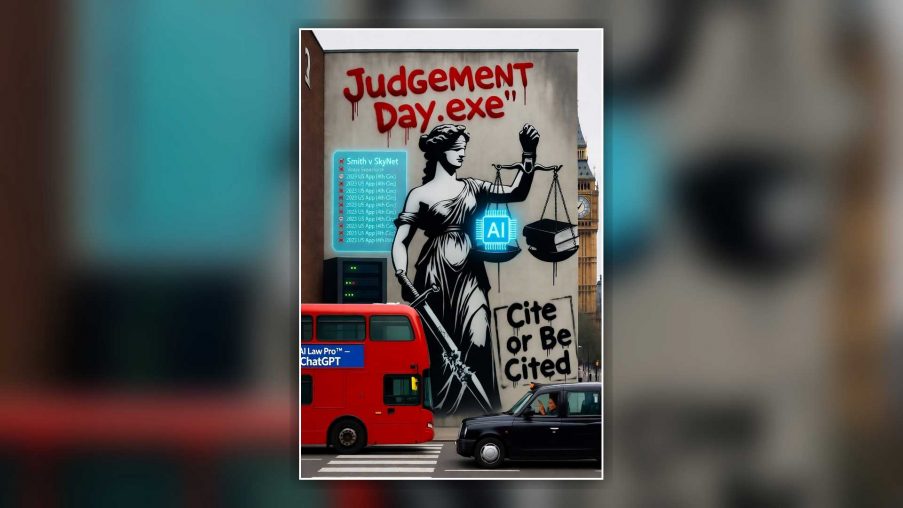
Earlier this year, the Divisional Court addressed AI misuse directly. In R (Ayinde) v London Borough of Haringey and the linked Al-Haroun v QNB case, the court considered an application for wasted costs after lawyers relied on multiple fake authorities that could not be produced when requested.
The court’s message was unequivocal: those who use AI must check accuracy against authoritative sources before advising clients or submitting material to the court.
What this means in practice
For judges and judicial staff
- Use only secure work devices.
- Obtain HMCTS service manager approval where required.
- If AI may have been used by parties, ask what checks were performed.
- Ensure the judge still reads the primary material.
For legal representatives
- Adopt a source-first workflow.
- Retrace every legal proposition to an authoritative source.
- Never paste client-confidential content into public tools.
- Be prepared to explain verification if asked.
For litigants in person
- Use AI only to help summarise or organise.
- Do not rely on AI for legal research or legal analysis.
- Check every legal point against official sources.
- Be ready to explain what checks were performed.
A minimal court-ready verification protocol
This protocol aligns with the guidance’s accuracy and accountability standards and does not create a new disclosure burden.
Identify the claim
State the legal proposition precisely, for example: “X is the test for strike-out.”
Find the source
Use primary legislation or a named judgment from an authoritative database.
Match the wording
Check whether the source actually says what the draft says it says.
Check jurisdiction and currency
Confirm that the authority is current and applicable to the relevant jurisdiction.
Record the citation
Record the neutral citation and pinpoint reference. If any step fails, do not submit the point.
What to implement this week
Written AI policy
- Define permitted uses such as administration and summarisation.
- Define prohibited uses such as unverified research and analysis.
- Include breach and data incident reporting routes.
Citation gate
- No filing unless every legal point has a verified primary source.
- Retain an audit trail of verification.
- Check citations before advice or filing.
Red-flag training
- Train teams to spot US citations and terminology.
- Watch for polished but wrong analysis.
- Check for hidden text artefacts.
Device controls
- Block unnecessary app permissions.
- Default to history-off where possible.
- Isolate public AI tools from client data.
The line the guidance draws
The judiciary’s position is pragmatic: AI may speed up administrative work, but it must never dilute human responsibility or the integrity of proceedings.
There is no general duty to disclose that AI was used. But there is an absolute duty to ensure that what reaches the court is accurate, appropriate and secure.
Primary documents
- Courts and Tribunals Judiciary, Artificial Intelligence (AI) – Judicial Guidance, October 2025.
- Divisional Court discussion of AI misuse: R (Ayinde) v London Borough of Haringey; Al-Haroun v QNB.
Legal disclaimer
This article is for informational purposes only and does not constitute legal advice. All references to legal authorities are provided for context. Users should verify all citations and consult the official text or a qualified legal professional before relying on any authority.