
 Written by
Access to justice – civil procedure – practical guidance
Civil courts in England and Wales are not merely allowed to adjust their process for vulnerable parties: the rules expect it. Since April 2021 the overriding objective has included making sure parties can participate fully and give their best evidence, and Practice Direction 1A hands judges a toolkit of directions to make that real. Many litigants in person have never heard of it. This guide sets out what the toolkit contains, who qualifies, and how to ask.
Snapshot
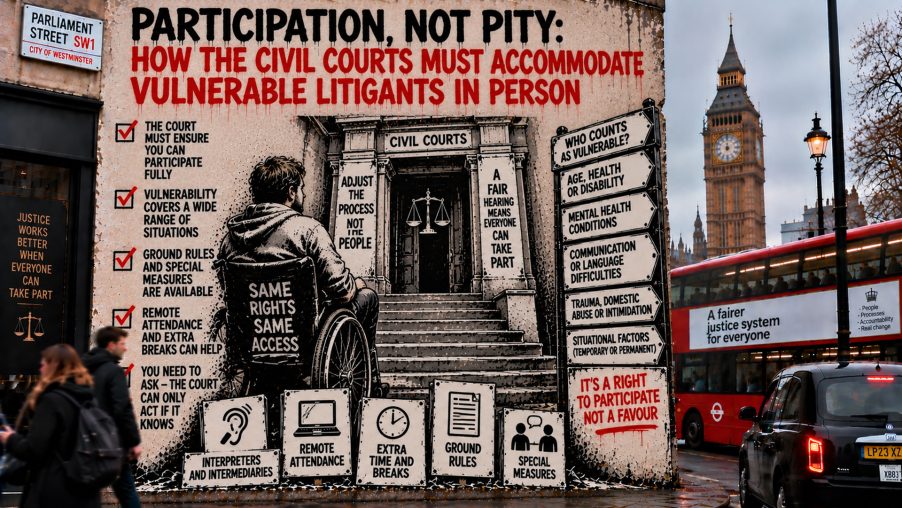
The civil courts owe vulnerable parties and witnesses more than sympathy: they owe them a process they can actually take part in. The tools exist – ground rules, special measures, remote attendance, intermediaries, extra breaks – but the court can only deploy them if it knows they are needed, and many unrepresented parties never ask because they do not know there is anything to ask for. Participation is a procedural right with paperwork attached. This is the paperwork.
The duty behind the directions
Every civil case is governed by the Civil Procedure Rules, and at the front of those rules sits the overriding objective: the court must deal with cases justly and at proportionate cost. Since 2021, dealing with a case justly expressly includes, so far as practicable, ensuring that the parties are on an equal footing and can participate fully in proceedings, and that parties and witnesses can give their best evidence. A hearing one side cannot follow or take part in is not an equal contest, and the rules now say so in terms.
Rule 1.6 of the Civil Procedure Rules provides that Practice Direction 1A makes provision for how the court is to give effect to the overriding objective in relation to vulnerable parties or witnesses. Both the new wording in the overriding objective and rule 1.6 were inserted by the Civil Procedure (Amendment) Rules 2021, which came into force on 6 April 2021. The framework is neither new nor a matter of judicial goodwill: it is the settled procedural law of every civil case in England and Wales.
The shift in thinking matters as much as the text: participation is now a condition of a fair hearing, not charity at the judge’s discretion. A litigant in person asking for ground rules or extra breaks is asking the court to do what its own rules contemplate.
Who counts as vulnerable
The definition is deliberately wide. Under Practice Direction 1A, vulnerability may impede participation and diminish the quality of evidence, and the court should take all proportionate measures to address that in every case; a person should be considered vulnerable when a factor – personal or situational, permanent or temporary – may adversely affect their participation or their evidence, assessed against their ability to understand the proceedings, express themselves, put their evidence before the court, respond to the court’s requests and attend hearings. Nothing in that test requires a diagnosis or a formal label.
The practice direction’s list of factors is expressly non-exhaustive: age, immaturity or lack of understanding; communication or language difficulties, including literacy; physical disability or health condition; mental health condition or significant impairment of intelligence or social functioning; the impact of the case’s subject matter; the person’s relationship with another party or witness, including sexual assault, domestic abuse or intimidation; and social, domestic or cultural circumstances. The list reaches people who would never describe themselves as vulnerable – the witness recounting a traumatic event, the party facing the person who intimidated them – and because temporary and situational factors count, no one has to prove a permanent condition.
For victims of domestic abuse there is a statutory layer beneath the practice direction. Section 64 of the Domestic Abuse Act 2021 requires rules of court to enable special measures directions in civil proceedings – the county court, the High Court and the civil division of the Court of Appeal – for parties or witnesses who are, or are at risk of being, victims of domestic abuse, or who are victims or alleged victims of a specified offence, where vulnerability is likely to diminish their participation or the quality of their evidence. For that group, special measures are not discretionary goodwill but something Parliament has directed the rules to provide.
The menu of participation directions
The machinery starts early. The court, with the assistance of the parties, should try to identify vulnerability at the earliest possible stage and consider whether participation or the quality of evidence is likely to be diminished and whether directions are needed; if so, it may identify the nature of the vulnerability in an order and order appropriate provisions, which can include concealing a party’s or witness’s address and contact details. That last power matters: a party holding back from litigating for fear their address will reach the other side has a direct, rules-based answer.
The centrepiece is the ground rules decision. Before a vulnerable person gives evidence, the court should consider ordering ground rules covering the nature and extent of that evidence, the conduct of the advocates and parties towards that person, whether special measures or other support should be put in place, and any power of the court to prohibit, limit or modify cross-examination of or by a vulnerable witness or to appoint a legal representative to conduct a cross-examination. A ground rules decision turns an abstract anxiety into directions the judge has settled in advance: how questioning will be conducted and what support will be in the room.
The practice direction’s menu of special measures includes screens to prevent a party or witness seeing another; evidence given remotely by video conference; evidence heard in private; dispensing with wigs and gowns; pre-recorded video evidence; questioning through an intermediary; and devices or other aids to help communication – and before ordering ground rules, special measures or other support, the court must consider the views of the party or witness themselves. Alongside those sit the court’s general case management powers. The court may hold a hearing and receive evidence by telephone or by any other method of direct oral communication, and it may exercise its powers on application or of its own initiative.
The final item on the menu is specific to litigants in person. Where at least one party is unrepresented, the court must have regard to that fact when exercising its case management powers, and at a hearing where evidence is being taken it may ascertain from an unrepresented party the matters on which a witness can give evidence or ought to be cross-examined, and put, or cause to be put, such questions as appear proper. A judge may, in other words, help frame the questioning – but judges cannot fix what they cannot see.
Adjustments outside the hearing room
Participation directions are the judge’s business; alongside them sits a separate duty owed by the courts service itself. HM Courts & Tribunals Service states that it has a legal duty under the Equality Act 2010 to make reasonable adjustments for disabled court users; its published examples include breaks during a hearing to help with concentration, British Sign Language interpreters, large-print forms, alternative-format guidance such as audio and Easy Read, hearing enhancement equipment and ramps, and adjustments can be requested by phone, in person or in writing – though they must be requested for each case. Where support is needed in the hearing room itself, HMCTS says it will discuss that with the judge.
The underlying duty, in section 20 of the Equality Act 2010, requires reasonable steps to avoid the substantial disadvantage a disabled person faces from a practice or a physical feature, and to provide an auxiliary aid – including information in an accessible format – and the person subject to the duty cannot charge the disabled person for the cost of complying. Adjustments to the building, paperwork and logistics are therefore free at the point of use.
The judiciary has its own reference text for all of this. The Equal Treatment Bench Book – July 2024 edition, most recently updated in February 2026 – is the judiciary’s published practical guidance, aimed at increasing understanding of the different circumstances of people appearing in courts and tribunals and at making the court experience fair and accessible for parties and witnesses who might be uncertain, fearful or feel unable to participate. A litigant in person does not need to cite it; it is enough to know that the judge’s own guidance points the same way as the rules.
Two routes, one goal. Ask HMCTS for reasonable adjustments to the building, the forms and the logistics; ask the judge, in writing, for participation directions about how the hearing itself runs. The two requests complement each other, and making one does not make the other.
How to ask: a short application
The court can act of its own initiative, but a judge cannot be expected to guess circumstances they have never been told about. The disciplined approach is to ask in writing early – ideally before the first case management hearing, and always before any hearing at which evidence will be given. A short letter or email to the court office, marked for the attention of the judge dealing with case management, often starts the conversation. Where a formal order is wanted, an application is made by filing an application notice – the standard form is N244 – which must state what order is sought and, briefly, why. A court fee is normally payable for an application, and help with fees is available depending on savings, benefits and income, by applying online or on form EX160.
The request itself can be short: who you are, why you fall within Practice Direction 1A, and exactly which directions you are asking for. For example:
“I am the claimant, acting in person. I ask the court to treat me as a vulnerable party under CPR Practice Direction 1A. My circumstances are: [one or two plain sentences]. These affect my ability to concentrate for long periods and to answer questions under pressure. To ensure I can participate fully and give my best evidence, I ask for: (1) a ground rules decision before I give evidence; (2) breaks of at least ten minutes in every hour when I am giving evidence; (3) questions in cross-examination to be kept short and put one at a time; and (4) permission to give evidence by video link [or to attend the hearing remotely]. I am content for the court to decide this without a hearing.”
Adapt the bracketed passages honestly; a short letter from a GP or support worker can help, though the practice direction’s test does not demand one. The route that works is unglamorous:
Write to the court office early, flagging that you may need participation directions.
Use form N244 or a clear letter, naming each measure you want and why it will help you participate.
Check the directions appear in an order, and chase any failure to provide them before the hearing.
If the request is refused, ask for the reasons in writing and note the date: a refusal can be challenged, and the record of what you asked for is the foundation.
Source anchors
These anchors support the legal framework described in this article. They are the primary sources a reader can check directly; they do not prove anything about any individual case.
The current text of Part 1, Part 3, Part 23 and Practice Direction 1A on vulnerable parties and witnesses.
Home of the Equal Treatment Bench Book – July 2024 edition, updated February 2026.
Reasonable adjustments, support for court and tribunal users, and how to contact the service.
Section 20 sets out the duty to make reasonable adjustments; the full Act is free to read.
The closing point
The merits matter. But procedure decides when the merits are heard, and a party who cannot participate cannot put their merits before the court at all. The toolkit has been in the civil rules since 2021; the weakest part of the system is that the people it was built for still often do not know it exists. Ask early, ask in writing, and ask for exactly what you need. That is not pity. It is what a fair hearing requires.
Participation decision point
Get a free written assessment of the route
Legal Lens can structure a preliminary written review of your position: whether Practice Direction 1A is likely to apply, which participation directions fit your circumstances, and how a short written request could be framed.
The measures that match your circumstances, drawn from the practice direction’s own toolkit.
How a short written request to the court could be sequenced and worded.
Assessment outputs
Participation obstacles, matching directions and live procedural steps.
What to gather before asking the court for directions.
Independent Legal Lens consultancy. Legal Lens is not a regulated solicitors’ firm. A preliminary assessment is not a substitute for regulated legal advice where that is needed.