
 Written by
 AI in law · judicial guidance · hallucinated authorities
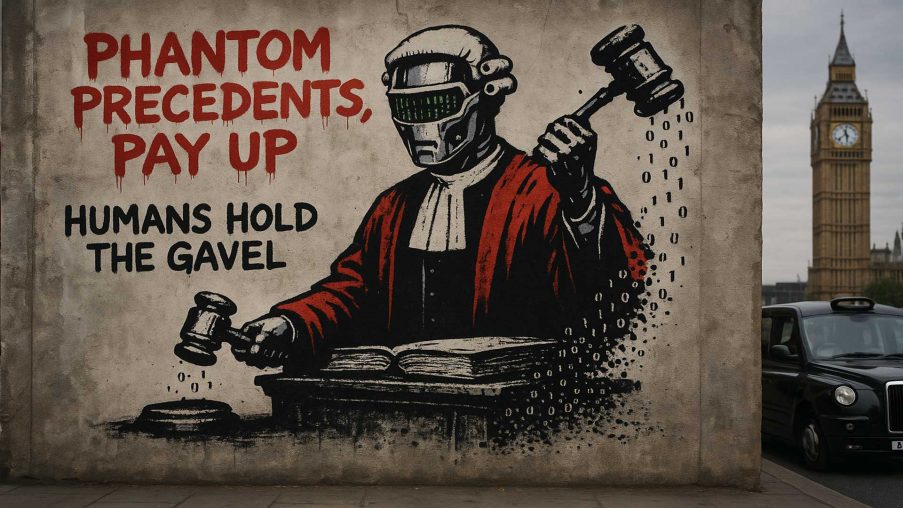
Talk of “robo-lawyering” has dominated headlines. In England and Wales, the courts have so far responded mainly through guidance and caution. In the United States, the lesson has been harsher: lawyers have already been sanctioned for filing AI-hallucinated law.
Publication snapshot
- Judicial guidance in England and Wales warns that public AI tools may invent fictitious cases, citations or quotes.
- No reported case in England and Wales has yet proved that a judge or barrister relied on ChatGPT-style tools in court.
- The first confirmed UK example in the source draft involved a litigant in person using AI to find supportive cases.
- US courts have already imposed sanctions and introduced AI-disclosure requirements after hallucinated authorities appeared in filings.
Why the judiciary is suddenly talking about algorithms
Since the Courts & Tribunals Judiciary issued its Artificial Intelligence Guidance for Judicial Office Holders in December 2023, updated in April 2025, British judges have been reminded that public chatbots “may make up fictitious cases, citations or quotes” and that any AI output “must be independently checked”.
The guidance bars confidential material from public tools and stresses that responsibility for every ruling remains personal to the judge. It pays particular attention to hallucination — the tendency of large language models to invent authority that looks plausible but is entirely false.
England and Wales: suspicion, but no proven professional use
Despite growing concern, there is no reported case in England and Wales where a judge or barrister has been proven to rely on generative AI tools in court. The judiciary’s guidance, as referenced in The King on the application of Frederick Ayinde v The London Borough of Haringey [2025] EWHC 1383 (Admin), catalogues actual or suspected use by lawyers of generative AI and laments a new “epidemic” of bogus citations.
However, in the most prominent incidents, courts have found that the misconduct lay in submitting unchecked or fabricated material, regardless of whether AI was the source.
Confirmed UK example
The only confirmed instance of generative AI use in UK courts identified in the source draft involves a litigant in person. In Zzaman v HMRC [2025] UKFTT 00539 (TC), the taxpayer candidly told the First-tier Tribunal he had asked an AI tool to find supportive cases.
Tribunal warning
The tribunal described the attempt as “logical and reasonable” for a non-lawyer, but dismissed the appeal because the cited authorities were irrelevant or misapplied. The case illustrates how plausible AI output can mislead the untrained.
There is no verified public record of Lord Justice Birss using ChatGPT or generative AI to prepare a judgment. While there have been reports of judicial interest in AI, no official or public statement confirms such use in a formal judgment.
In short, British judges have erected cautionary fences before the horse has bolted: guidance is in place, regulators are on alert, but no reported judgment shows a professional yet relying on AI output in court.
United States: sanctions, show-cause orders and AI certificates
If the UK judiciary is building the fence, US courts are busy shutting stable doors that have already been kicked off their hinges.
Other recent US cases have raised similar issues, but the safe approach is to cite only verified cases and avoid relying on unverified or hypothetical examples.
Fed-up judges have moved from case-by-case penalties to standing orders. Judge Brantley Starr of the Northern District of Texas, for example, now requires every filer to certify whether generative AI was used and, if so, to confirm that a human has verified each citation.
Similar disclosure rules have appeared in other federal courts, including the Eastern District of Pennsylvania, the Northern District of Illinois and the Court of International Trade, with commentators predicting that AI-disclosure certificates may become the US norm.
What is driving the divergence?
The UK and US are confronting the same technology, but at different points in the adoption curve.
Timing and culture
US litigators embraced ChatGPT with early enthusiasm. The UK Bar, governed by close professional oversight and personal responsibility for pleadings, has been slower to experiment openly.
Regulation first versus regulation after
The English judiciary produced guidance before any proven AI debacle. American courts reacted to malpractice that had already reached the docket.
Disclosure
No English court yet demands a routine AI certificate. US judges, stung by hallucinated authorities, increasingly insist on upfront declarations.
Yet the underlying concerns are identical: hallucination, hidden bias, data-privacy breaches, and the erosion of transparent reasoning.
The next fault-lines
Disclosure and insurance
- Senior judges have hinted that advocates may soon be asked, on the record, whether AI assisted their submissions.
- Chambers and law firms are drafting policies to log prompts, store outputs and require senior sign-off before AI-drafted text leaves the building.
Ethics and public confidence
- The Solicitors Regulation Authority has not issued AI-specific rules, but its Codes of Conduct require accuracy, candour to the court and professional standards.
- Senior judiciary, including the Master of the Rolls, have warned that litigants must remain confident that a human judge is accountable.
Conclusion: keep the human hand on the tiller
For now, Britain’s courts have escaped the “hallucinated brief” scandals that plague US dockets — by the skin of their teeth. The first confirmed UK AI user was an unrepresented taxpayer; the first confirmed US user was a lawyer who landed a headline fine.
Both jurisdictions are converging on the same message: AI may draft, summarise or search, but it cannot shoulder legal responsibility. Until large language models can guarantee factual accuracy and disclose their working, judges will keep justice human.
Lawyers who forget that lesson risk joining the growing roll-call of sanctions, costs orders and professional referrals that already define the American experience.
Legal disclaimer
This article is for general information and public-interest commentary only. It is not legal advice. Legal duties concerning court filings, professional conduct, confidentiality, data protection and AI use depend on the facts, jurisdiction, procedural context and applicable professional rules. Any AI-generated legal material should be independently checked against reliable primary sources before use.