
 Written by
 Civil procedure · Service by email · Claim forms
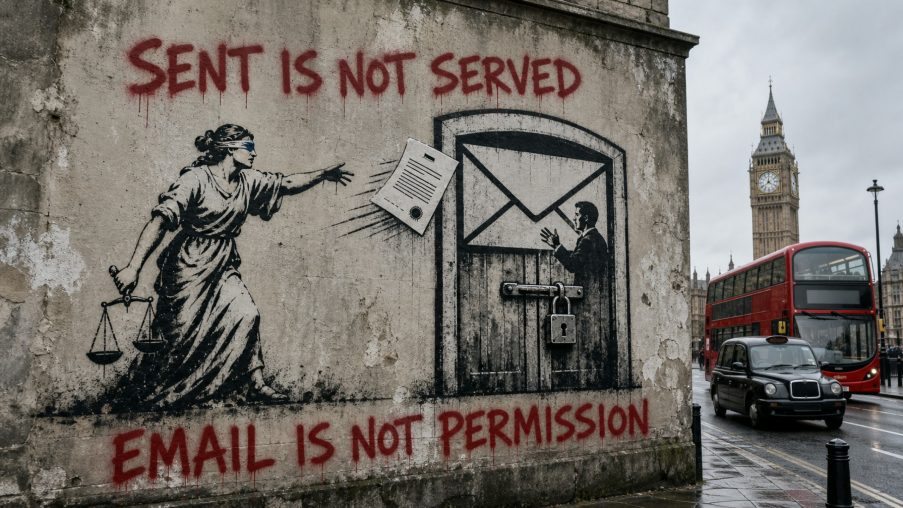
Sending is communication. Service is a legal act. That distinction can decide whether a civil claim continues, stalls, or fails before the merits are ever heard. The screen may show a sent email. The law may still ask a harder question: was the claim form served by a method the rules recognise?
Publication snapshot
- Email can prove that something was sent, but it does not automatically prove valid service of a claim form.
- Service by electronic means normally requires prior written indication of willingness to accept electronic service and identification of the relevant email address.
- A solicitor can correspond about a dispute without necessarily being authorised to accept service of the claim form.
- Actual knowledge of the claim may matter, but it is not the same as valid service.
- The practical protection is strict: ask, check, serve by an authorised route, keep proof, and do not leave service until the last day.
The core point: “I emailed it” is not enough
A claimant sends the claim form. The other side receives it. A solicitor may read it. Someone may even reply. The claimant assumes the job is done.
Civil procedure may ask a different question. Was the claim form served by a method the rules allowed? Was the solicitor authorised to accept service? Had the recipient agreed to accept service by email? Was the correct email address used? Was the claim form sealed? Was it the right version? Was it served in time?
Those are not technical niceties. They are control points. A person may think they have a live court claim. In law, they may have an issued claim form that has not been validly served.
Communication occurred
An email may show that a message left the sender’s system, but that does not decide whether service was valid.
Knowledge may exist
The recipient may know about the claim, but awareness is not automatically a substitute for service.
The gateway matters
Email service depends on the rules, a court order, a contractual route, or proper written acceptance.
Evidence must be kept
The party relying on service needs proof of authority, route, address, document, time and attachment.
Why service is different
A claim form is not just another document. It is not a letter before claim, a bundle, a witness statement, a costs schedule, a settlement offer, or correspondence about the dispute. It is the formal document that brings the defendant into the court process.
Once a claim form is validly served, procedural consequences follow. The defendant must decide whether to acknowledge service, defend, admit, settle, or challenge jurisdiction. If the defendant does nothing, judgment may follow. If service is late or invalid, the claimant may face serious consequences.
That is why courts treat service of a claim form more strictly than ordinary communication. In everyday life, if someone receives an email, they have received it. In civil procedure, the question is narrower: was the formal step taken in the way the rules require?
Issued
The court has issued the claim form at the claimant’s request. A draft or attempted filing is not the same thing.
Served
The issued claim form is served by a method and at a place recognised by the rules or authorised by the court.
Clock starts
Service creates response obligations. Acknowledgment, defence, admission or challenge may then follow.
Consequence follows
Non-response, defective service or late correction can affect default judgment, validation, limitation and costs.
The email trap
Email feels practical. It is quick, cheap, familiar and traceable. It fits modern litigation. Solicitors, insurers, public bodies, courts and online systems all use email.
That familiarity is the trap. The fact that parties have used email for correspondence does not mean a claim form can be served by email. The fact that a solicitor has replied to emails does not necessarily mean that solicitor accepts service by email. The fact that an email address appears in a footer, signature block, website or letterhead does not always mean it can be used for service.
For service by email, the gateway must be open. The safer assumption is that email service is not permitted unless the rules, a court order, a contractual route, or clear written acceptance says that it is.
The email-service warning
Do not treat email as a service route for a claim form merely because it is convenient, familiar, or already used for correspondence. The practical question is not “did they see it?” but “was it served by a permitted method, to the right address, with the right document, in time?”
Consent and authority: correspondence is not service acceptance
The key distinction is between an address used for correspondence and an address used for service. An email address used for correspondence is not automatically an email address for service.
A solicitor may write, negotiate, ask questions, propose directions, discuss settlement, or agree extensions without agreeing that the claim form can be served by email. A message saying “please correspond with us” does not necessarily mean “we are authorised to accept service of the claim form”.
A claimant can therefore fail in two ways. First, the solicitor may not be authorised to accept service of the claim form at all. Secondly, even if the solicitor is authorised to accept service, email may not be an accepted method.
Correspondence
Email used for letters, questions, negotiation or case discussion. This may show involvement, but not necessarily authority to accept service.
Service acceptance
Clear written indication that service is accepted, with the correct method and address identified for the claim form.
The nominated address problem
Even where email service is accepted, the address matters. A party or solicitor may identify a specific address for service: a central litigation inbox, a “service@” address, a government department address, a new-proceedings address, or another nominated route.
Sending the sealed claim form to a named lawyer may feel sensible. That lawyer may know the case and may open the email immediately. But if a different service address has been specified, using the wrong inbox can still be dangerous.
The reason is certainty. Service of the claim form starts legal time running. If a party has identified a specific service address, the claimant should not assume that sending the document somewhere else is close enough.
Before serving by email, ask four questions
- Are you authorised to accept service of the claim form?
- Do you accept service by email?
- Which exact email address must be used?
- Are there any limits on format, attachments, file size or multiple inboxes?
Actual knowledge is not the same as service
The next mistake is to say: “But they knew.” They may have known. That does not necessarily answer the service question.
Actual knowledge can matter. It may be relevant if the claimant applies for retrospective validation of service. It may show that the defendant understood the nature of the claim. It may reduce some arguments about prejudice. But actual knowledge is not normally a substitute for valid service of a claim form.
The court may ask a more exact set of questions: what was received, where, when, by what method, under what authority, and was that method legally effective?
The hard distinction
Knowing about a claim and being validly served with the claim form are different procedural questions.
What did the defendant actually receive?
Was it the issued and sealed claim form?
Was the method authorised?
Was any application made promptly?
The wrong document problem
There is another trap: sending the wrong thing. A claim form usually needs to be the issued and sealed claim form. A draft claim form is not the same. A pre-issue document is not the same. An unsealed version is not the same. A wrong version, incomplete version, or earlier amended version may create a separate problem.
This matters because a service defect can be about method, place, timing or document. Sending the right sealed claim form to the wrong address is one kind of problem. Sending the wrong document is another.
Not necessarily issued
A draft may show intention, but it may not be the court-issued claim form.
Not necessarily effective
An unsealed version may not prove that the court has issued the claim form.
Risk of confusion
An earlier, incomplete or incorrect version may not perform the required procedural function.
Check accompanying material
Particulars of claim or response-pack material may raise separate timing and service questions.
When the court may help
The court has powers to address some service problems. There may be an application for alternative service. There may be an application to validate steps already taken to bring the claim form to the defendant’s attention. There may be an application to dispense with service. There may be an application to extend time for service.
Those powers matter. They prevent civil procedure from becoming completely mechanical. They can assist where a defendant is evading service, where the claimant took reasonable steps, where the method used actually brought the claim form to the defendant’s attention, or where the problem is procedural rather than substantive.
But they are not safety nets to rely on casually. Alternative service requires good reason and evidence. Dispensing with service is exceptional. Extending time after the service period has expired is difficult and promptness-sensitive.
Prospective or retrospective
The court may permit another method or place where there is good reason, including treating steps already taken as good service.
Exceptional route
The court can dispense with service of a claim form, but the threshold is exceptional and evidence is required.
Promptness matters
After expiry, the claimant must fit the specific rule conditions and show prompt action.
Consequences may follow
If non-response leads to judgment, the set-aside route may require promptness, a real defence or good reason.
Practical discipline: ask, check, prove
The safest service habit is simple, but strict. Ask before serving by email. Check whether the solicitor is authorised to accept service. Check whether service by email is accepted. Check the exact email address. Check any limits. Check that the document is the sealed claim form. Do not leave service until the last day.
If service is challenged, the evidence trail may be the difference between a fixable error and a serious failure.
Keep the service proof pack
- The issued and sealed claim form, with the correct version preserved.
- The written confirmation that service of the claim form is accepted.
- The written confirmation that service by email is accepted.
- The exact email address or addresses identified for service.
- Any limits on attachments, file size, format or transmission.
- The sent email, timestamp, attachment list and email headers.
- Delivery records, bounce-backs, auto-replies and any reply from the recipient.
- The service deadline and how it was calculated.
- Any certificate of service, application, order or challenge to service.
Source anchors
These anchors support the procedural framework. They do not decide any individual claim, service dispute, limitation issue, default judgment, validation application or extension of time.
- CPR Part 6: service of documents — methods and places of service, service on solicitors, alternative service, dispensing with service and certificates of service.
- Practice Direction 6A: service within the United Kingdom — service by fax or other electronic means, including written indication of willingness to accept electronic service and email-address requirements.
- CPR Part 7: how to start proceedings — issue of claim forms, service period and extensions of time for serving a claim form.
- CPR Part 12: default judgment — judgment without trial where acknowledgment of service or defence has not been filed.
- CPR Part 13: setting aside or varying default judgment — mandatory and discretionary set-aside routes, including promptness.
- CPR Part 1: overriding objective — equal footing, participation, proportionate cost, fairness and compliance.
- CPR Part 3: case management powers — court powers, conditions, consequences of non-compliance and unrepresented-party considerations.
Closing point
The email may have arrived. The lawyer may have read it. The defendant may know about the claim. The court may know proceedings exist.
None of that necessarily answers the question that matters: was the claim form served?
The Legal Lens point is simple. Do not confuse sending with service. Do not confuse correspondence with consent. Do not confuse awareness with compliance. And do not assume the court will rescue an email mistake after the deadline has passed.
Service dispute, deadline risk and claim-form evidence
Get a free written assessment before an email-service mistake becomes fatal
Legal Lens can help turn a service problem into a structured procedural map. The assessment can separate communication, service authority, email acceptance, address evidence, claim-form version, deadline risk and possible application routes.
Check whether the defendant or solicitor accepted service, and whether email was permitted.
Identify the sealed claim form, version, attachments, address, timestamp and proof of transmission.
Consider correction, alternative service, validation, extension, set aside or urgent legal advice.
Independent Legal Lens consultancy. Legal Lens is not a regulated solicitors’ firm, court office, claims-management company or emergency advice service. A preliminary assessment is not a substitute for regulated legal advice, urgent court advice, formal representation, service of proceedings or filing an application where a deadline is imminent.