
 Written by
 Employment Tribunal guidance
Many Employment Tribunal cases are shaped before the witnesses begin. Not because the facts have changed, but because the case has been translated into a list of legal questions — and that translation can quietly determine what the hearing is really about.
Publication snapshot
Core line: a list of issues is not administrative decoration. It is the point at which the pleaded case is translated into the questions the Tribunal is being asked to decide.
That process is necessary. It can also be dangerous. A good list protects fairness. A bad list can narrow what should be heard, expand what was never pleaded, or leave the parties fighting over the wrong questions.
The point where story becomes case
Employment disputes usually begin as stories. A claimant explains what happened at work: the grievance, dismissal, protected disclosure, discrimination, sickness absence, management conduct, redundancy process or breakdown in trust. A respondent answers with its own account: what it says happened, why decisions were made, what procedures were followed, and why liability is denied.
The Tribunal cannot decide the case at that level of generality. It has to decide claims, issues and remedies. It has to ask legally structured questions. Was there a dismissal? What was the reason for it? Was the dismissal fair? Was there a protected disclosure? Was the treatment because of a protected act or protected characteristic? Was a claim brought in time? Was a particular detriment caused by the protected disclosure? What loss was caused by the unlawful act?
The list of issues is the document that should perform that conversion. It turns the dispute from narrative into decision-points.
That conversion is necessary. Without it, hearings become unfocused. Witness statements expand. Bundles become cluttered. Cross-examination wanders across every grievance in the employment relationship. Closing submissions become another attempt to tell the whole story. The Tribunal is then left to extract legal issues from a mass of material that should have been structured earlier.
But the conversion is also risky. Something may be lost. A badly drafted list can omit a real pleaded issue, mislabel a claim, treat background facts as if they are separate complaints, or include points that were never properly pleaded at all. Once the hearing is prepared around that list, the distortion can become embedded.
The list of issues is therefore not just a document about organisation. It is a procedural control point.
The pleaded case still matters
The starting point remains the pleaded case: the ET1, the ET3, any attached particulars, any further information, and any permitted amendments. Those documents identify the essential claim and response. The list of issues should organise that case. It should not quietly replace it.
That distinction matters because Employment Tribunal pleadings are often less formal than pleadings in ordinary civil litigation. The system is designed to be accessible. It should not punish a party simply because they have not written like a lawyer. But accessibility does not mean that the case can float indefinitely. The respondent must know what claim it has to meet. The claimant must know what defence is being advanced. The Tribunal must know what questions it is deciding.
A list of issues should sit in that space. It should make the pleaded case workable for hearing. It should not extinguish a real issue that is fairly raised in the claim or response. It should not create a new claim merely because a point has been added to a draft list. It should not allow either side to shift the case late by moving a sentence from evidence into the language of legal issue.
The danger is not abstract. Different issues require different preparation. A new allegation may require different documents. A new protected disclosure may require evidence about who knew what, when, and why. A new comparator may change the discrimination enquiry. A new causation argument may require different cross-examination. A new defence may alter the whole shape of the hearing.
Fair notice is not a technical courtesy. It is part of the fairness of the hearing.
Why agreed lists can matter
Where parties agree a list of issues, especially where they are legally represented, the Tribunal will usually be entitled to treat that list as the hearing roadmap. That is not because the list is magic. It is because the parties have organised the hearing around it.
If a respondent prepares for the claims in the agreed list, it may be unfair for the claimant to run a materially different case at the hearing. If a claimant prepares to meet the defences in the agreed list, it may be unfair for the respondent to advance a new answer after the evidence has closed. If the Tribunal decides a point that neither side understood to be live, the problem is not merely technical. The parties may have been deprived of the chance to call evidence, test witnesses or make submissions on the real issue.
That is why lists of issues matter.
But the opposite error is also dangerous. A list is not a pleading. It is not normally a final adjudication of substantive rights. It should not be used as a procedural weapon to defeat a claim that was actually pleaded but poorly labelled, especially where a litigant in person has set out the substance but not the legal terminology.
The safer analysis is this: an agreed list generally guides the hearing, but it must still be checked against the real pleaded dispute. If it reflects the case, parties may be held to it. If it misstates the case, it may need correction. If a party wants to add something new, the issue is not simply wording. The issue may be amendment.
Clarification is not amendment
A great deal of confusion comes from treating clarification, relabelling and amendment as if they were the same thing.
They are not.
Clarification explains what is already in the case. It may identify which pleaded act is relied on, which dates matter, which statutory ingredient is disputed, or which factual allegation supports which legal complaint. Clarification is particularly important where a litigant in person has described the facts but used the wrong language. If the issue already “shouts out” from the pleaded case, clarification may prevent unfair technicality.
Relabelling is more delicate. Sometimes the facts have been pleaded, but the legal route has been misdescribed. Correcting that may not change the real enquiry. In that situation, the problem may be one of label rather than substance. But a new legal label is not always harmless. It may bring in different statutory ingredients, different causation questions, different comparators, different protected acts, different protected disclosures, different justification issues or different remedies.
Amendment is different again. Amendment is the route for changing the case. If the party seeks to add a new factual allegation, new legal complaint, new protected disclosure, new protected act, new detriment, new comparator, new provision, criterion or practice, new causation case or new defence, the Tribunal may need to consider whether amendment is required and whether allowing it would be fair.
This is where procedural language becomes practical. The question is not whether the new point feels connected to the same employment dispute. Most late points will. The question is what the point changes.
Would the other side have prepared differently? Would new disclosure be needed? Would witness evidence change? Would cross-examination need to cover different territory? Does the point raise a time-limit issue? Has the hearing been listed on a narrower basis? Can any prejudice be cured by directions, or would the hearing have to be adjourned?
Those are not lawyer’s technicalities. They are fairness questions.
Evidence is not a pleading
The same problem appears in another form when parties confuse evidence with claims.
A witness statement can give evidence about a pleaded issue. It can explain context. It can support an inference. It can give detail about an allegation already in the case. But it does not usually introduce a new claim.
A bundle document can prove or undermine a point. It can show what was said, when it was said, and who saw it. But a document is not in the case merely because it sits in the bundle. Its presence does not make every sentence in it an issue for determination.
Cross-examination can test evidence. It can explore knowledge, motive, credibility, causation and context. But it should not be used to introduce a new legal complaint by ambush.
Closing submissions can draw the Tribunal’s attention to the significance of the evidence. They can refine argument. They can explain why the facts satisfy the legal test. But they are not a second claim form or response after the evidence has closed.
This is a frequent trap in discrimination and whistleblowing claims. Background evidence may be highly relevant. Earlier incidents may help explain motive or inference. Context may help the Tribunal understand the meaning of a disclosure, the reason for a detriment, or the relationship between events. But background is not automatically a separate complaint.
The list of issues should help maintain that boundary. Which acts are complaints? Which facts are background? Which disclosures are relied on? Which detriments are alleged? What is the causation issue? What is merely context?
If those distinctions are not made, the hearing can become both unfair and unmanageable. Respondents may face allegations they did not know they had to meet. Claimants may find that real issues are buried under an unfocused history. The Tribunal may be left to decide a case that has never been properly defined.
Litigants in person: fairness without advocacy
The list of issues is particularly important where one or both parties are unrepresented.
Employment Tribunals are not supposed to operate as technical obstacle courses. A litigant in person should not lose a real claim simply because they used the wrong legal label or failed to draft with professional precision. The Tribunal may need to read the claim form, response, particulars and core documents fairly. It may need to ask neutral questions. It may need to check whether an earlier list of issues actually captures the significant issues in dispute.
That is legitimate clarification.
But there is a boundary. The Tribunal must remain neutral. It should not invent a case. It should not gather evidence for a party. It should not suggest factual allegations that have not been advanced. It should not advise a claimant how to improve the claim or a respondent how to improve the defence.
The distinction is important because fairness runs in both directions. An unrepresented party may need help to identify what they are saying. The other side is still entitled to know the case it must meet. A Tribunal can clarify the existing case; it should not build a better one.
The practical question is whether the issue is already fairly there. If the pleaded documents contain the substance of the point, the list may need to reflect it. If the point is not there, the answer is not to pretend it has always been part of the case. The answer may be amendment, with all the fairness questions that follow.
The quiet consequences of a bad list
A bad list of issues rarely causes only one problem. It tends to infect the whole preparation of the case.
If the list is too narrow, disclosure may omit documents relevant to a real pleaded issue. Witness statements may fail to address the point. Cross-examination may not test it. Submissions may leave it untouched. The Tribunal may then give judgment on a version of the case that is not quite the real dispute.
If the list is too broad, the opposite problem arises. The hearing may be dragged into every grievance, every background event and every peripheral argument. The respondent may have to meet allegations that were never properly pleaded. The Tribunal may spend time on points that are not claims. The central issue may be diluted by volume.
If the list mislabels the case, the problem is subtler. The right facts may be present, but under the wrong legal heading. The hearing may then proceed on an artificial structure. A claim that should be considered one way is forced into another. A real issue becomes harder to see because the document designed to clarify the case has obscured it.
That is why parties should not treat the list as something to approve casually. Once disclosure, bundles, witness statements and hearing time have been organised around it, changing direction becomes harder. It may still be possible, but the Tribunal will have to consider timing, disruption, prejudice and whether the other side can fairly respond.
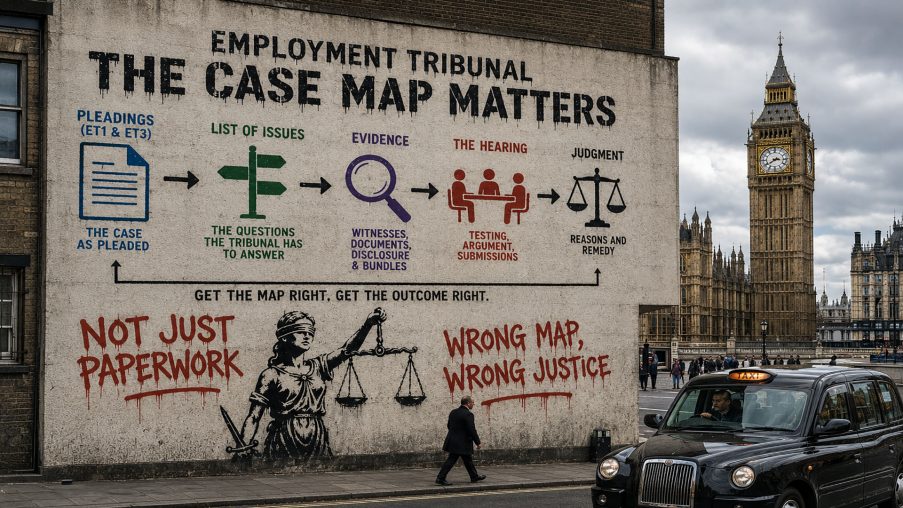
The procedural point is simple: fix the map before the journey is built around it.
What should be checked
Before a list of issues is agreed or treated as the hearing structure, the parties should check it against the pleaded case. That does not require over-engineering. It requires discipline.
The key questions are these. What claims are actually in the ET1, particulars and permitted amendments? What responses are actually in the ET3? Which issues are legal questions, and which are factual disputes? Are time limits, jurisdiction and remedy addressed where they matter? Are background facts being confused with free-standing complaints? Is anything in the list not actually pleaded? Is anything pleaded but missing from the list?
The next question is procedural. If the problem is lack of clarity, clarification may be enough. If the list misdescribes a pleaded issue, correction may be needed. If the party is trying to add something materially new, amendment may be required. If the problem concerns an existing case-management order, an application may be needed.
The wrong route matters. Trying to use evidence as amendment creates unfairness. Trying to use a list as a pleading creates confusion. Trying to use reconsideration or appeal as the first opportunity to fix a known issue may be too late.
Why this matters after judgment
The list of issues does not stop mattering when the hearing ends. It often shapes the judgment.
A Tribunal’s reasons should explain the material issues, the essential findings, and why the parties won or lost. If the issues have been properly identified, the judgment is more likely to answer the right questions. If the issues were confused, the reasons may inherit that confusion.
But it would be wrong to overstate the point. Not every defect in a list of issues creates an appeal. Appeal is not a general clean-up process for poor preparation. The question will usually be whether the error mattered: whether a necessary issue was not decided, whether an unpleaded issue was decided unfairly, whether the parties lacked fair notice, or whether the reasons fail to explain the result.
Reconsideration is not a general solution either. It has its own test. It is not a second opportunity to run a case that should have been structured properly before the hearing.
The safer course is to deal with the list when it still matters most: before the case is prepared around it.
Source anchors
This article is anchored to the Employment Tribunal Procedure Rules 2024 and current Judiciary/HMCTS public guidance. Judiciary guidance explains that final-hearing preparation starts with the claim form, response form and permitted amendments, and that complex cases may involve a case-management hearing to prepare a list of issues and give directions.
The core Legal Lens point
The list of issues is not administrative decoration. It is a procedural safeguard.
It is where the Tribunal case is translated from story into legal decision-making. That translation is necessary. But it is also a point at which fairness can be protected or quietly lost.
A good list focuses the case without distorting it. It identifies the real dispute without inventing a new one. It respects the pleadings without becoming trapped by poor labels. It gives the other side fair notice without shutting out a real issue through technicality. It helps the Tribunal decide the case that is actually before it.
A bad list does the opposite. It narrows what should be heard, expands what was never pleaded, or leaves everyone fighting over the wrong questions.
That is why the list should be checked early, carefully and against the pleaded case.
If the map is wrong, say so before the hearing is built around it. Once the case has moved through disclosure, witness evidence, cross-examination and submissions, the error may no longer be a small drafting problem. It may have become part of the structure of the hearing itself.
Before the list becomes the hearing structure
Get a free written assessment before the case is built around the wrong questions
Legal Lens can review the pleadings, draft list of issues, case-management orders and evidence structure to identify whether the problem is clarification, relabelling, amendment or hearing preparation risk.
Independent Legal Lens consultancy. Legal Lens is not a regulated solicitors’ firm. A preliminary assessment is not a substitute for regulated legal advice where that is needed.