
 Written by
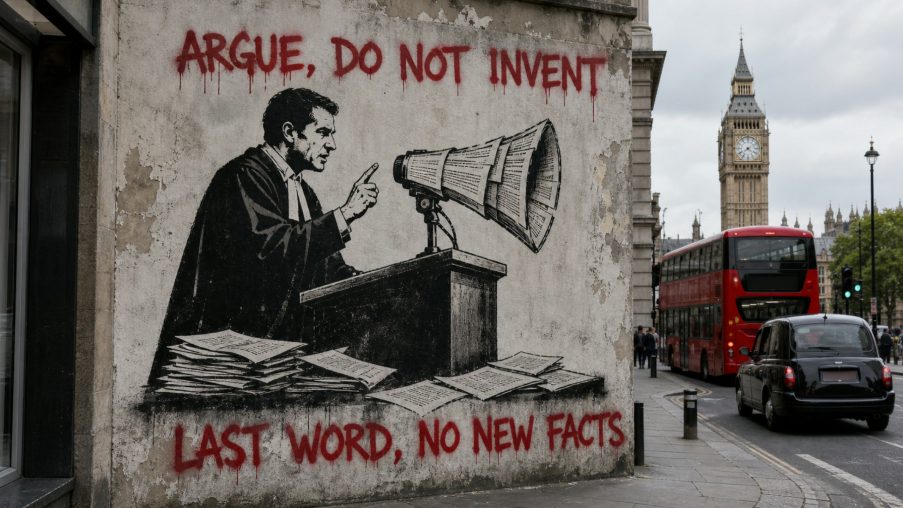
 Closing submissions are not a second witness statement. They are the point at which the evidence has ended and argument begins. A good closing submission helps the Tribunal move from the evidence it has heard to the findings and legal conclusions it must make.
Publication snapshot
- Closing submissions are argument, not new evidence.
- The list of issues should usually be the starting point.
- A closing submission should link findings sought to evidence already heard and legal tests already in play.
- New facts, new claims and serious allegations raised for the first time at closing can create fairness problems.
The last-word trap
There comes a point in an Employment Tribunal final hearing when the evidence is over. The witnesses have given their statements. They have answered questions. The documents have been referred to. The Tribunal has heard the factual dispute.
Then come closing submissions.
For many claimants and respondents, this feels like the final chance to say everything. The last chance to persuade the Tribunal. The last chance to fix what did not go well during the hearing.
The trap is understandable. Employment Tribunal hearings are stressful. Parties often leave the evidence stage feeling that something important was missed. But closing submissions are not a repair shop for missing evidence.
A closing submission is not a new ET1. It is not a new ET3. It is not a new witness statement. It should not be used to introduce fresh evidence unless the Tribunal permits a further procedural step.
Nor is it the safe place to make serious allegations for the first time if those allegations were never fairly put to witnesses. A closing submission is argument. Its job is to help the Tribunal decide the issues by linking the evidence already heard to the legal tests the Tribunal has to apply.
This article concerns Employment Tribunal procedure in Great Britain. It does not address Northern Ireland tribunal procedure.
Evidence and argument
The distinction between evidence and submission is central. Evidence is what the Tribunal uses to decide what happened. Submissions are what a party says the Tribunal should do with that evidence.
The evidence stage asks: what happened? The closing submission asks: what should the Tribunal find from what it has heard?
Evidence may include
- witness statements;
- answers in cross-examination;
- documents in the bundle;
- agreed facts;
- oral answers to Tribunal questions.
Submissions should do
- identify the issues;
- point to the evidence on each issue;
- ask for specific findings;
- apply the legal test;
- state the outcome sought.
A closing submission can point to evidence, explain evidence, invite the Tribunal to prefer one witness over another, identify contradictions, or argue that a document supports one version of events.
It should not try to become evidence itself. The other side cannot cross-examine a closing submission in the way it can cross-examine a witness.
Start with the list of issues
The list of issues should usually be the starting point. In many Employment Tribunal cases, it is the map for the final hearing. It identifies the legal and factual questions the Tribunal needs to answer.
That does not mean the list is always perfect. Issues can sometimes be clarified, corrected or refined. A Tribunal is not required to follow an agreed list mechanically if that would prevent it deciding the case properly on the law and evidence.
Do not treat flexibility as permission to roam
A closing submission should normally work through the issues the Tribunal has been asked to decide. A forceful submission that ignores the issues may still be unhelpful.
If the issue is unfair dismissal, address the reason for dismissal, investigation, procedure, decision, appeal, reasonableness and remedy. If the issue is discrimination, address the treatment, comparator or evidential basis, protected characteristic, causation, burden of proof and remedy.
If the issue is whistleblowing, address the alleged protected disclosure, the legal elements, employer knowledge, detriment or dismissal, causation and remedy. If the issue is wages, holiday pay or breach of contract, address entitlement, calculation and evidence.
The point is not to sound technical. The point is to help the Tribunal decide the case it actually has.
Do not save a new case for closing
A party should be cautious about raising a new point for the first time in closing submissions. Sometimes a point genuinely emerges from the evidence. A witness may give an unexpected answer. A document may become more significant during cross-examination. The Tribunal may ask a question that reveals an issue was not properly framed.
But if the point is outside the pleaded case or outside the list of issues, it may create a fairness problem.
A late point may really be an amendment issue
The other side may say: that is not the case we came to meet; we would have asked different questions; we would have called different evidence; we need time to respond; or this should not be decided without further case management.
That does not mean every late point is automatically excluded. But a party should not assume that a new argument can simply be unveiled at the end.
If a point emerges late, the safer course is to identify it openly, explain how it arises from the evidence, say whether it is within the existing issues, and let the Tribunal decide how it should be dealt with.
A closing submission should not be an ambush. It should be the conclusion of the case that has been heard.
What good submissions do
A good closing submission does not need to be long. It needs to be structured. It should tell the Tribunal what the party asks it to find and why.
Identify the issue
Begin with the question the Tribunal has to decide.
Identify the evidence
Point to the witness answer, document, page reference or agreed fact.
Apply the legal test
Explain how the evidence meets, or fails to meet, the legal question.
State the result
Say what finding, liability decision or remedy outcome follows.
In an unfair dismissal claim, a claimant might argue that the decision-maker had already decided the outcome, that the investigation missed a key witness, that the appeal did not cure the defect, and that dismissal was outside the range of reasonable responses.
A respondent might argue that the reason was misconduct, the investigation was reasonable in the circumstances, the claimant knew the allegations, the claimant had an opportunity to respond, and dismissal was within the range of reasonable responses.
Those are arguments from evidence. They are not new evidence.
Documents and weaknesses
Documents can be powerful in closing submissions, but they need to be used properly. It is not enough to say, “it is all in the bundle”. The Tribunal is not required to search through hundreds or thousands of pages to find the points a party has not identified.
If a document matters, give the page reference. Then explain why it matters. A document is not an argument by itself.
Use fewer documents well
The best submissions do not bury the Tribunal under page references. They identify the documents that matter, connect them to the issues, and explain the finding sought.
A closing submission should also deal with weaknesses. Every case has problems. A claimant may have delayed in raising a complaint. A respondent may have made procedural mistakes. A witness may have contradicted their statement. A key document may be missing. An explanation may be incomplete.
Ignoring those points rarely helps. The Tribunal is likely to have noticed them. A better submission deals with weaknesses directly and explains why they do not defeat the point.
Useful document discipline
- give the page reference;
- identify the issue it addresses;
- explain why it supports the finding sought;
- avoid relying on documents never put to a key witness where fairness required it;
- do not ask the Tribunal to do the page-searching for you.
Useful weakness discipline
- acknowledge the weak point;
- explain its true significance;
- distinguish imperfection from legal failure;
- show what evidence still supports your case;
- avoid pretending there is no problem.
Serious allegations
Closing submissions are not cross-examination. A party should be careful about using closing submissions to attack a witness who is no longer giving evidence.
Sometimes serious criticism is justified. A submission may say that a witness was inconsistent, that an answer should not be accepted, or that a document contradicts the account given.
But if a party wants the Tribunal to make a serious adverse finding against a witness — for example, that they lied, fabricated evidence, concealed documents or gave a false reason — the substance of that allegation should usually have been put clearly enough for the witness to answer.
This is a fairness point
A witness cannot answer a new accusation after their evidence has finished unless the Tribunal permits further steps. Serious allegations should not normally be saved for the end of the hearing.
That does not mean a party must use a magic phrase. The question is practical: did the witness understand the serious case being put and have a fair opportunity to respond?
Apply the legal tests
Some closing submissions fail because they use legal language without applying it. Words like burden of proof, causation, range of reasonable responses, less favourable treatment, proportionality, protected disclosure and detriment matter. But legal labels do not decide the case by themselves.
The submission must connect the law to the evidence.
Claimant example
- what facts have been proved?
- what treatment, disclosure, dismissal or detriment is relied on?
- what is the evidential link to the protected characteristic or protected disclosure?
- why should the Tribunal accept the claimant’s evidence?
- what finding and remedy should follow?
Respondent example
- what was the reason for the decision?
- what evidence did the decision-maker have?
- why was the procedure reasonable?
- why was the treatment not discriminatory or retaliatory?
- why should any award be reduced or refused?
It is usually better to be simple and accurate than technical and vague. A good submission does not recite legal tests as decoration. It applies them.
Submission flow
Closing submissions may be oral, written, or both. The Tribunal controls that process. A Tribunal may limit the time for submissions, require written submissions, allow short oral submissions, or ask focused questions.
That is not necessarily unfair. It is part of managing the hearing proportionately. The better prepared the submission is, the easier it is to adapt to the time available.
Start with the issues
Use the list of issues as the working structure unless the Tribunal directs otherwise.
Choose the findings sought
Say what facts the Tribunal should find, not merely what story you prefer.
Anchor each finding
Connect the finding to a witness answer, document, page reference or agreed fact.
Apply the law
Explain how the evidence meets, or does not meet, each legal test.
State the result
End with the outcome sought: liability, dismissal of the claim, remedy, reduction or other order.
Claimants and respondents
For claimants, the closing submission should not simply repeat the workplace story. It should explain why the legal claim succeeds.
If the claim is unfair dismissal, address the reason for dismissal, procedure, investigation, decision, appeal, reasonableness and remedy. If the claim is discrimination, address the treatment, comparator or evidential basis, protected characteristic, causation, burden of proof and remedy. If the claim is whistleblowing, address the disclosure, why it is said to be protected, who knew about it, what detriment or dismissal followed, and why causation is made out.
For respondents, the closing submission should not simply say that the claimant has failed to prove the case. It should explain why. If the respondent accepts some facts but disputes liability, say so. If the respondent relies on a fair reason for dismissal, identify the evidence supporting that reason. If the respondent says the treatment was not discriminatory, explain the non-discriminatory reason and the evidence supporting it.
Plain structure beats volume. Litigants in person often feel that unless they repeat everything, the Tribunal will miss something. But a clear issue-by-issue submission is usually more useful than a long, unfocused speech.
The Tribunal may assist an unrepresented party with structure or process. It may ask questions or clarify what issues remain. But it does not become the party’s advocate.
Source anchors
These source anchors help separate practical hearing guidance from the procedural framework in which Employment Tribunal final hearings are managed.
The Legal Lens point
Closing submissions are not the last chance to say everything. They are the chance to explain what the evidence means.
That is a narrower task. But it is an important one.
A good closing submission helps the Tribunal move from the evidence to the decision. It identifies the issues, points to the key evidence, asks for specific findings, applies the law, addresses weaknesses, and explains the outcome sought.
A poor closing submission tries to restart the case after the evidence has ended. It introduces new facts, raises new allegations, ignores the issues, repeats the story without applying the law, or asks the Tribunal to do the party’s work for them.
The last word in an Employment Tribunal case should not be a second witness statement. It should be a focused argument about the evidence already heard.
Preparing closing submissions?
Get a free written assessment before the final hearing closes
Legal Lens can help identify the structure, evidence anchors, weak points and legal-test issues that should shape a closing submission before the Tribunal hears final argument.
What we assess
Issue structure, findings sought, evidence references, cross-examination points, missing links, legal tests and remedy arguments.
When to use it
Oral submissions, written submissions, respondent reply, remedy submissions, or urgent final-hearing preparation.
What you get
A concise written view on what to emphasise, what to avoid and how to keep the submission focused on the Tribunal’s issues.
Independent Legal Lens consultancy. This is not a regulated solicitors’ firm. A preliminary assessment is not a substitute for regulated legal advice where that is needed.