
 Written by
 Civil procedure – case management – practical guidance
Once a defence is filed, the court begins the paperwork that decides where a case will live: which track, which timetable, which costs regime and which kind of hearing. The directions questionnaire is the single document through which a litigant in person shapes all of that – and ignoring it carries one of the sharpest automatic sanctions in the Civil Procedure Rules.
Snapshot
CPR Part 26 sorts every defended civil claim into one of four case management tracks, and the sorting mechanism is a form: the directions questionnaire. It arrives with a notice of proposed allocation shortly after the defence is filed, it carries a fixed deadline that the parties cannot extend between themselves, and missing that deadline can end a claim or a defence without any judge looking at the merits.
What happens when a defence is filed
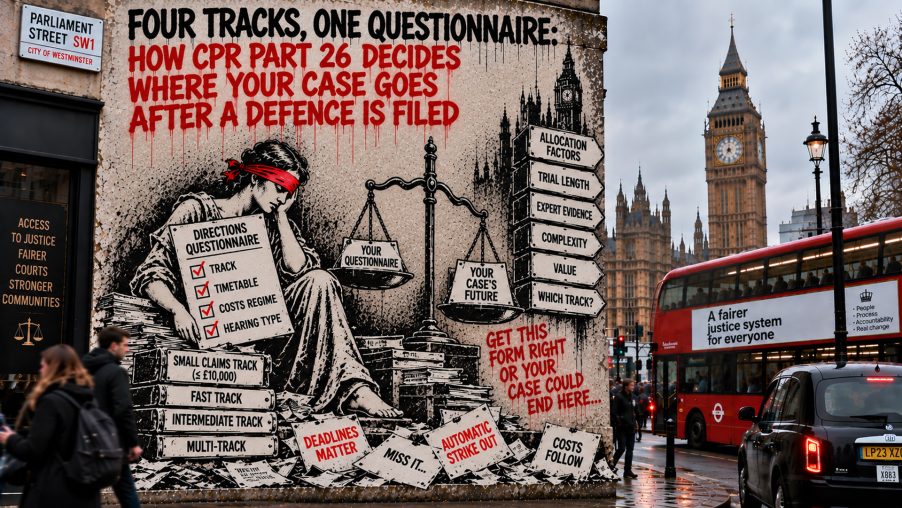
Once a defence is filed, the court takes hold of the file and begins managing the case towards a hearing. The first step is allocation: deciding which track the claim will follow. The four tracks are the small claims track, the fast track, the intermediate track and the multi-track.
The process starts without any judge. When a defendant files a defence, a court officer must provisionally decide the track which appears to be most suitable for the claim, and must serve on each party a notice of proposed allocation requiring the parties to file a completed directions questionnaire and serve copies on all other parties. The notice comes in one of four forms – N149A for the small claims track, N149B for the fast track, N149D for the intermediate track and N149C for the multi-track – and the questionnaire is form N180 for the small claims track or form N181 for the other three tracks. Where a party is unrepresented, the court serves the appropriate questionnaire on that party.
If the case appears suitable for the fast track, the intermediate track or the multi-track, the notice must also require the parties to file proposed directions by the date it specifies. That catches many litigants in person off guard: the court is asking you to draft your own litigation plan. The court then allocates the claim after all parties have filed their questionnaires, unless it has stayed the proceedings, and may order further information or an allocation hearing if the paperwork is not enough.
Deadlines and the cost of silence
The notice fixes the date by which the questionnaire must be filed and served. That date must be at least 14 days after deemed service where the notice relates to the small claims track, and at least 28 days where it relates to the fast track, the intermediate track or the multi-track, and it cannot be varied by agreement between the parties. A litigant who needs more time must apply to the court, not negotiate with the other side.
The sanction for ignoring the questionnaire is unusually direct. In a County Court money claim, if a party does not comply with the notice by the specified date, the court must serve a further notice requiring compliance within seven days. If the party still does not comply, that party’s statement of case is struck out without further order of the court – and the party in default will be ordered to pay the costs the default caused to any other party, unless the court thinks it unjust to do so. A claim or a defence can therefore disappear automatically, on paperwork alone. For the narrower class of specified-money High Court claims against an individual defendant, the court instead has a discretion to make any appropriate order, including striking out the claim, or striking out the defence and entering judgment.
The practical point. HM Courts and Tribunals Service’s own guidance to court users puts it plainly: a questionnaire you have been sent must be returned by the date specified, and failure to do so may result in your claim being struck out. Treat the return date as the most important deadline in the early life of the case.
The four tracks under rule 26.9
Rule 26.9 sets out the normal scope of each track. Value is the headline criterion, but trial length and expert evidence also count.
The normal track for any claim with a value of not more than £10,000, subject to special rules for personal injury claims and certain housing disrepair claims, which carry lower limits.
The normal track for monetary claims worth not more than £25,000, but only where the court considers that the trial is likely to last no longer than one day and that oral expert evidence will be limited to one expert per party in any field, in no more than two expert fields.
The normal track for claims worth not more than £100,000 that suit neither the small claims track nor the fast track, where the court considers that a proportionately managed trial will not exceed three days, oral expert evidence is likely to be limited to two experts per party, and the case is brought by one claimant against one or two defendants, or by two claimants against one defendant.
The normal track for every claim for which no other track is the normal track. Some claims must go there regardless: mesothelioma and asbestos lung disease claims, most clinical negligence claims, and certain claims against the police or public authorities among them.
The track is not a label: it drives the directions, the hearing format, the disclosure expected and, through fixed recoverable costs on the fast and intermediate tracks, the costs recoverable at the end.
How the court decides: the allocation factors
The normal track is a starting point, not an answer. When deciding the track for a claim, the court must have regard to matters that include the financial value of the claim, the nature of the remedy sought, the likely complexity of the facts, law or evidence, the number of parties, the value and complexity of any counterclaim, the amount of oral evidence likely to be required, the importance of the claim to people who are not parties, the views expressed by the parties, and the circumstances of the parties.
First, value is counted by the court, not the claimant. It is for the court to assess the financial value of a claim, disregarding any amount not in dispute, any claim for interest, costs, and any contributory negligence. A claim issued at £30,000 with £22,000 admitted is, for allocation purposes, an £8,000 dispute. Second, the parties’ own views only go so far. The court treats the views expressed by the parties as an important factor, but decisions on allocation are for the court, which will not be bound by any agreement or common view of the parties.
Complexity bands on the fast and intermediate tracks
Allocation to the fast track or the intermediate track is only half the decision. When a claim is allocated to either of those tracks the court must also assign it to a complexity band, numbered 1 to 4 on an ascending scale of allowable costs, and that band determines the costs allowed under the fixed costs tables in Practice Direction 45. The parties may agree the band, but the court may direct a different one, and every party must state on their directions questionnaire the agreed band or, where the parties disagree, the band that party considers appropriate, together with supporting information.
The questionnaire is therefore also a costs document: a careless band answer lets the court decide the point on the other side’s material.
Settlement: the stay and the Mediation Service
The questionnaire is also the first formal invitation to stop litigating. A party may, when filing the completed directions questionnaire, make a written request for the proceedings to be stayed while the parties try to settle the case by alternative dispute resolution or other means. If all parties request a stay, the proceedings shall be stayed for one month. Where a stay is ordered, the claimant must tell the court if a settlement is reached. The court can also order or extend a stay of its own initiative.
For smaller claims, a second route. Where a County Court claim would normally be allocated to the small claims track and all parties indicate on their directions questionnaire that they agree to mediation, the claim must be referred to the Small Claims Mediation Service operated by HM Courts and Tribunals Service. Road traffic accident, personal injury and housing disrepair claims, and any claim where a party does not agree, are excluded.
Changing track: reallocation and reassignment
Allocation is not necessarily final. The court may, on application or on its own initiative, reallocate a claim to a different track or reassign it to a different complexity band. But the room for movement narrows sharply once the case is underway: where a claim has been allocated to the intermediate track and directions have been given, the court may reallocate it only where there are exceptional reasons, and a complexity band may be reassigned only where a change of circumstances since the assignment justifies it. Get the allocation arguments right in the questionnaire, when they are cheap to make, rather than by application later, when the bar is higher.
Completing the questionnaire: what each part is really asking
Read functionally, the directions questionnaire asks six questions, each feeding a decision the court is about to make.
Whether you want a stay to attempt settlement, or referral to mediation. This answer drives rules 26.5 and 26.6; it commits you to nothing on the merits.
Which track you say the claim belongs on, and why. Answer by reference to the rule 26.9 scope and the rule 26.13 factors, not by preference.
On the fast and intermediate tracks, the band you agree or propose. This is a costs answer: support it with the factors the court will use.
For the fast, intermediate and multi-tracks, the timetable you invite the court to order. Draft directions you can actually keep.
Who will give evidence, what expert input is genuinely needed, and dates to avoid. These answers shape the trial estimate and the expert permissions.
Intended applications, additional parties, or facts that affect the timetable. Give this with the questionnaire, not months later.
Two disciplines govern the exercise. First, openness between the parties. Further information a party wants the court to consider must be given when the questionnaire is filed and copied to all other parties, and the general rule is that the court will not take it into account unless the other parties have confirmed it as agreed or been sent a copy. Second, co-operation without delay. The parties must consult one another and co-operate in completing their questionnaires, and must try to agree the case management directions they will invite the court to make – but consultation must not delay filing.
And the questionnaire must be served as well as filed: the notice requires copies to go to every other party.
The closing point
The merits matter. But procedure decides when the merits are heard. The directions questionnaire is a short form that decides a long list: track, timetable, costs band, settlement route and hearing shape. A litigant in person who answers it accurately, serves it on time and argues the allocation points by reference to the rules has taken the cheapest available step towards keeping the case on its proper path.
Allocation decision point
Get a free written assessment of the allocation and the questionnaire
Legal Lens can structure a preliminary written review of a notice of proposed allocation: which track the claim fits, what the questionnaire answers commit you to, and the filing steps that need attention first.
How the value, complexity and evidence of the dispute map onto the four tracks, and what each track means for timetable, hearing format and recoverable costs.
What each part of the directions questionnaire is really asking, and how to answer it without closing off track, band or settlement options.
Assessment outputs
The realistic track and band options, with the allocation factors that support each.
The dates in the notice, sequenced, with the documents each date requires.
Independent Legal Lens consultancy. Legal Lens is not a regulated solicitors’ firm. A preliminary assessment is not a substitute for regulated legal advice where that is needed.