
 Written by
 Employment Tribunal reform · public legal commentary
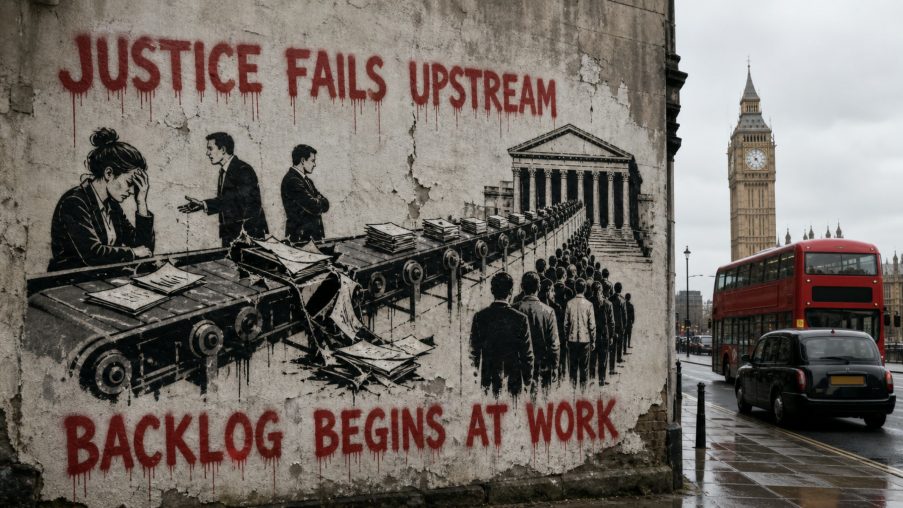
Most workers do not reach tribunal because they are eager to litigate. They get there because earlier safeguards have failed: the workplace, management, HR, grievance, appeal, Acas, and finally the tribunal process.
Core message
- The employment tribunal is not usually where the problem begins.
- It is where earlier workplace, HR, grievance, appeal and conciliation failures arrive.
- Reform focused only on speed is inadequate if it leaves the upstream failures untouched.
- Low value should never mean low importance.
The worker does not begin with litigation
The ordinary worker usually begins by trying to preserve the job. They speak to a manager. They email HR. They ask payroll to correct the figures. They explain why they need an adjustment. They raise concerns informally because they do not want to be labelled difficult.
That stage matters. The worker is not yet thinking like a claimant. They are thinking like someone trying to survive inside an employment relationship.
The employer, however, usually controls most of the important material: the documents, policies, payroll records, HR file, investigation process, witnesses, rota, internal messages, and often the narrative.
But if the employer responds defensively, the dispute hardens. The worker may be ignored, blamed, moved, performance-managed, signed off sick, disciplined, dismissed, or told there is “no evidence”. They may then submit a grievance or appeal, expecting the employer to look properly at what happened. Too often, that is where trust finally breaks.
The grievance is often the turning point
A grievance should be an opportunity to repair the damage. In practice, many workers experience it as the employer marking its own homework.
The complaint is narrowed. The uncomfortable documents are not provided. The witness questions are controlled. The worker’s concerns are reframed as communication issues, personality clashes, management discretion, or misunderstanding.
The outcome letter may look formal. It may cite a policy. It may say the complaint is “not upheld”. But the worker is left with the sense that the substance has never really been addressed.
By that stage, the worker may be out of work, short of money, unwell, unsupported, and trying to understand a legal system designed around professional users.
Acas is a gateway, not a remedy
Before most employment tribunal claims, the worker must notify Acas. Early conciliation is designed to give both sides a chance to resolve the dispute before formal tribunal proceedings begin. That is sensible in principle. Early settlement can save time, cost and stress.
But Acas is not a judge. It is not the worker’s representative. It does not decide who is right.
Acas says it cannot represent either side, take sides, help prepare the tribunal case, say whether the worker has a valid claim, or give legal advice. That distinction matters.
A worker may think they have entered a justice process. In reality, they have entered a conciliation process. Acas can help the parties settle, but it cannot fix a poor grievance investigation. It cannot compel disclosure. It cannot force the employer to engage meaningfully. It cannot correct the imbalance of power by itself.
That is a hard lesson for litigants in person. They are encouraged to use internal processes. They must usually go through Acas. They must preserve limitation. They must identify the correct respondent. They must complete the ET1. They must translate what happened into legal claims.
The worker knows the story. The system demands the legal category.
The ET1 is where the worker’s story becomes a legal case
The ET1 is not just a form. It is the point where lived experience must become litigation.
A worker may know exactly what happened to them, but not know whether the claim is unfair dismissal, discrimination, whistleblowing detriment, automatic unfair dismissal, victimisation, harassment, failure to make reasonable adjustments, unlawful deduction from wages, holiday pay, breach of contract, or something else.
That translation is where many litigants in person struggle.
The employer may then file a professionally drafted response. It may deny the facts. It may challenge jurisdiction. It may argue the claim is out of time. It may say the worker has named the wrong respondent. It may seek strike-out or a deposit order. It may use procedure tactically.
Mediation is not a sticking plaster
This is why “mediation first” cannot be treated as the answer. There is already an early resolution stage. It is called Acas early conciliation.
The real question is why early resolution sometimes fails.
It may fail because the worker does not have the documents. They may not have advice. They may not know the value of the claim. They may be out of work. They may be under pressure. They may be facing an employer who has little incentive to disclose weakness early.
When mediation can help
Mediation can help where both sides have information, advice and good faith.
When mediation can harm
Mediation without safeguards risks becoming pressure without accountability.
If a worker has been dismissed, denied documents, put through a weak grievance process, and left financially exposed, another settlement stage may simply become another barrier before anyone with authority looks properly at the case.
Legal officers: administration, not courthouse control
There may be a role for legal officers in employment tribunals. Routine administration should not require a judge every time. Listing, correcting party details, chasing missing information, standard directions and routine extensions may be suitable for properly supervised legal officers.
But the line must be clear. Anything that affects whether a person gets a hearing needs judicial oversight.
Low value should never mean low importance.
A wages claim may be small because the worker was low paid. A holiday pay claim may look modest to an employer but matter deeply to the person bringing it. A dismissal claim may not have a high financial value but may affect a worker’s reputation, confidence and future employment.
If lower-value or worker-led claims are diverted away from judges, the system risks sending a dangerous message: that low-paid workers deserve less scrutiny.
The backlog starts before the tribunal
The employment tribunal backlog is not only a tribunal problem. It is also the product of disputes not being dealt with properly earlier.
Poor grievance handling
Weak internal processes turn manageable workplace concerns into entrenched disputes.
Weak investigations
If key documents are not gathered or disclosed, the worker may reasonably believe the employer has avoided the real issue.
Defensive HR
Delay, reframing and procedural defensiveness can harden positions before the tribunal is ever involved.
Lack of early advice
Workers often reach the ET1 stage without advice on limitation, claim type, respondent identity, evidence or settlement value.
By the time the tribunal becomes involved, the parties may already be entrenched.
What would actually help?
The solution is not one reform. It is a sequence of safeguards.
Workplace-stage safeguards
- Better workplace accountability.
- Early disclosure of core documents.
- Employers should not be able to run poor grievance processes, ignore key documents, and then complain that workers have gone to tribunal.
Advice-stage safeguards
- Funded early advice.
- Early help with limitation, claim type, respondent identity, evidence and settlement value.
- Plain-English tribunal management for ordinary people, not only professional users.
Tribunal-stage safeguards
- Proper tribunal resourcing.
- Judicial oversight where rights are at stake.
- Efficiency must not remove scrutiny from the cases that need it most.
Delay changes behaviour. Employers may hold out because the worker may not last. Workers may abandon good claims because the process is too slow.
Reform must start before the tribunal door
Employment tribunal reform should not be measured only by how quickly cases can be moved through the system. It should be measured by whether ordinary people can use the system fairly.
That means asking harder questions.
Questions about the employer
- Did the employer investigate properly?
- Were the key documents disclosed early?
- Was the worker pressured to settle before understanding the case?
Questions about the system
- Did the worker have access to advice before the ET1?
- Was Acas being used for genuine settlement or tactical delay?
- Were procedural tools used to clarify the dispute or exhaust the litigant in person?
These are not side issues. They are the system.
Closing message
The public debate should not be framed as workers versus efficiency. Workers need efficiency. They also need fairness.
They need a system that resolves genuine disputes early, filters weak cases properly, and gives strong cases a fair route to be heard.
They need Acas to remain a meaningful conciliation stage, not a procedural hurdle.
They need mediation with safeguards, not mediation as a pressure valve.
They need legal officers for administration, not as a substitute for judges where rights, credibility and access to a hearing are at stake.
Above all, they need a system that recognises the simple truth at the heart of many employment disputes: the tribunal is not usually where the problem begins. It is where earlier failures arrive.
Source pointers
- Acas early conciliation guidance: acas.org.uk/early-conciliation
- GOV.UK employment tribunal claim guidance: gov.uk/employment-tribunals/make-a-claim
Publication note
This article is public legal commentary, not legal advice. Live claims require case-specific advice on limitation, jurisdiction, remedies, evidence, privilege, costs exposure and settlement terms.