
 Written by
 Decision-making · Evidence · Accountability
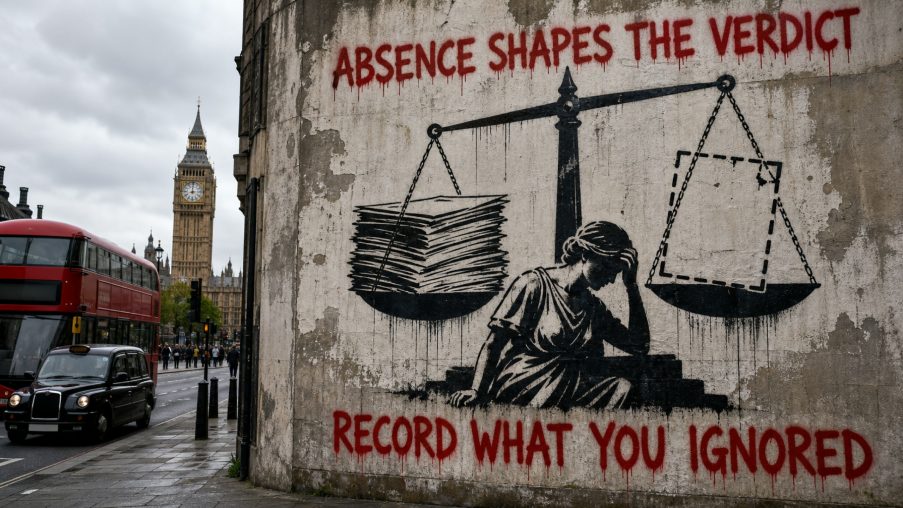
A decision does not need to discuss every document. But where central evidence disappears from the reasoning, the person affected is left with a practical accountability problem. They cannot tell whether the evidence was accepted, rejected, misunderstood, treated as irrelevant, outweighed by other material, or simply missed.
Publication snapshot
This article explains why the record matters when a complaint, workplace process, regulatory decision, review outcome or public-body decision fails to engage with central evidence. The point is not that every document must be recited. The stronger accountability question is whether the decision shows a coherent route from the issue being decided, to the evidence relied on, to the findings made, to the reason given and to the outcome reached.
Why missing evidence matters
One of the most common frustrations in institutional decision-making is not simply that the person loses. It is that the evidence they relied on appears to vanish from the answer. The complainant sends the emails. The employee provides the medical evidence. The service user identifies the record. The regulated person points to the document that changes the context. The family sends the chronology. The final decision arrives, and the evidence that mattered is not dealt with.
Sometimes the decision says all documents have been considered. Sometimes it lists the material received. Sometimes it summarises the background at length. Sometimes it thanks the person for the information provided. Yet when the reader looks for the route from evidence to conclusion, the route is missing.
That is not a technical complaint about drafting style. It is a practical accountability problem. If the person affected cannot see how the decision-maker moved from issue, to evidence, to finding, to reason, to outcome, they cannot properly understand the decision they have been given.
Not every omission is a failure
There is an important distinction at the centre of this problem. Not every missing reference matters. People involved in disputes often read decisions under pressure. They search for the sentence that deals with the document they sent, the event they highlighted or the contradiction they believed changed the case. If it is not there, the immediate reaction may be that the evidence was ignored.
That may be right in some cases. But it should not be assumed too quickly. A decision-maker may have considered evidence without discussing it in detail. A point may have been dealt with by necessary implication. A document may be background rather than central evidence. A fact may be accepted but not decisive. A piece of correspondence may be relevant to the history, but not to the test the decision-maker was applying.
This distinction matters because overstatement can weaken a strong challenge. If the real problem is that the decision does not explain what was done with central evidence, the safer and stronger point is not to allege concealment, bias or deliberate avoidance. The stronger point is to identify the missing reasoning link.
Background material
Some documents explain context but do not decide the issue. Their omission may not matter.
Central evidence
Some material bears directly on the issue. Silence about it may need explanation.
Reasoning gap
The strongest point is often not that evidence was ignored, but that its treatment cannot be seen.
Central evidence
Evidence becomes central when it bears directly on the issue the decision-maker had to decide. In a workplace process, that might be evidence about what happened, what was known, whether a policy was followed, whether an adjustment was requested, or whether the stated reason was the real reason. In a complaint, it might be the record that shows what was raised, when it was raised and how the organisation responded.
In a regulatory or professional setting, central evidence may be a document that supports an alternative explanation. In a public-body decision, it may be material going to the relevant policy, statutory power, fairness of the process or the question the body had to answer. The same discipline applies across those settings. The decision does not need to become a catalogue of documents, but if evidence is central to the issue, the decision should show enough engagement for the reader to understand its treatment.
A decision may say, “We have reviewed the information provided.” That is not the same as explaining how the important information affected the conclusion. A decision may say, “There is insufficient evidence.” That is not the same as identifying what evidence was accepted, what evidence was rejected and why the remaining material did not meet the threshold.
Acknowledgement is not analysis
There is a difference between acknowledging evidence and analysing it. Acknowledgement tells the reader that material was received. Analysis tells the reader what the decision-maker did with it.
Many institutional decisions appear complete because they contain the right visible parts. There may be a background section, a process summary, a list of documents, a chronology, a conclusion and a review paragraph. The structure can give the appearance of careful consideration. But the real question is whether the decision engages with the evidence that mattered to the issue.
A document list may show what was before the decision-maker. It does not show how the document was weighed. A chronology may show the sequence of events. It does not show which facts were accepted, which were disputed and why. A statement that all available evidence was considered may be true, but it does not explain why central evidence did not change the outcome.
The decision records that the document, submission, message or chronology was provided.
The decision shows that the material was read against the issue being decided.
The decision explains whether the material was accepted, rejected, outweighed, irrelevant or insufficient.
The record as safeguard
In many disputes, the contemporaneous record becomes more important than later explanation. A later explanation may clarify what was intended. It may correct a misunderstanding. It may fill a gap. But where a decision is challenged, the original record often carries greater weight because it shows what was raised, what was before the decision-maker, what was treated as relevant and how the conclusion was expressed at the time.
That is why broad assertions that evidence was ignored are often less useful than a disciplined record. The record should show the issue. It should show the evidence relied on. It should show where that evidence was supplied. It should show why the evidence mattered. It should show the gap between the evidence and the reasoning.
This does not require aggressive language. In fact, aggressive language often gets in the way. If the decision is weak because it does not engage with central evidence, the record should make that weakness visible in precise terms: this was the issue, this was the evidence, this is where it was raised, and the decision does not explain how it was treated.
The evidence map
The practical tool is an evidence map. It is a disciplined way of connecting documents to issues. It prevents the argument from becoming a general complaint that “they ignored everything”. It also prevents a large bundle from being treated as if volume is the same as relevance.
The map starts with the issue. What was the actual question the decision-maker had to answer? It then identifies the evidence: which document, record, message, witness account, policy, medical note, meeting note or prior decision bears directly on that issue? It then explains relevance: what does that evidence prove, undermine, contradict or contextualise?
The map should also identify where the evidence appeared in the record. Was it in the complaint, grievance, appeal, disclosure, investigation bundle, response, hearing material, chronology or review request? Finally, it compares the evidence with the decision. Did the decision accept it, reject it, distinguish it, treat it as irrelevant, say it was insufficient, or say nothing about it?
Issue. Identify the question the decision-maker had to answer.
Evidence. Identify the document or record that bears directly on that question.
Relevance. Explain what the evidence proves, contradicts or contextualises.
Decision. Compare the evidence with the reasons actually given.
Losing and not being answered
A person can lose even when their evidence has been properly considered. That needs to be said plainly. Evidence does not speak for itself. A document may support one part of the case but not the whole case. A record may prove that something was raised but not prove that the outcome should have been different. A medical letter may explain impact without proving causation. A policy may create an expectation without deciding the facts.
Losing is not, by itself, proof that evidence was ignored. But the decision should still give the reader enough to understand the route. If the evidence was accepted but not decisive, the decision should explain why. If it was rejected, it should explain why. If it was outside scope, it should say so. If it was outweighed by other material, the reasoning should identify the basis. If it did not meet the threshold, the threshold should be intelligible.
That is the difference between a disappointing decision and an accountable one. An accountable decision does not have to satisfy the person who loses. It does have to show enough of its reasoning for the person to understand the answer they have been given.
The accountability test
The accountability question is not whether the person affected agrees with the outcome. It is whether the decision shows the path taken. Public administration guidance points to the same basic discipline: decisions should take account of relevant considerations, balance evidence appropriately, give reasons, keep proper records and provide clear, evidence-based explanations in complaint handling.
Those standards do not require perfect reasons in every case. They do require enough structure for the reader to see the basis of the decision. If the issue is missing, the decision may be answering the wrong question. If the reasons are missing, the decision may be giving an outcome without an explanation. If the central evidence is missing, the decision may leave the person affected unable to tell whether the material point was considered at all.
For the person affected
Keep the decision, evidence map, chronology, submissions, review request and the documents that went to the central issue.
For decision-makers
Record the issue, relevant evidence, accepted facts, rejected points, threshold applied and reason for the outcome.
For escalation
Separate disagreement with outcome from a missing reasoning link, procedural unfairness, irrelevant factor or record gap.
Source anchors
These sources support the accountability framework used in this article. They do not prove any disputed complaint, defective decision, procedural unfairness or organisation-specific failure.
PHSO good administration
Relevant considerations, lawful decision-making, policy discipline and balancing evidence.PHSO openness and records
Reasons for decisions, clear information, accountability and reliable usable records.PHSO complaint handling
Evidence-based explanations, reasons for decisions and records of evidence considered.PHSO fair complaint handling
Thorough and fair investigation based on available facts and evidence.LGSCO getting it right
Reasonable, timely decisions based on all relevant considerations and basic record discipline.LGSCO openness and accountability
Decision criteria, reasons, proper records and evidence-based decision explanations.The Legal Lens point
When evidence disappears from a decision, the strongest response is not louder language. It is better structure. The question is not simply whether the decision was adverse. The question is whether the decision shows a coherent route from issue, to evidence, to finding, to reason, to outcome.
A clear record turns frustration into analysis. It shows what was raised. It shows what mattered. It shows where the evidence sat. It shows whether the decision engaged with it. Where the reasoning fails, it identifies the failure without needing to overstate it.
Central evidence does not need to be repeated for its own sake. But it should not simply disappear from the route to the decision. When it does, the accountability question is simple: what happened to the evidence that mattered?
Evidence and decision route map
Get a free written assessment of the route
If a decision, complaint response, review outcome or investigation finding does not engage with central evidence, Legal Lens can help structure the issue, evidence map and next practical questions before escalation or specialist review.
Clarify the question the decision-maker had to answer and the test or policy being applied.
Connect the documents, messages, records or chronology entries to the issue they were said to prove.
Separate disagreement with the result from a missing reasoning link, record gap or procedural concern.
Assessment outputs
Question, test, central evidence, reasoning link and route selection.
Documents, chronology, relevance, gaps and next questions.
Independent Legal Lens consultancy. Legal Lens is not a regulated solicitors’ firm. A preliminary assessment is not a substitute for regulated legal advice where that is needed.