
 Written by
 Complaints · Final responses · Accountability
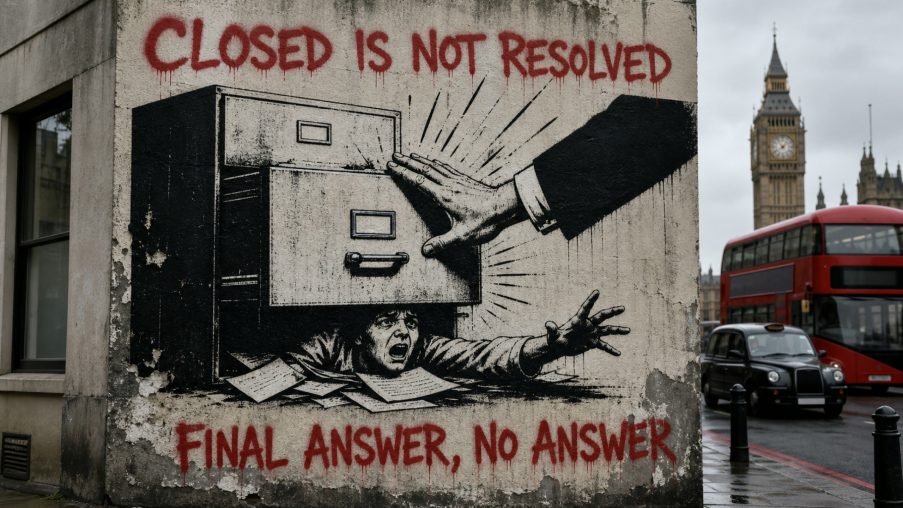
A final response can close a process without resolving the complaint. The question is not whether the organisation has said enough to stop corresponding. The question is whether it has said enough to answer the issue actually raised.
Publication snapshot
This article examines the difference between administrative closure and substantive resolution. Many complaint responses look complete because they contain a reference number, a review stage, a conclusion, and signposting to the next route. The more important question is whether the response identifies the issue, engages with the material, makes a finding, gives reasons, and explains the outcome.
Closed file, unanswered issue
There is a particular kind of frustration that appears again and again in complaint handling. It is not simply that the complaint has failed. It is that the person who complained still cannot identify the answer to the complaint itself.
The final response may be formal, careful and procedurally complete. It may refer to a review. It may explain that the complaints process has now ended. It may signpost an ombudsman, regulator, appeal route or external body. In form, it may look as though the organisation has dealt with the matter.
The difficulty is that the issue remains unanswered. Closure describes what the organisation has done with the file. Resolution describes whether the complaint has been answered. Those are different things.
Final is not answered
The word final can create the impression of authority. It suggests completion. It tells the reader that the organisation has had its last say. In some contexts, it may also matter procedurally because time limits, escalation routes or external review options may begin to run from that point.
But finality is not the same as adequacy. A response may be final because the organisation has completed its complaints stage, because an internal review has ended, because a policy says no further review is available, or because the organisation will not continue correspondence. None of that automatically means the complaint has been answered.
A meaningful answer does more than announce that the file is closed. It identifies the issue, explains the material considered, makes the necessary finding, gives the reason for that finding, and explains what outcome follows.
Closure
The organisation has ended its internal process or correspondence stage.
Resolution
The response has answered the issue actually raised and explained the basis for the outcome.
Accountability
The reader can trace the route from complaint, to evidence, to finding, to reason, to outcome.
Answering the wrong thing
Many complaint responses fail not because they say nothing, but because they answer something different from the complaint actually made. A person may complain about the substance of a decision, but the response deals only with whether the correct process stage was used. A complainant may say evidence was not considered, but the response says only that a review took place.
A service user may challenge the fairness of a process, but the response says only that the organisation followed its standard procedure. An employee may raise a concern about the real reason for a decision, but the answer discusses only whether the policy exists.
The response may be accurate as far as it goes. That is the difficulty. It may answer a question. It may even answer a relevant question. But it may not answer the question that mattered.
What a real answer needs
A real answer needs structure. It starts with the issue. What complaint was actually raised? What question did the organisation need to answer? What decision, conduct, omission, process, evidence or explanation was being challenged?
It then needs the relevant material. The response does not have to recite every document, but it should show that the important material has been understood. It then needs a finding: what is accepted, rejected, treated as unclear, placed outside scope, or said to be undetermined on the available material.
It then needs reasons. Why was that finding reached? Why did the evidence not change the outcome? Why was one account preferred? Why was a policy treated as satisfied? Why was no remedy offered? Finally, it needs an outcome: uphold, partly uphold, reject, apologise, correct, review, refer, learn, remedy or take no further action.
Issue. What complaint was actually raised?
Material. What evidence, policy, record or chronology mattered?
Finding. What was accepted, rejected, unclear or outside scope?
Reason. Why was that finding reached?
Outcome. What follows from the finding and reasons?
The closure trap
There is a trap for complainants at this stage. Once a final response says that the organisation will not correspond further, it is easy to focus on the refusal itself. That is understandable. The language can feel dismissive. The complainant may feel shut out. The organisation may appear to be using process language to avoid scrutiny.
But the stronger accountability point is usually narrower: what issue remains unanswered?
Institutions are not required to correspond indefinitely. Complaint processes have endpoints. Repeated correspondence can become circular. A person is not entitled to an endless exchange simply because they remain dissatisfied. That restraint prevents every final response from being treated as defective.
But the restraint cuts both ways. If the original complaint has been answered, closure may be justified. If the original complaint has not been answered, closure language does not cure the gap. The problem is not simply that the organisation has stopped corresponding. The problem is that it has stopped corresponding without answering the complaint.
The record that matters
A complaint about administrative closure needs a disciplined record. The record should show the complaint as it was put. That means identifying the actual issue, not merely the broad subject. A general statement that the complaint was about a decision is usually too broad. A more useful record identifies the particular evidence, policy requirement, explanation, meeting note, chronology or contradiction that was said to matter.
The record should show where the issue was raised: in the original complaint, review request, appeal, chronology, witness account, correspondence, disclosure, bundle or follow-up letter. It should show why the issue mattered: fairness, evidence, stated reason, policy test, factual finding, remedy or power to act.
It should then compare the complaint with the final response. Did the response identify the issue? Did it engage with the evidence? Did it make a finding? Did it give reasons? Did it explain the outcome? Or did it answer a narrower, different or more convenient question?
For complainants
Keep the complaint, review request, chronology, evidence, final response and unanswered-issue schedule.
For organisations
Keep the issue analysis, evidence considered, findings, reasons, remedy decision and signposting record.
For escalation
Separate disagreement with outcome from a missing answer, missing reasons or answered-wrong-question issue.
When closure is legitimate
Closure can be legitimate. An organisation may be entitled to close a complaint after it has properly considered the issue. It may be entitled to refuse repeated correspondence where the same point has already been answered. It may decide that a complaint is outside scope, out of time, repetitive, abusive, unsupported or better addressed elsewhere.
A final response is not inadequate merely because it is brief. It is not defective merely because the complainant wanted more detail. It is not evidence of bad faith merely because the person disagrees with the outcome.
That matters because the argument should not become too broad. The problem is not closure itself. The problem is premature or superficial closure that gives the appearance of resolution without the substance of an answer.
The accountability test
Good complaint handling is not measured only by whether a stage has ended. Public-facing complaint principles emphasise clear processes, evidence-based explanations, reasons for decisions, usable records, fair investigation, and proper signposting when a final response has been given.
The practical test is whether the response can be reconstructed. What issue was accepted for decision? What material was considered? What finding was made? What reason explains the finding? What outcome follows? What route is available if the person remains dissatisfied?
If that chain is visible, closure may be justified even if the complainant disagrees. If that chain is missing, the organisation may have closed the file while leaving the accountability problem open.
Source anchors
These sources support the complaint-handling framework used in this article. They do not prove any disputed complaint, defective final response, procedural unfairness or organisation-specific failure.
PHSO complaint handling
Final responses, next-stage information, governance and accountable complaint processes.PHSO openness and records
Evidence-based explanations, reasons for decisions and reliable complaint records.PHSO fairness
Thorough and fair investigation based on available facts and evidence.PHSO putting things right
Remedy, acknowledgement, explanation and practical correction where things have gone wrong.PHSO good administration
Reasons, decision criteria, transparency and reliable usable records.LGSCO good administration
Timely decisions based on relevant considerations and basic record discipline.The Legal Lens point
Administrative closure is not resolution. Closure belongs to the file. Resolution belongs to the issue.
A final response may end an internal process. It may start a time limit. It may signpost the next route. It may tell the complainant that the organisation will not correspond further. But it does not become an answer merely because it is labelled final.
The accountability question is more precise: what issue was raised, what answer was given, and what remains unresolved?
If the response avoids the central issue, narrows the complaint, ignores the material point, gives a conclusion without reasons, or substitutes closure language for explanation, the file may be closed while the accountability problem remains open. The strongest challenge is often this: you have closed the file, but you have not answered the complaint.
Complaint response route map
Get a free written assessment of the route
If a final response closes the process without answering the complaint, Legal Lens can help structure the issue, evidence, reasons gap and next route before escalation or specialist review.
Clarify the issue actually raised, where it was raised, and why it mattered.
Check whether the final response identified the issue, engaged with evidence, made findings and gave reasons.
Separate internal review, ombudsman complaint, regulator complaint, appeal route and legal advice questions.
Assessment outputs
Complaint, evidence, final response, unanswered issue and next route.
Chronology, documents, correspondence, missing reasons and escalation questions.
Independent Legal Lens consultancy. Legal Lens is not a regulated solicitors’ firm. A preliminary assessment is not a substitute for regulated legal advice where that is needed.