
 Written by
 Disability discrimination · legal expenses insurance · regulatory accountability
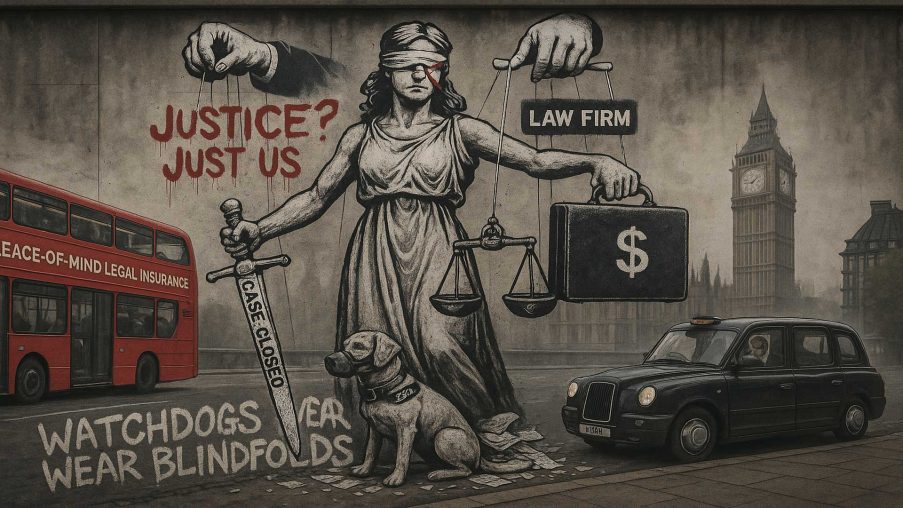
Ms C, a blind client, sought legal support after years of alleged disability discrimination and an alleged breach of a previous compromise agreement. What followed, according to documents reviewed for this article, was a chain of legal, insurance and regulatory failures that raises serious questions about access to justice for disabled clients.
Publication snapshot
- The article concerns an anonymised blind client referred to as Ms C.
- It describes alleged failures by panel solicitors, a legal expenses insurer and the Solicitors Regulation Authority.
- It preserves the central public-interest question: whether vulnerable clients are being dismissed despite evidence of merit.
Ms C’s position
Ms C, a blind client, endured over five years of alleged disability discrimination by her employer, the Ministry of Justice, resulting in significant mental health challenges. Seeking legal support for a matter that was both urgent and emotionally complex, she turned to her legal expenses insurer after her employer allegedly breached a previous compromise agreement.
What followed was, on Ms C’s account, a cascade of procedural failures, culminating in a regulatory system that refused to act even when she considered the evidence to be clear and compelling.
Panel solicitor failures
Ms C’s case was prematurely closed by panel solicitors after two assessments she says were flawed. From the outset, concerns were raised about potential conflicts of interest between the solicitors, the insurer and her employer.
The solicitors are alleged to have prejudged her case as weak before any proper assessment had taken place, undermining her access to justice.
Core concern
The complaint was not simply that Ms C disagreed with the solicitors’ assessment. It was that the assessment process was said to be premature, conflicted and insufficiently reasoned.
Access issue
Where a disabled client depends on insured legal support, early case closure can have a practical effect beyond ordinary service dissatisfaction: it can determine whether the client can access legal remedy at all.
Insurer refusal and the barrister’s opinion
When the case was returned to her insurer, Arc Legal, the company echoed the solicitors’ view and refused to fund a reassessment. Ms C was told she would need to obtain her own independent legal opinion before the insurer would reconsider.
Only after persistent challenge did the insurer agree to instruct a barrister. The barrister concluded that her case had a greater than 51% chance of success, directly contradicting the earlier dismissals.
Complaint handling and accessibility
A formal complaint was submitted to the solicitors, but it was dismissed by the firm’s compliance director, who was also a solicitor. That same individual later handled Ms C’s Data Subject Access Request, which was provided in an inaccessible format despite her known disability.
This dual role in both the conduct and complaint handling raised serious concerns about impartiality and internal containment.
Independence concerns
Further complicating matters, the solicitor in question was said to have documented links to both the insurer and the Ministry of Justice. These connections, according to Ms C and her advocate, cast doubt on the independence of the process.
The concern was sharpened by the insurer’s attempt to reject the case outright after it was returned to the solicitors, despite previously accepting liability. Ms C’s position is that this reversal appeared to follow internal communications she was never permitted to see.
The SRA response
The Solicitors Regulation Authority was presented with a detailed complaint, supported by a positive barrister’s opinion, a grievance finding described by the source as damning, and evidence said to show accessibility breaches.
Yet, according to Ms C’s account, the SRA refused to investigate. Its responses were described as templated, dismissive and failing to engage with the substance of the allegations.
A wider pattern?
Shortly after the complaint was submitted, whistleblower-style feedback on the SRA’s Trustpilot page, describing similar regulatory failures, was reportedly removed. The review was later reinstated following the submission of Ms C’s complaint, suggesting either internal reconsideration or external pressure.
Ms C and her advocate considered the timing significant. They say it mirrored a similar deletion by the law firm involved, reinforcing their concern about reputational containment.
The subsequent discovery of SRA Under Fire, a published exposé detailing widespread allegations of regulatory capture, whistleblower retaliation and failure to act on serious misconduct, led Ms C’s advocate to view her experience as part of a documented pattern rather than an isolated incident.
Escalation and public interest
Ms C’s advocate, Mr E, has since escalated the matter to disability rights organisations, oversight bodies and Members of Parliament.
But the question remains: how many vulnerable clients are being quietly dismissed, their evidence ignored and their rights eroded — not because their cases lack merit, but because the system lacks accountability?
Disclaimer
This article is based on real events and documents but has been prepared for the purpose of public-interest commentary, advocacy and awareness. Certain names and identifying details have been changed to protect the privacy of individuals involved. Allegations remain allegations unless admitted or determined by a competent authority. The information presented reflects the author’s understanding of the facts at the time of writing and should not be relied upon as legal advice. Readers are encouraged to seek independent legal or professional advice in relation to any similar circumstances.
Thank you for posting the case of a blind client. I am suffering the same abuse and obstruction of justice. I do hope this lady’s case was finally settled as this is a horrific account of networking abuse of process and obstruction of justice.
I’m really glad this has been written. As a visually-impaired person who is also taking action against my employer and the legal system, I know how deeply these issues run. Far too many blind and partially sighted people have been disadvantaged by a system that should protect them but instead puts up barriers at every stage.
What’s most troubling is that the very places people turn to for justice can be just as flawed, biased, and defensive as the organisations they’re challenging. The justice system is not exempt from scrutiny it is a public body, funded by the public, and it must be held to the same standards of fairness, transparency, and accountability that it demands of everyone else.
No one should be denied fairness or access to justice because of their disability. It’s encouraging to see someone shining a light on these failures, and I’m glad that Legal Lens have been prepared to look deeper into what appears to be a serious miscarriage of justice. Their willingness to challenge institutional bias is both courageous and long overdue.